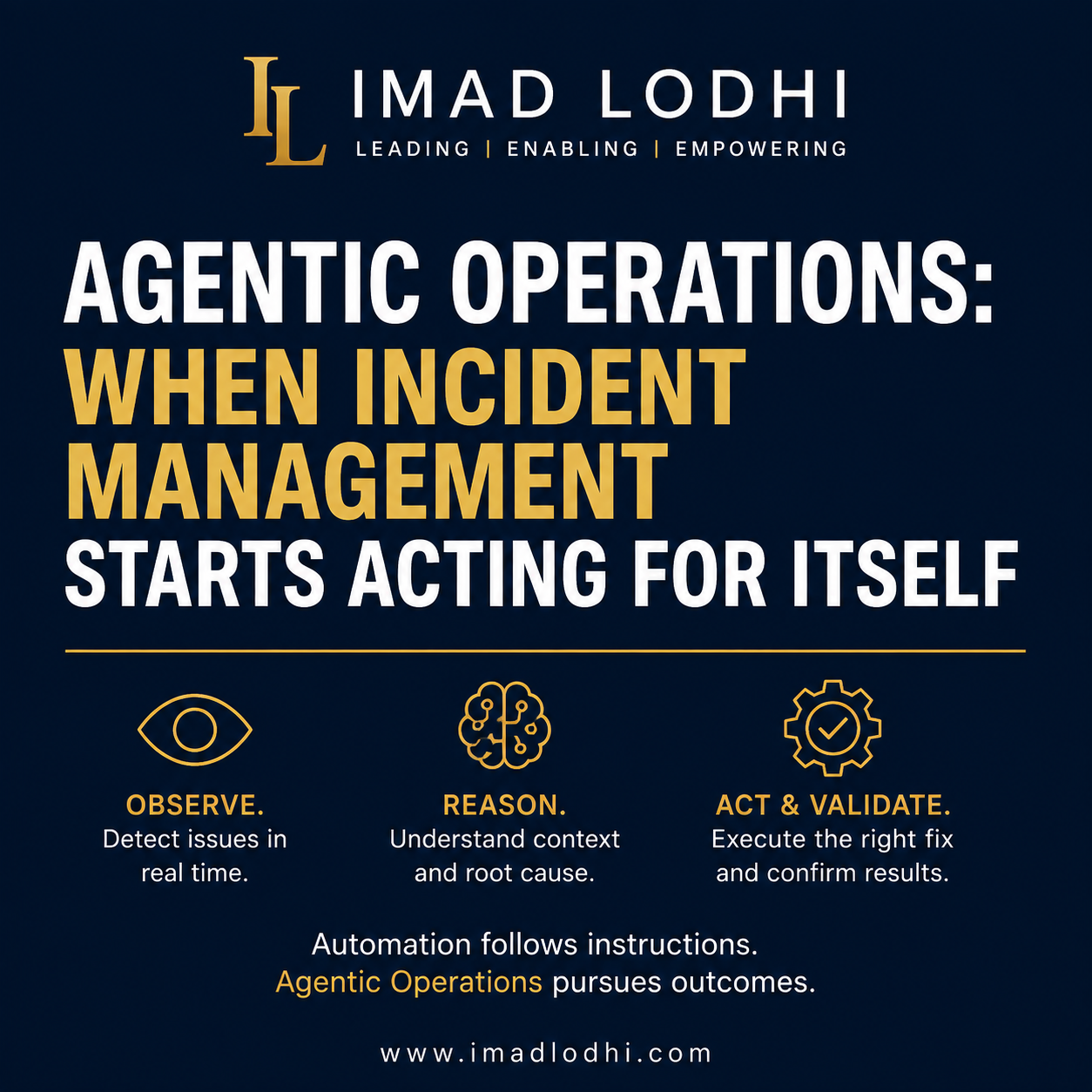
We have been automating IT operations for years.
We automate monitoring. We automate ticket creation. We automate deployments. We automate scripts. We automate alerts.
But if we are being honest, most of that automation still waits for a human to connect the dots.
An alert fires. Somebody looks at it. Somebody opens Remedy. Somebody checks the logs. Somebody looks at the CMDB. Somebody searches old incidents. Somebody decides what to do. Then somebody runs the fix and checks whether it worked.
That is where I think Agentic Operations starts to get interesting.
Automation follows instructions. Agents pursue outcomes.
Agentic Operations is not simply putting a chatbot in front of the Service Desk.
It is about introducing agents into operational workflows that can observe what is happening, gather context from multiple systems, reason about that information, decide what should happen next, take an approved action, validate the outcome and then update the operational record.
Think about autonomous incident management.
An application service fails at 2:13 in the morning.
Today, that might generate an alert, create an incident and wake up an engineer.
In an agentic model, the agent can take the incident further.
It can pull the incident from Remedy. Check the affected CI in the CMDB. Look at monitoring and logs. Check whether there was a recent change. Search previous incidents. Find the approved runbook. Determine whether the incident matches a known failure pattern.
Then it can make a decision.
If the scenario is low risk and already approved for autonomous remediation, it can invoke the runbook. Restart the service. Run a health check. Execute a synthetic transaction. Watch the monitoring state.
If everything comes back healthy, it updates Remedy with exactly what happened and resolves the incident according to policy.
If it does not work, it stops and escalates to a human with the evidence already assembled.
That is a very different operating model.
But autonomous does not mean uncontrolled.
This is probably the most important part.
I would never start by giving an AI agent unrestricted production access and telling it to figure things out. That is not innovation. That is an incident waiting to happen.
The agent should operate inside boundaries.
Start with observation. Then recommendations. Then human-approved execution. Only after the evidence demonstrates that a particular scenario is predictable, safe and measurable should that scenario become autonomous.
And notice the wording: the scenario becomes autonomous. Not the entire agent.
A known application-service restart might be autonomous. A production database restart might still require approval.
The agent reasons. A deterministic policy layer decides what it is allowed to do. An approved automation platform executes the runbook. An independent validation step proves whether the service actually recovered.
That separation matters.
The real opportunity is operational capacity.
The objective is not to remove engineers from operations.
It is to stop using engineers as expensive human middleware between monitoring systems, ITSM tools, knowledge bases, automation platforms and infrastructure.
If an incident that normally takes 40 minutes and six human touches can be diagnosed, remediated and validated in four minutes without waking anybody up, that is meaningful.
Lower MTTR. Fewer escalations. Fewer SLA breaches. Less repetitive work. More engineering capacity available for the incidents that actually require engineering judgment.
That is where I see Agentic Operations going.
Not AI replacing Operations.
Operations moving from observe and notify to observe, reason, decide, act and validate.
And autonomous incident management may be one of the best places to prove that it works.
Key Takeaways
- Agentic Operations goes beyond traditional rule-based automation by pursuing operational outcomes.
- Autonomous incident management can connect ITSM, CMDB, monitoring, logs, knowledge and approved runbooks into a closed-loop workflow.
- Autonomy should be granted scenario by scenario, with clear policy, validation and fallback controls.
- The business case should be measured through MTTR, manual touches, SLA performance, autonomous resolution rate and engineering capacity returned.


