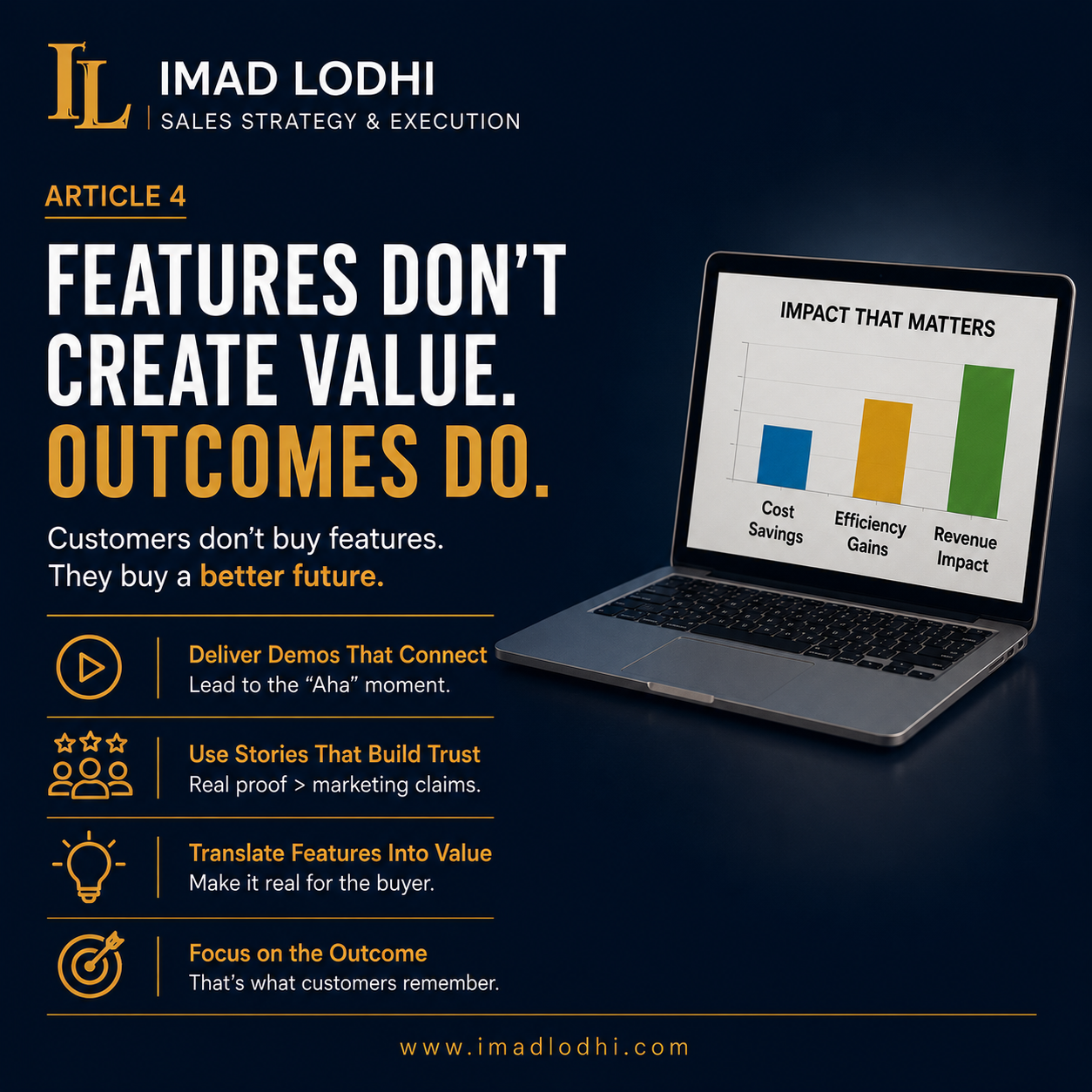
Your product can have 100 features. The customer may care deeply about three.
This is where a lot of otherwise good sales conversations go sideways.
The seller knows the product. They are proud of the product. So they start explaining the product.
Twenty minutes later, the customer has seen dashboards, integrations, automation rules, configuration screens and reporting options.
And still has no clear reason to buy.
A feature tells me what the product does. Value tells me why I should care.
Feature. Benefit. Value.
The translation is simple in concept.
A feature is what the solution has or does.
A benefit is what that capability enables.
Value is what materially changes for the customer: time, money, risk, productivity, revenue, customer experience, confidence or operational performance.
Take automated exception routing in a logistics platform.
The feature is automated routing. The benefit is that high-priority shipment issues reach the right people without somebody manually watching spreadsheets and email. The value might be fewer SLA breaches, less escalation effort and lower risk of losing an important customer.
But here is the important part: not every customer values those outcomes equally.
Find the true value driver
The Operations Director may care about reducing late-night escalation calls. Finance may care about penalties. The customer-experience leader may care about proactive communication. The CEO may care about retaining major accounts during growth.
Same capability. Different value.
That is why generic value propositions eventually become wallpaper. “Save time and improve efficiency” can describe almost anything.
Value becomes persuasive when the customer can recognize their own problem inside your explanation.
A demo is not a guided tour
The same principle should control the demonstration.
If discovery tells us the customer is drowning in shipment exceptions, show that workflow first. If VIP customers are escalating because issues are not identified quickly enough, show how the system identifies and routes those exceptions.
Get to the Aha moment early.
Then connect what the customer sees back to the outcome they told you matters.
“You mentioned that your team spends roughly 40 hours a week manually handling escalations. This is the workflow that removes the routing step and prioritizes the exceptions requiring human judgment.”
Now the product is supporting the value conversation instead of replacing it.
Proof reduces uncertainty
Stories, testimonials and case studies also matter, but only when used honestly.
A relevant anonymized example can help the buyer imagine implementation in their own environment. A credible customer result can reduce uncertainty. An analogy can make a complex capability understandable.
None of these should become theatrical persuasion. Their purpose is clarity and confidence.
Key Takeaways
- Translate capabilities from feature to benefit to business value.
- Identify the buyer’s true value driver rather than assuming all benefits matter equally.
- Tailor demos to discovery findings instead of giving product tours.
- Show the Aha moment early.
- Use proof to reduce uncertainty, not decorate the pitch.
If your customer remembers ten features but cannot explain what changes for their business, the demo was informative. It was not necessarily effective.