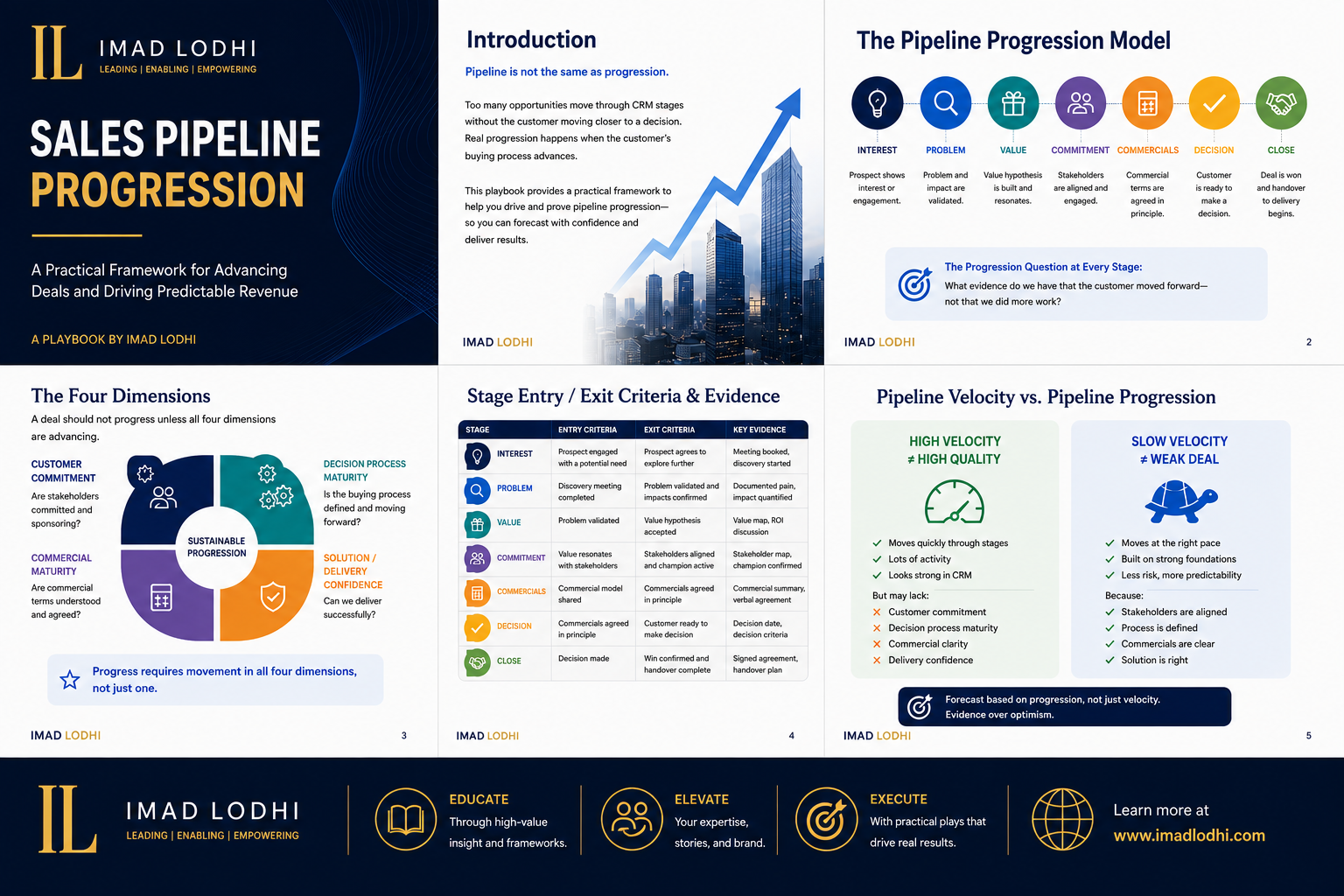
Years ago at IBM, one of the disciplines drilled into us was pipeline progression.
It wasn’t enough to tell your manager how much pipeline you had. You had to go through the deals and explain how you were progressing each one so you could actually hit your number.
On larger opportunities, that discipline became even more formal. We had Win Plans and CVDM — Client Value Deal Management — reviews where the opportunity, the strategy, the gaps and the path to winning were challenged.
And there is a lesson in that which I think many sales organizations have lost.
Busy does not mean progressing
A lot of what gets called pipeline progression today is really just sales activity.
We had another meeting.
We sent the proposal.
We did the demo.
We followed up.
We moved the opportunity from Stage 3 to Stage 4 in the CRM.
Great.
What did the customer do?
That is the question.
If the customer validated the problem, that is progression. If they confirmed there is a compelling reason to act, that is progression. If they brought the economic buyer into the conversation, that is progression. If Finance validated the business case, that is progression. If Procurement explained the buying process, that is progression. If they committed resources, shared decision criteria or agreed to a mutual next step, that is progression.
A busy sales team can still have a stagnant pipeline.
You can spend weeks creating decks, pricing models, demos, solution designs and proposals and convince yourself the opportunity is advancing.
Meanwhile the customer has not confirmed budget. You have never met the economic buyer. Procurement does not know the deal exists. The incumbent is quietly negotiating an extension. And your CRM says 70%.
That is not a 70% deal.
That is a very busy sales team.
The pipeline review question that matters
Instead of asking only, “What did you do this week?” ask:
What materially changed in the customer’s buying process since our last review?
Then ask what evidence proves it, what is preventing the next decision, who needs to become involved, what customer commitment is needed next, what the strategy is for earning it, and who owns the action by when.
That changes the conversation from activity management to opportunity management.
Why Win Plans matter
A good Win Plan is not paperwork attached to a large opportunity because governance says one is required. It should expose what we do not know.
Who actually makes the decision? Why does the customer need to act now? Why would they choose us? Who prefers the competitor? What could kill the deal? Is funding real? What is the decision process? What commitments have we earned? What must happen next?
The value of a CVDM-style review was not the meeting itself. It was having experienced people challenge the assumptions behind the forecast.
The stage should describe where the customer is in the decision — not where the seller is in the sales process.
Forecast evidence, not optimism
Pipeline stages and percentages create an illusion of precision. A seller can call something 70%. The CRM can call something Stage 5. Neither means much unless the buyer has done something that justifies it.
Probability should follow evidence. Evidence should never be reverse-engineered to justify probability.
Forecast evidence, not optimism.
Because ultimately, sales activity is not pipeline progression.
Buyer commitment is.


