The Buyer Changed. Sales Has To Change With Them.
There was a time when the salesperson controlled much of the information.
The seller explained the problem. The seller introduced the solution. The seller compared the options. The seller handled objections. Then the seller tried to close.
That world is disappearing.
Today's buyer can research your company, your competitors, your capabilities, your customer stories and sometimes even your weaknesses before they ever speak to you.
The salesperson has not become less important because buyers became more informed. The salesperson has to become more valuable because buyers became more informed.
The Sales Cycle Is No Longer the Buyer's Journey
One of the mistakes organizations make is assuming that their sales process and the customer's buying process are the same thing.
They are not.
Your CRM may say Discovery, Qualification, Proposal, Negotiation and Close. The buyer may be researching, comparing, disengaging, reconsidering, bringing in another stakeholder, questioning the business case and wondering whether doing nothing is actually safer.
The buyer does not care what stage your CRM says the opportunity is in.
That is why I prefer to say that the sales process must synchronize with the buyer's decision process.
And There Is Rarely One Buyer
This becomes even more important in enterprise technology and services.
Imagine selling an ITSM analytics capability into a large organization.
The CIO may care about business outcomes. Service Management wants visibility and governance. Operations wants to know whether this creates more work. Finance wants ROI. Security wants to understand data exposure. Architecture wants to understand integration. Procurement wants commercial leverage.
And somewhere in the organization, somebody is asking: Why can't our internal team just build this?
These people are not necessarily moving through the decision at the same speed. They do not share the same concerns. They may not even agree on what problem they are solving.
Enterprise selling is increasingly the work of helping multiple people reach enough shared confidence to make a decision.
That Changes the Salesperson's Job
A modern salesperson cannot create much differentiation by simply saying, “Let me tell you about our solution.” The buyer can find product information almost anywhere.
The higher-value conversation sounds more like this:
I understand what you are trying to accomplish. Here are the obstacles I see. Here are the stakeholders who may resist it. Here are the risks in the current approach. Here are the trade-offs between the alternatives. And here is how organizations like yours typically move forward.
That is no longer just product selling.
It is diagnosis. Facilitation. Risk reduction. Decision orchestration. And increasingly, it looks a lot like consulting.
Guide Does Not Mean Passive
Being buyer-aligned does not mean sitting quietly and waiting for the customer to make up their mind.
Good salespeople actively help buyers navigate the decision. They identify missing stakeholders. They surface objections that have not yet been spoken. They challenge assumptions. They quantify the cost of doing nothing. They help champions build an internal business case. They reduce uncertainty.
The best salesperson is not simply the person who knows the product. It is the person who helps the customer think.
Four Principles for Modern Selling
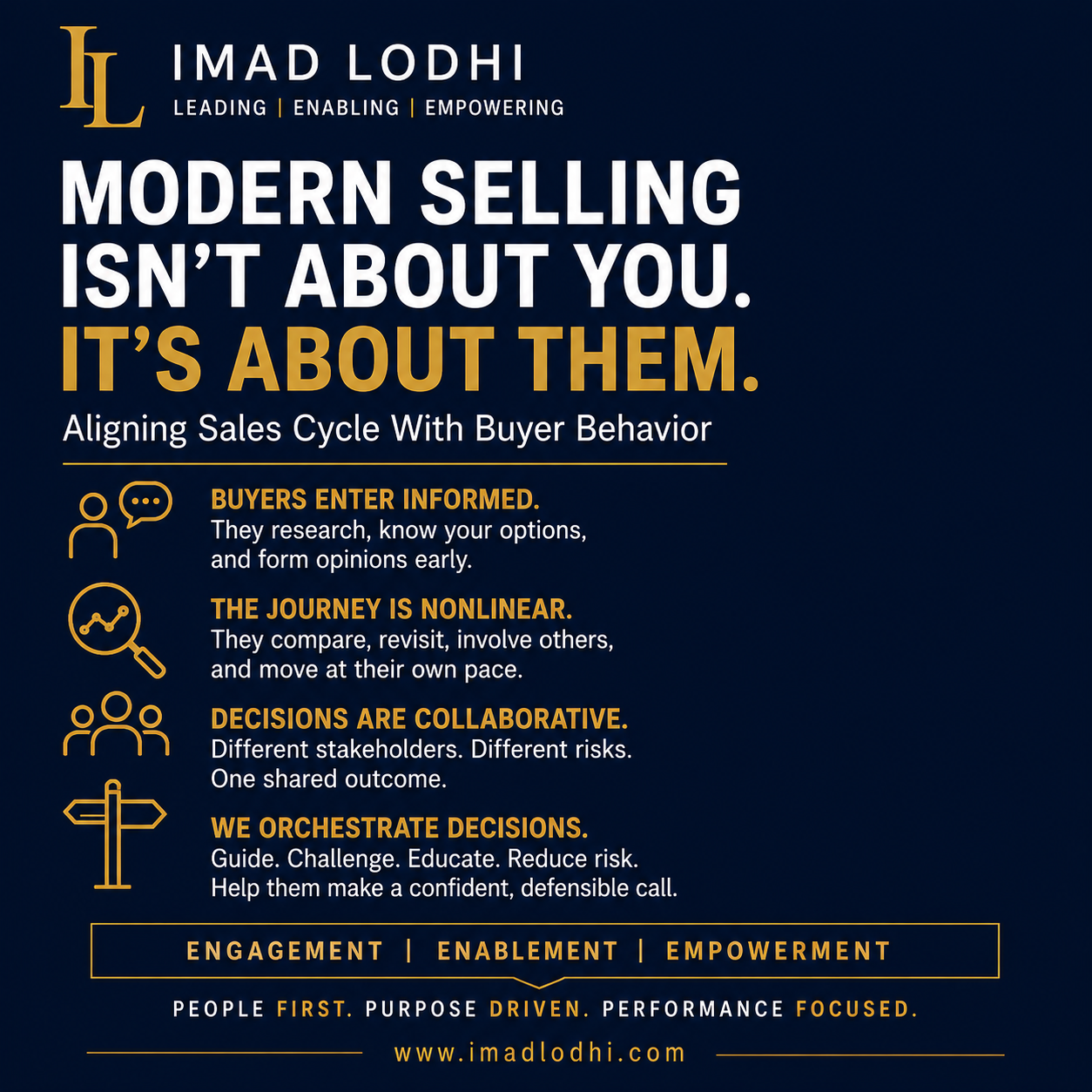
1. Buyers enter the conversation already informed.
Basic product knowledge is no longer meaningful differentiation.
2. Buyers follow nonlinear journeys.
They research, compare, pause, reconsider and involve new stakeholders.
3. Enterprise buying is a consensus process.
Different stakeholders have different motivations, risks and definitions of value.
4. Salespeople orchestrate decisions rather than push products.
They diagnose, challenge, educate, reduce uncertainty and help organizations reach defensible decisions.
Key Takeaways
The modern sales cycle should not attempt to force buyer behaviour into seller-defined stages. It should help sales teams recognize where the customer actually is in the decision process and what is preventing movement.
That requires a different kind of salesperson: less product broadcaster, more trusted advisor; less pressure, more insight; less obsession with moving the CRM stage, more focus on moving the customer's thinking.
Because when information is abundant, information itself becomes cheap.
Judgment, context and the ability to help someone make a difficult decision become valuable.