A buying decision can look rational on paper while being deeply human underneath.
We love to imagine that B2B customers make decisions like calculators.
Requirements go in. ROI comes out. Highest score wins.
Except that is not how people work.
A customer can agree with your business case and still hesitate. They can prefer your solution and still renew with the incumbent. They can tell you price is the issue when the real concern is implementation risk, internal politics, or whether they trust your organization to deliver.
The spreadsheet evaluates the decision. The human being still has to make it.
Fast thinking meets slow thinking
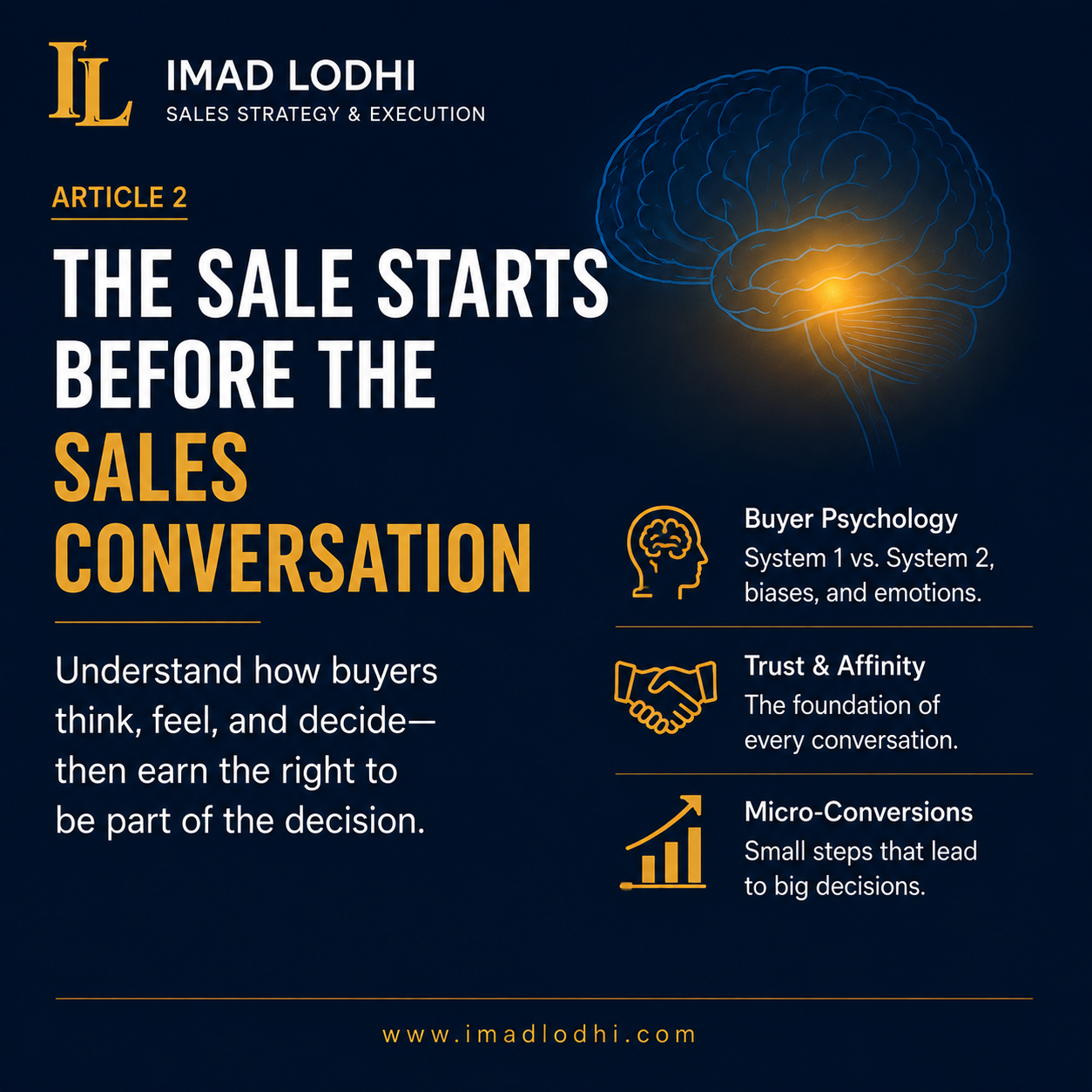
Buyer psychology is useful because it reminds us that people process decisions in different ways. Some reactions are fast and intuitive. Others are deliberate and analytical.
Think about a CIO reviewing two suppliers. Both meet the technical requirements. One team has listened carefully, understood the environment, acknowledged risks and demonstrated that they know how the customer operates. The other has a slightly lower price but has spent most of the process talking about itself.
The eventual decision may be defended with commercial and technical criteria. But confidence and perceived risk are already shaping how those criteria feel.
Status quo has a powerful advantage
This matters enormously in enterprise sales.
If the customer already has a supplier, doing nothing is an option. And doing nothing often feels safer than changing—even when the existing situation is imperfect.
The incumbent does not need to be brilliant. Sometimes they only need to be familiar.
That means a challenger cannot simply demonstrate that its solution is better. The customer has to believe the improvement is worth the disruption, uncertainty and personal risk of change.
This is where loss aversion, anchoring, confirmation bias and status quo bias become commercially relevant. Not because we should manipulate them, but because we need to recognize how they affect decisions.
A customer can believe your solution is better and still believe changing is too risky.
Trust is not a soft metric
Trust affects access. It affects what customers tell you. It affects whether they introduce you to other stakeholders. It affects how much benefit of the doubt you receive when something is unclear.
And trust is built through small moments.
Did you listen? Did you remember what mattered? Did you answer the difficult question directly? Did you admit what you did not know? Did you follow through on the next action?
Those are micro-conversions. The customer is not signing the contract yet. They are deciding whether to take the next meeting, share more information, involve Finance, introduce the economic buyer, or let you deeper into the decision process.
Sell to the decision, not just the requirement
Good discovery therefore needs to uncover more than functionality.
What does success mean? What does failure mean? Who carries the risk? What happened the last time the organization tried something similar? What would make the buyer comfortable recommending change?
Those questions do not replace the business case. They make the business case more complete.
Key Takeaways
- B2B buying decisions contain both rational and emotional elements.
- Status quo and perceived switching risk can defeat a technically superior solution.
- Trust influences access, disclosure and decision confidence.
- Cognitive biases should be recognized ethically, not exploited.
- Small buyer commitments often precede the final commercial commitment.
Before asking why a customer has not bought, ask a better question: what would have to become true for this decision to feel safe enough to make?