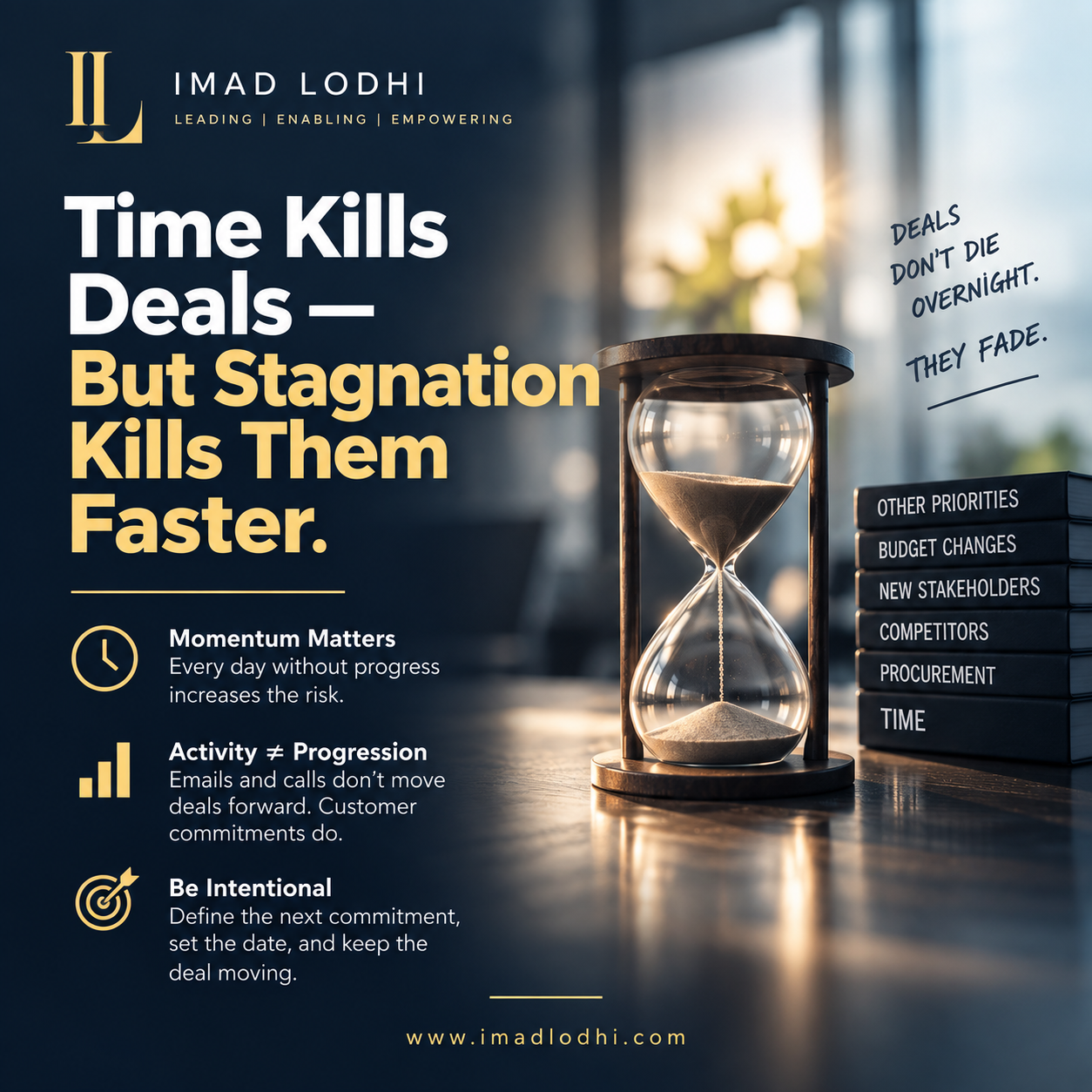
Deals rarely die in a dramatic moment.
They decay.
A meeting gets pushed two weeks. The proposal sits unanswered. Legal takes ten days. Your champion gets distracted. A budget cycle closes. Another executive enters the conversation.
Meanwhile, the opportunity stays in the CRM as active pipeline because nobody has explicitly said no.
Every day a deal sits without meaningful forward movement, the probability of something changing increases.
And that “something” usually isn’t in your favour.
Priorities change. Budgets move. Stakeholders change roles. Competitors get access. Procurement introduces another requirement. The business problem that felt urgent six weeks ago becomes less urgent—or somebody finds another way to live with it.
So yes, time kills deals.
But I think the more useful diagnosis is this: stagnation kills deals.
Activity isn’t progression
This is where sales teams can fool themselves.
Sending another follow-up email isn’t progression. Having another friendly conversation isn’t necessarily progression. Updating Salesforce isn’t progression. Moving the expected close date into next quarter definitely isn’t progression.
Those are activities.
A deal progresses when the customer makes a meaningful commitment that reduces the distance to a decision.
That commitment might be giving you access to another stakeholder. Providing data required for the business case. Agreeing to a technical validation. Confirming commercial parameters. Scheduling procurement. Assigning legal resources. Approving the next stage of the evaluation.
The important word is customer.
If only the seller is doing things, the opportunity may be warm—but it may not be moving.
What progress should look like
Most complex B2B technology deals move through some version of a path like this:
Interest → Discovery → Validation → Solution → Commercial → Decision → Contract
At every stage, I want one question answered:
What customer commitment moves this opportunity to the next stage, and by when?
That changes pipeline management from reporting activity to governing progression.
It also exposes uncomfortable truths earlier.
If the customer will not introduce the economic buyer, perhaps the deal is not as qualified as we think. If nobody will commit resources to validation, maybe the problem is not important enough. If procurement has supposedly been “next week” for a month, the forecast should reflect that reality.
Sales management matters here
Good pipeline governance should not become an interrogation where sellers defend why deals have not closed.
It should help determine what is preventing the opportunity from progressing.
Is there a customer constraint? A weak champion? Missing stakeholder access? An unclear value proposition? Competitive pressure? A seller capability problem? An internal approval bottleneck? A delivery concern damaging customer confidence?
Different constraints require different interventions.
That is why simply asking, “When will it close?” is rarely enough.
A better question is: “What has the customer committed to doing next?”
Stop carrying zombie pipeline
There is another discipline sales organizations need: the willingness to downgrade, re-qualify or remove opportunities that are not moving.
A stalled deal is not necessarily lost.
But it probably isn’t worth what your CRM says it’s worth.
Keeping zombie opportunities alive makes the pipeline look healthier while making the forecast less trustworthy. It also consumes seller attention that could be invested in opportunities where customers are actually moving.
Key Takeaways
- Time increases deal risk because customer conditions keep changing.
- Sales activity should never be confused with customer progression.
- Define the customer commitment required to move every stage.
- Use pipeline reviews to diagnose constraints, not merely defend close dates.
- Downgrade or re-qualify stalled opportunities so the forecast reflects reality.
Discussion question: How long can an opportunity sit without a meaningful customer commitment before you stop calling it active pipeline?


