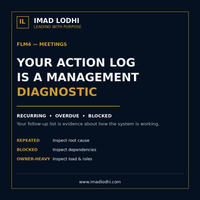
Most managers treat the action log as meeting administration.
Someone reads the open items. A few dates move. An owner explains why something is late. Then the meeting continues.
But the action log is doing something much more useful. It is showing you where the management system is struggling.
If the same action keeps returning, if one person owns half the list, or if items remain blocked week after week, that is not a clerical problem. That is operational data.
The action that came back for the fifth week
Imagine a Network Operations team supporting several hundred sites. Intermittent VPN failures are creating repeat incidents across twelve locations. In the weekly service review, an action is assigned: “Senior engineer to investigate recurring VPN drops.”
The next week, it is still open. The engineer was pulled into two major incidents.
The week after that, it is “in progress.” The carrier has not provided packet-loss data.
By week four, the same engineer now owns nine other actions. By week five, another VPN incident hits during business hours. The Service Desk receives a surge of calls, Remote Support cannot resolve the issue, and Network Operations begins the same investigation again.
Everyone attended the meetings. The action was documented. The status was reviewed.
The system still failed.
An action log is not evidence that governance happened. Closure is.
Read the pattern, not just the status
This is where first-line managers need to stop treating actions as isolated tasks.
A repeated action may tell you the root cause has not been addressed. An overdue action may expose a capacity problem. A blocked action may reveal a dependency or unclear decision authority. An action repeatedly reassigned may point to weak role definition. If one person owns most of the list, you may have created a key-person dependency.
And an action that closes but keeps returning in another form may be telling you that the corrective action was ineffective.
In FLM4, Meetings are not simply conversations. They are part of the management architecture that connects decisions to execution. The action log is one of the places where that architecture becomes visible.
If the same action returns every week, stop asking only when it will close. Ask what system is keeping it open.
Turn follow-up into diagnosis
Start with a simple standard. Every meaningful action needs a clear owner, a defined outcome, a due date, and evidence that it is complete.
Then look beyond individual items.
Once a month, ask: Which actions keep recurring? Which remain blocked? Which owners are overloaded? Which actions close without improving the underlying condition? Which dependencies repeatedly delay delivery?
That discussion can point you back into the other management systems: Roles & Responsibilities, Processes & Procedures, Technology & Tools, Reporting & Measurements, Analytics & Optimization, and Continual Service Improvement.
This is where meetings become genuinely useful. They do not merely remind people to do things. They reveal where the operating model needs attention.
Recurring actions are management data. Use them that way.
Key Takeaways
- Do not measure governance by the number of actions recorded.
- Repeated actions often signal unresolved root causes.
- Overdue and blocked actions can expose capacity, dependency, and authority problems.
- Owner-heavy action logs can reveal key-person risk.
- Review action patterns, not only individual statuses.
Discussion question: What would your last three months of action logs tell you about the health of your management system?


