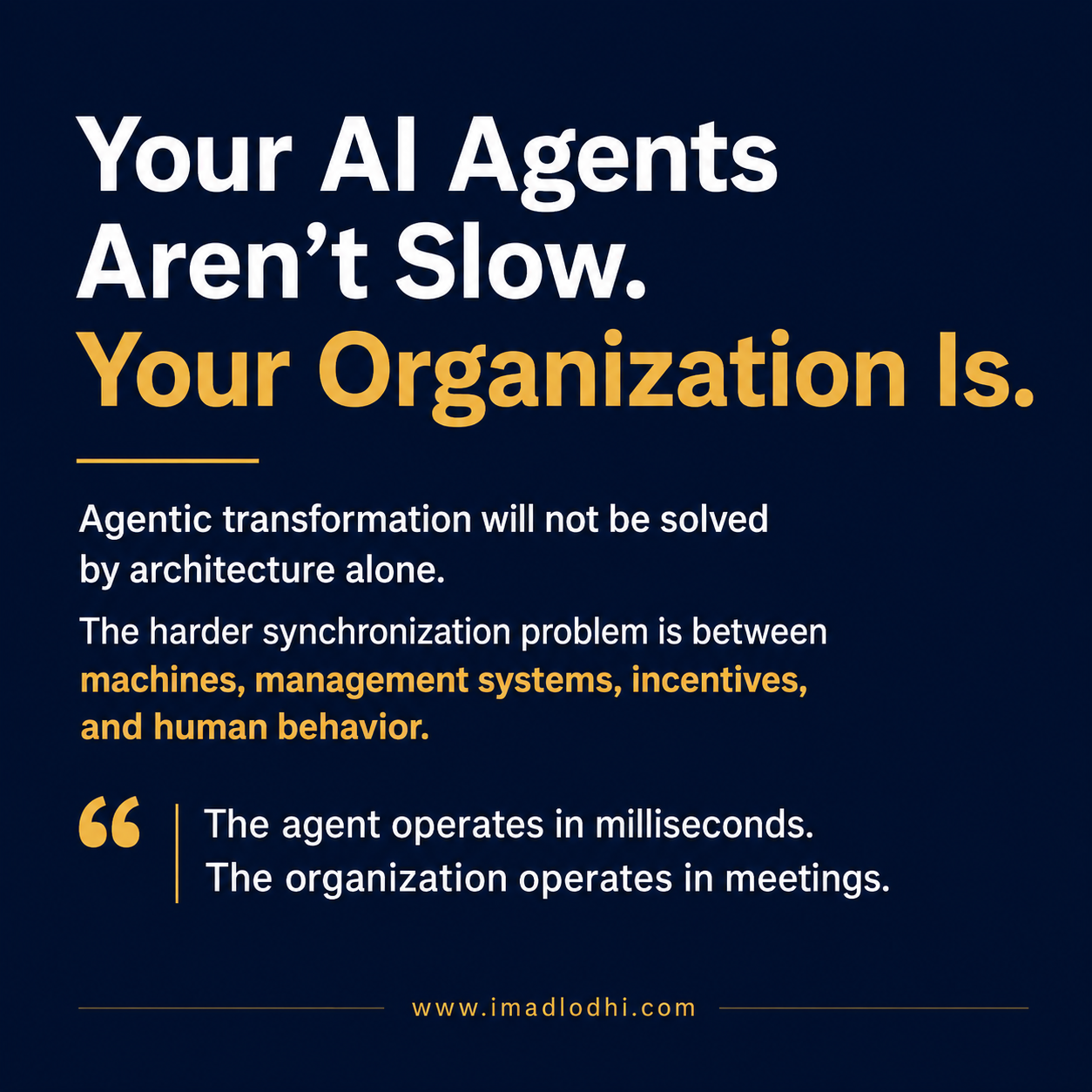
Agentic transformation has a human synchronization problem
There is a growing argument that enterprise AI is running into a synchronization constraint. Real-time agents can operate continuously, but corporate workflows remain asynchronous. Decisions wait for meetings. Approvals sit in queues. Governance processes move in hours or days while software operates in milliseconds.
That diagnosis is valid. But I think it stops one layer too early.
Agentic transformation has two synchronization problems: machine synchronization and human synchronization. Most organizations are concentrating on the first. The second may prove harder.
The technology problem asks whether agents can operate continuously across systems, workflows, APIs, controls and decision points.
The human problem asks whether people will trust them, relinquish control to them, know when to intervene and actually work differently because of them.
Fix the architecture without fixing the human operating model and the organization may simply rebuild its old bureaucracy around faster technology.
Human-in-the-loop latency is not always an architectural defect
We often talk about human-in-the-loop processes as though the human is simply slowing down an otherwise elegant system.
Sometimes that is true.
But sometimes human-in-the-loop latency is organizational behaviour expressed through architecture.
A manager who insists on approving every action may not be protecting an outdated workflow because they dislike technology. The organization may have spent twenty years teaching that manager that they are personally accountable when something goes wrong.
Then we introduce autonomous software and ask why they refuse to get out of the loop.
That behaviour is predictable.
If the management system rewards risk avoidance, control and escalation, employees will continue inserting control and escalation into the new operating model.
The four human pillars of agentic transformation
1. Engagement: Do people want to participate?
If employees believe automation is ultimately a headcount-reduction exercise, engagement will deteriorate before the transformation has a chance to prove itself.
People do not experience software as neutral infrastructure. They interpret what it means for their role, status, security and future.
2. Enablement: Do people know how to operate differently?
Giving someone an AI assistant, autonomous agent or orchestration platform does not teach them how to delegate to software.
People need to learn how to establish guardrails, evaluate outputs, manage exceptions, challenge decisions and determine when human judgment should override machine recommendations.
This is fundamentally different from traditional application training. We are no longer teaching people which buttons to click. We are teaching them how to supervise a new type of digital worker.
3. Empowerment: Are people actually allowed to let the agent act?
An organization can deploy autonomous technology while retaining approval structures that effectively make the technology non-autonomous.
If every meaningful agent action requires three approvals, two committees and a manager's sign-off, the organization has not created agentic operations. It has automated the preparation of paperwork.
4. Human behaviour: What happens when software threatens agency?
Traditional enterprise software was largely passive. Humans entered information, clicked buttons and initiated workflows.
Agentic software is different. It can observe, recommend, decide and potentially act.
That changes the psychological relationship between employee and technology. The employee may lose some sense of mastery, autonomy and professional identity. Resistance is therefore not necessarily anti-technology bias. It can be a rational response to perceived loss of control.
And there is a fifth pillar: incentives and consequences
This may be the most overlooked issue of all.
People adapt to what organizations reward and punish.
If I am told to trust autonomous decision-making but I personally wear the consequences when the autonomous system makes a bad decision, I will insert myself back into the workflow. Every single time.
Organizations cannot demand autonomy from technology while maintaining accountability structures designed around manual human control.
An IT service delivery example
Consider a major incident management environment.
An agentic capability could continuously analyze monitoring data, correlate events, identify the likely failing component, assemble the appropriate resolver teams, summarize diagnostic evidence, recommend remediation, draft stakeholder communications, update the incident record and begin preparing the post-incident review.
Technically, this could happen almost instantaneously.
Now put that capability inside a traditional enterprise operating model.
The Network team does not trust the diagnosis and manually validates the telemetry.
The Application team refuses automated remediation against production without human review.
The Incident Manager continues running the bridge exactly as before because that is how major incidents have always been governed.
Change Management requires approvals designed for human-generated changes.
Security requires another review.
Managers want to be consulted because they remain accountable if the automated recommendation causes another outage.
The agent operates in milliseconds. The organization operates in meetings.
Eventually leadership looks at the investment and asks why agentic AI did not produce the expected productivity improvement.
Perhaps the technology worked perfectly.
The operating system surrounding the technology did not change.
The management system has to change too
Agentic transformation therefore cannot be treated as an AI implementation project.
Management systems need to evolve from approval engines toward exception-handling and governance systems.
The question should no longer be, “Which human approves every transaction?”
It should become, “Under what conditions may the system act autonomously, and what conditions require human judgment?”
That is a fundamentally different management philosophy.
Lessons for managers
- Do not interpret every form of resistance as fear of technology. Understand what employees believe they are losing.
- Clarify where human judgment remains essential and where autonomous execution is genuinely expected.
- Reward appropriate delegation to autonomous systems rather than quietly rewarding manual control.
- Teach employees how to challenge and govern agents, not merely how to use AI tools.
- Create psychological safety around responsible experimentation and well-governed failure.
Lessons for organizations
- Redesign governance at the same time as workflows.
- Align accountability with the level of autonomy granted to technology.
- Replace blanket approvals with risk-based thresholds and exception handling.
- Measure behavioural adoption, not merely technical deployment.
- Examine whether legacy KPIs and management incentives are forcing people back into manual control.
Key Takeaways
- Agentic transformation has both a machine synchronization problem and a human synchronization problem.
- Human-in-the-loop latency can be a symptom of management systems, incentives and organizational behaviour.
- Engagement determines whether people want to participate.
- Enablement determines whether they know how to work with autonomous systems.
- Empowerment determines whether they are actually allowed to delegate decisions.
- Architecture can make software autonomous. Only the operating model can make the organization autonomous.
The next generation of enterprise transformation will not be won simply by organizations with the fastest AI agents.
It will be won by organizations capable of redesigning the relationship between people, management systems and increasingly autonomous software.


