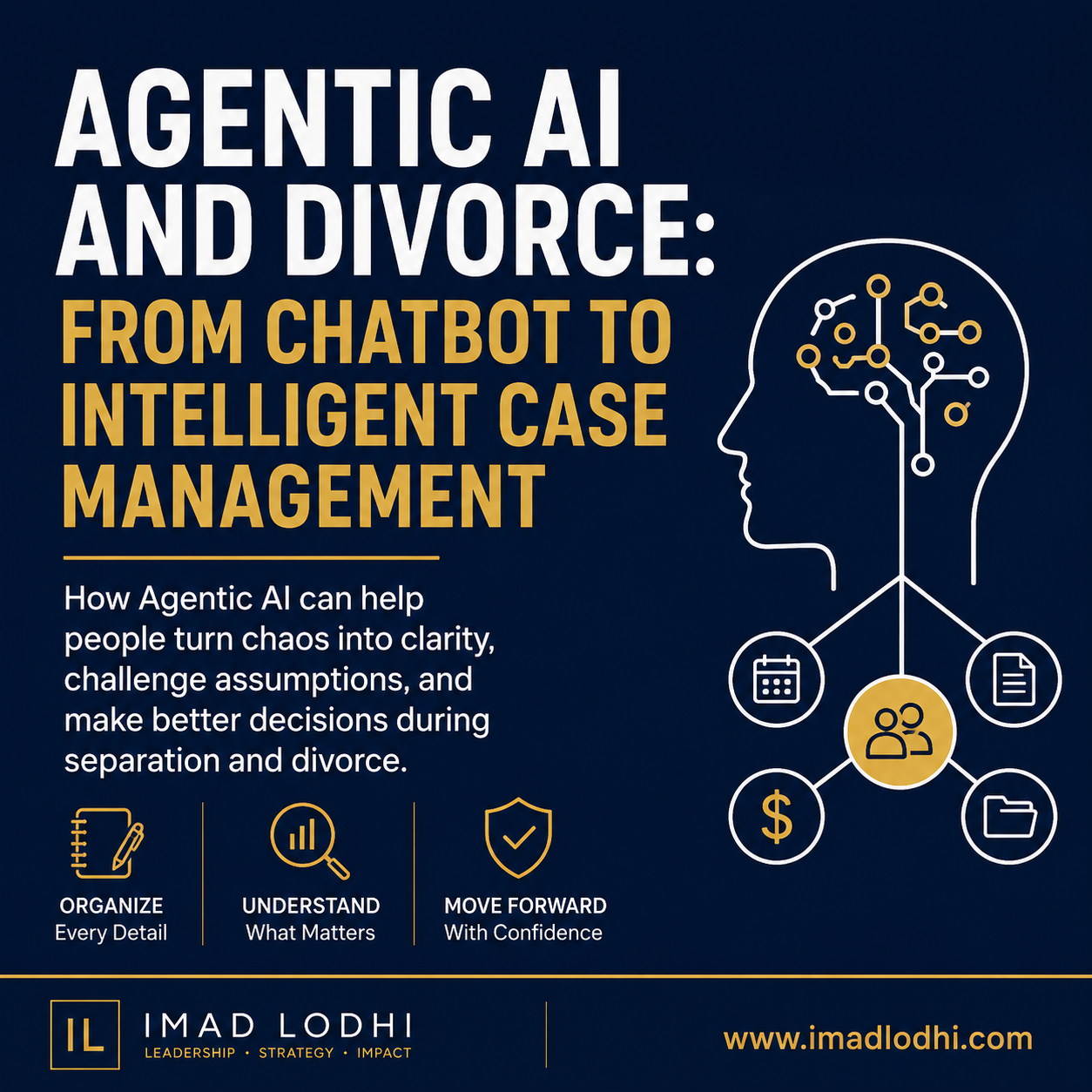
There is a lot of discussion about agentic AI right now.
Much of it focuses on the technology: agents, models, tools, orchestration, memory and autonomous workflows.
But I keep coming back to a much simpler question: What problem are we actually trying to solve?
Divorce provides an interesting example.
Divorce isn't a single transaction. It can be a months- or years-long process involving parenting schedules, financial obligations, expenses, emails, text messages, court documents, agreements, incidents, appointments, lawyers and hundreds of small events that eventually become important.
The problem isn't necessarily a lack of information. The problem is managing it.
Generative AI Helps. Agentic AI Changes the Workflow.
Imagine a separated parent writes that pickup was supposed to happen at 6:00, but the other parent arrived at 7:25, and this has happened several times recently.
Generative AI could rewrite the entry, summarize it or help compose an email. Useful.
But imagine an agentic system. It recognizes this as a parenting-exchange event. It associates the entry with the parenting schedule. It searches previous records for similar incidents. It discovers three documented late exchanges during the previous 30 days. It connects the relevant journal entries and updates the case chronology.
Then it asks: I found three similar documented exchanges during the past 30 days. Would you like me to prepare a factual timeline?
That's a fundamentally different application of AI. The user isn't repeatedly asking AI to perform individual tasks. The system understands an objective and performs a controlled sequence of tasks toward achieving it.
This Is Where CustodyMate Gets Interesting
I've been thinking about this in relation to CustodyMate.
The objective isn't to turn CustodyMate into an AI divorce lawyer. In fact, I think that would be the wrong objective.
The opportunity is to evolve CustodyMate toward an intelligent case-management partner.
Imagine specialized capabilities working together: a Journal Agent organizes events and observations; an Evidence Agent connects journal entries with supporting documents, messages, photographs and records; a Parenting Agent tracks schedules, exchanges, missed parenting time and recurring issues; a Financial Agent organizes support obligations, shared expenses and reimbursements; and a Case Agent continuously maintains the chronology of what happened.
The technology begins taking responsibility for the administrative burden while the human remains responsible for consequential decisions.
But There Is an Even More Important Opportunity
Divorce is emotional. Memory is imperfect. Our interpretation of events is influenced by frustration, fear and conflict.
That creates a dangerous possibility for AI. An AI system could become an extraordinarily sophisticated confirmation-bias machine.
Tell it that an ex always prevents someone from seeing their children, and a poorly designed system might help construct an argument supporting that assertion.
I would rather see the system challenge it.
Perhaps the documented record shows two disrupted exchanges during six months. The system should be able to say: Your records contain two documented parenting-time disruptions during the past six months. Based on the information currently available, the record does not establish that this happens consistently.
That isn't taking the other person's side. It's taking the evidence's side.
AI Should Create Friction Sometimes
We normally think good technology should eliminate friction. In emotionally charged environments, sometimes good technology should deliberately introduce it.
Before sending an angry message, it might point out that several accusations aren't supported by information currently recorded and offer to rewrite the message using only documented facts.
Before escalating an isolated incident, it might identify that only one documented occurrence exists and suggest recording it as an individual event rather than a recurring issue.
The system isn't making the decision. It's creating a moment between emotion and action.
Controlled Agency Is the Key
This doesn't mean handing control of someone's divorce to an algorithm. Quite the opposite.
Low-risk administrative work can happen automatically: categorizing records, connecting related information and maintaining timelines.
Medium-risk activities should require approval: preparing summaries, drafting communications and identifying potential patterns.
High-risk activities involving legal conclusions, allegations, filings or external communications should remain firmly under human control and, where appropriate, professional legal review.
The architecture becomes: Capture → Understand → Connect → Analyze → Recommend → Human Approves → Act
Not: Capture → AI Decides → AI Acts
The Larger Agentic AI Lesson
Organizations shouldn't start by saying: Agentic AI is the next big thing. Where can we deploy agents?
Start with the operational problem. Where are people repeatedly collecting information? Where are they manually correlating information from multiple places? Where are they repeatedly performing predictable administrative tasks? Where does information have to be transformed into decisions? And where can software safely perform some of that work while keeping people accountable for consequential decisions?
Those are potential agentic workflows. The technology comes second.
That is how I'm thinking about the evolution of CustodyMate. Not AI looking for a divorce problem. A real divorce problem where carefully designed agentic AI might actually help.
The best AI in a divorce shouldn't tell you that you're right. It should help you understand what the evidence actually says.
Learn more about CustodyMate at www.custodymate.com.