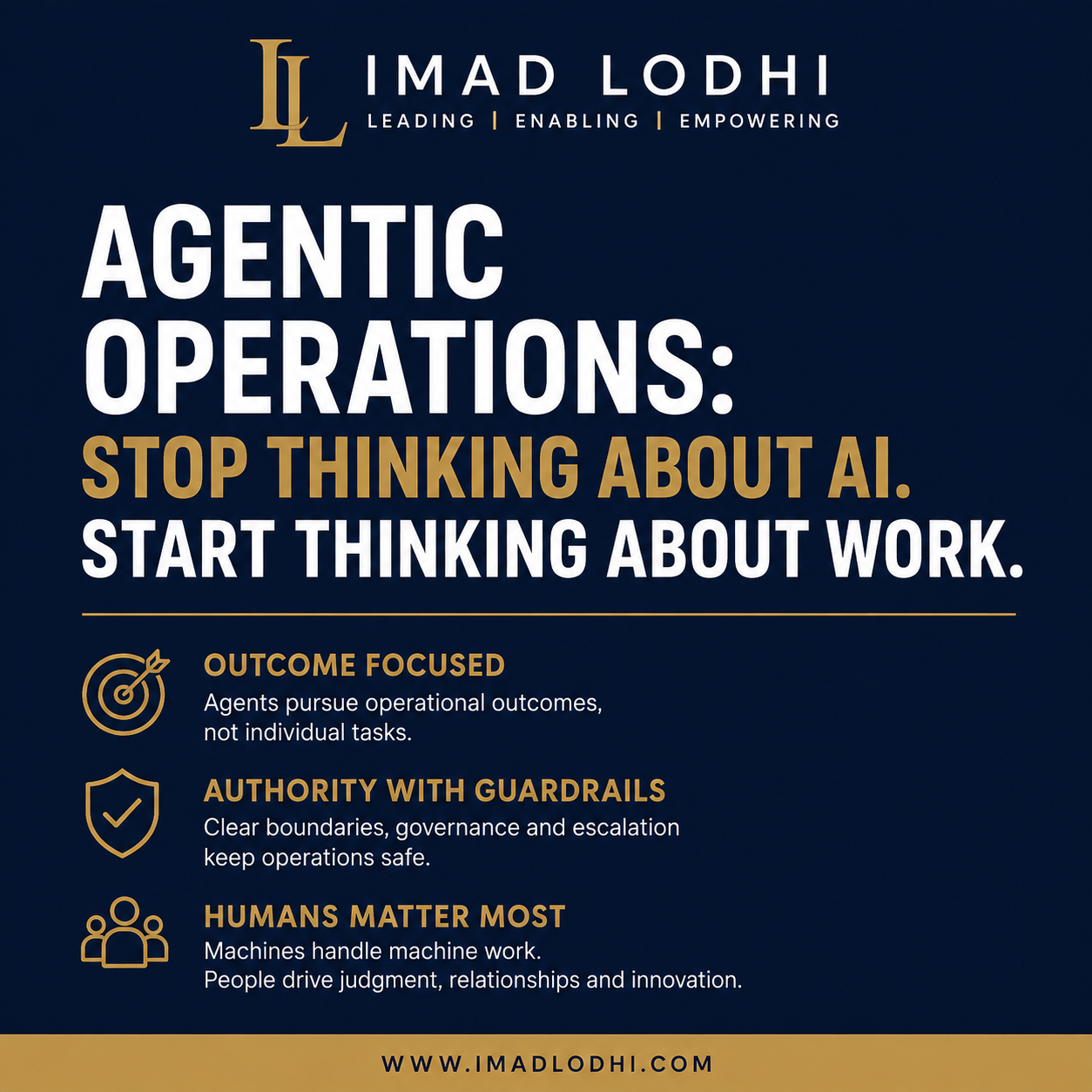
Agentic Operations isn't about adding another AI tool. It's about changing how work gets done.
There is a lot of discussion about AI agents right now.
Agents that can reason. Agents that can use tools. Agents that can talk to other agents.
Interesting stuff.
But if I'm talking to an operations leader, I wouldn't start there.
I'd ask a much simpler question:
How much of your operation is waiting for someone to do something?
Someone needs to look at the ticket. Someone needs to figure out who owns it. Someone needs to check another system. Someone needs to send an email. Someone needs to chase an approval. Someone needs to escalate because the first person didn't respond.
That is where Agentic Operations gets interesting.
So What Is Agentic Operations?
Traditional automation usually works like this:
When X happens → do Y.
Agentic Operations is different:
Here is the objective → figure out what needs to happen → take action → evaluate the result → continue until the objective is achieved or human judgment is needed.
Think of traditional automation as following a recipe.
Agentic Operations is more like giving an experienced chef the ingredients and saying: “Dinner needs to be ready by 7.”
You've defined the outcome, the boundaries and the authority. You haven't prescribed every movement.
A Simple IT Example
Imagine someone contacts the Service Desk: “I can't access the finance application.”
Today, we might create a ticket, categorize it, troubleshoot it, send it to another team, wait for them, discover an access problem, send it somewhere else and eventually restore access.
Lots of activity. Not necessarily lots of value.
Now imagine an AI agent receives the request. It checks whether the application is available. It checks the user's identity and approved access. It discovers a required security group is missing. It checks whether the user previously had approved access, restores it within predefined authority, tests the result, updates the ticket and tells the employee their access has been restored.
The objective wasn't to route a ticket. The objective was to restore service.
That distinction matters.
Now Imagine a Major Incident
An application suddenly slows down.
Today we generate alerts, open an incident, assemble a bridge and invite Application, Middleware, Database, Server, Storage and Network.
Twenty people join. Someone inevitably asks: “Any updates?”
Meanwhile, everyone checks their own little piece of the universe.
In an agentic model, an operational agent could start investigating immediately. Check telemetry. Check infrastructure. Check the database. Check recent changes. Compare against previous incidents.
Maybe it discovers that performance degraded immediately after a configuration change. If rollback is within its authority, it executes the rollback, validates recovery, updates the incident and documents what happened.
Maybe twenty people and ninety minutes becomes two people and fifteen minutes.
That's where Agentic Operations starts becoming economically interesting.
But This Doesn't Mean Giving AI the Keys to the Building
Agency doesn't mean unlimited authority.
An agent might be allowed to investigate anything, recommend certain actions, execute low-risk reversible actions, request approval for higher-risk actions and immediately escalate situations requiring human judgment.
We've dealt with this concept for decades. Employees have different authority levels. Managers have approval limits. Administrators have privileged access. Changes have risk classifications.
Agentic Operations simply forces us to define those boundaries for a new kind of operational participant.
And Here Is Where It Gets Really Interesting
The biggest challenge may not be AI. It may be us.
Our organizations are built around human handoffs.
Service Desk hands to Application. Application hands to Middleware. Middleware hands to Database. Database says it isn't them. Someone calls Network.
But what happens when an agent can investigate across all of them?
What happens to resolver groups? What happens to escalation models? What happens to SLAs? What happens to roles? What happens to the manager whose primary responsibility today is coordinating work between teams?
Those are much bigger questions than which AI model we should buy.
The Real Opportunity
I don't think Agentic Operations means replacing everyone with AI.
I think it means something much more practical.
Let machines do machine work.
Searching. Correlating. Monitoring. Updating. Routing. Following up. Executing repetitive actions.
And let people concentrate on the things humans are actually good at: judgment, relationships, leadership, innovation, managing ambiguity and solving problems we haven't seen before.
Agentic Operations isn't simply about putting AI into today's operations.
It's about asking whether today's operating model still makes sense once AI becomes capable of doing the work differently.
And that, to me, is the much more interesting conversation.
Key Takeaways
- Agentic Operations focuses on outcomes, not individual tasks.
- Agents need clearly defined authority, governance and escalation boundaries.
- The biggest opportunity may be eliminating operational handoffs and coordination overhead.
- Organizations will eventually need to rethink roles, processes, measurements and organizational structures.
Don't start by asking where you can deploy an AI agent. Start by asking why the work operates the way it does today.


