One of the biggest shifts in enterprise sales happens after you win the customer.
The question changes from “How do I close this deal?” to “How do I become valuable enough that this relationship keeps growing?”
That requires a different discipline.
Enterprise account growth is not simply selling more products into the same logo. It is understanding the customer deeply enough that you can connect their business direction, technology roadmap, stakeholder priorities and emerging needs to outcomes you can genuinely help create.
Enterprise account growth doesn’t come from selling more. It comes from understanding more.
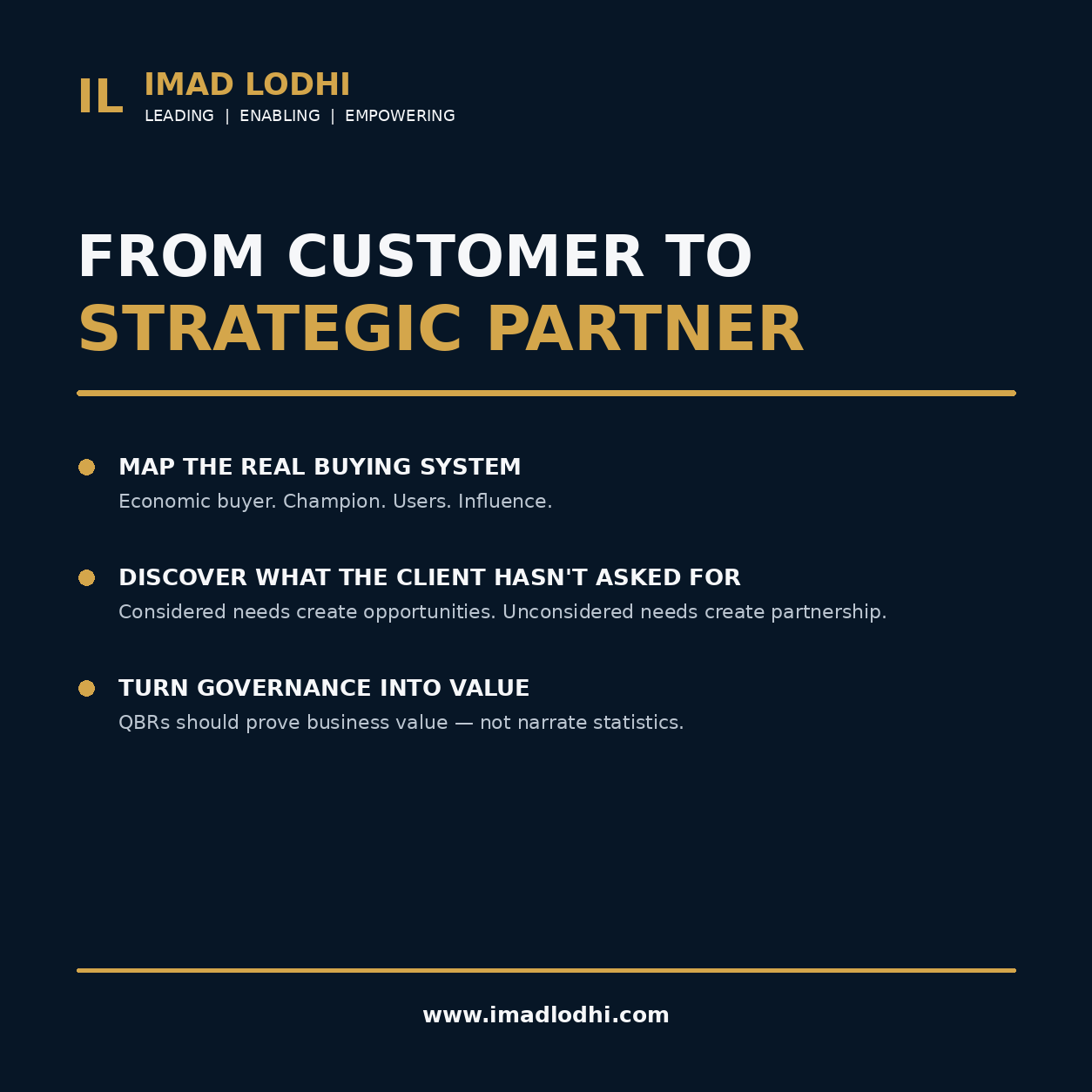
Stop reading the org chart. Start mapping power.
In a complex account, titles matter less than the roles people play in a decision.
The economic buyer can authorize the investment. The champion wants you to win and actively helps you navigate the organization. Users will live with the solution. Finance, procurement, security, technology, operations and business leaders may all influence whether an initiative moves forward.
A real champion is especially important because they sell your case when you are not in the room.
That is why stakeholder mapping is not org-chart reading. You need to understand who has authority, who has influence, who carries risk, who benefits, who can block progress and who will advocate internally.
Growth lives in considered and unconsidered needs.
A considered need is straightforward: the customer recognizes a problem and comes to you for help.
The more interesting opportunities often come from unconsidered needs.
That requires continuously studying the customer's industry, competitive landscape, business strategy and technology direction. It means watching research, market shifts and emerging technologies, then asking what those developments could mean for this specific customer.
A considered need can create an opportunity. An unconsidered need can start turning a supplier into a strategic partner.
The objective is not to manufacture problems so you can sell something. It is to bring perspective the customer finds useful.
Account planning connects their world to your capabilities.
When I went through annual client-development planning, the exercise was never simply a list of offerings we wanted to sell.
I wanted to understand the client's business metrics, priorities, technology roadmap, current environment, major initiatives and stakeholder objectives. Then I could examine our capabilities and identify where there was legitimate alignment.
The logic is simple:
Client objectives → Roadmaps → Challenges → Stakeholders → Considered and unconsidered needs → Relevant capabilities → Expansion opportunities.
Now the account plan is not asking, “What else can we sell them?”
It is asking, “Where is this organization going, what could prevent it from getting there, and where can we legitimately help?”
Your QBR should prove value, not narrate statistics.
This is where governance becomes critical.
A QBR can easily become 45 minutes of SLA charts, ticket volumes, availability percentages and project updates. Those metrics matter, but they are not the purpose of the relationship.
The stronger question is: What changed for the customer because we were here?
Operational metrics should become evidence supporting that value story.
Governance should therefore examine delivery health, contractual health, financial health, relationship health, stakeholder health, risk, innovation, value realization and the renewal or expansion trajectory.
The renewal does not begin six months before contract expiry. It starts the day after the contract is signed.
Every service review, executive interaction, escalation, improvement, innovation and business outcome contributes to the customer's eventual answer to one question:
Why should we continue—and potentially expand—this relationship?
The strategic-partner flywheel
Done well, enterprise account growth becomes a reinforcing cycle:
Deliver → Demonstrate Value → Build Trust → Gain Access → Discover → Solve → Expand → Deliver.
That is a very different mindset from simply looking for the next cross-sell.
You are building account equity.
And over time, the strongest evidence that you have moved from vendor to strategic partner is simple: the customer starts bringing you into conversations before they have decided what they need.
Key Takeaways
- Map decision roles and influence, not merely job titles.
- Distinguish considered needs from unconsidered needs.
- Build account plans around the customer's strategy and roadmaps before your offering portfolio.
- Use QBRs to demonstrate realized business value, not merely operational activity.
- Treat renewal and expansion as outcomes of the entire delivery relationship.
- Account growth is a Sales + Delivery system outcome: what was sold must become value the customer can see.
Discussion question: In your largest account, do you understand the services you sell—or do you understand where the customer is actually going?


