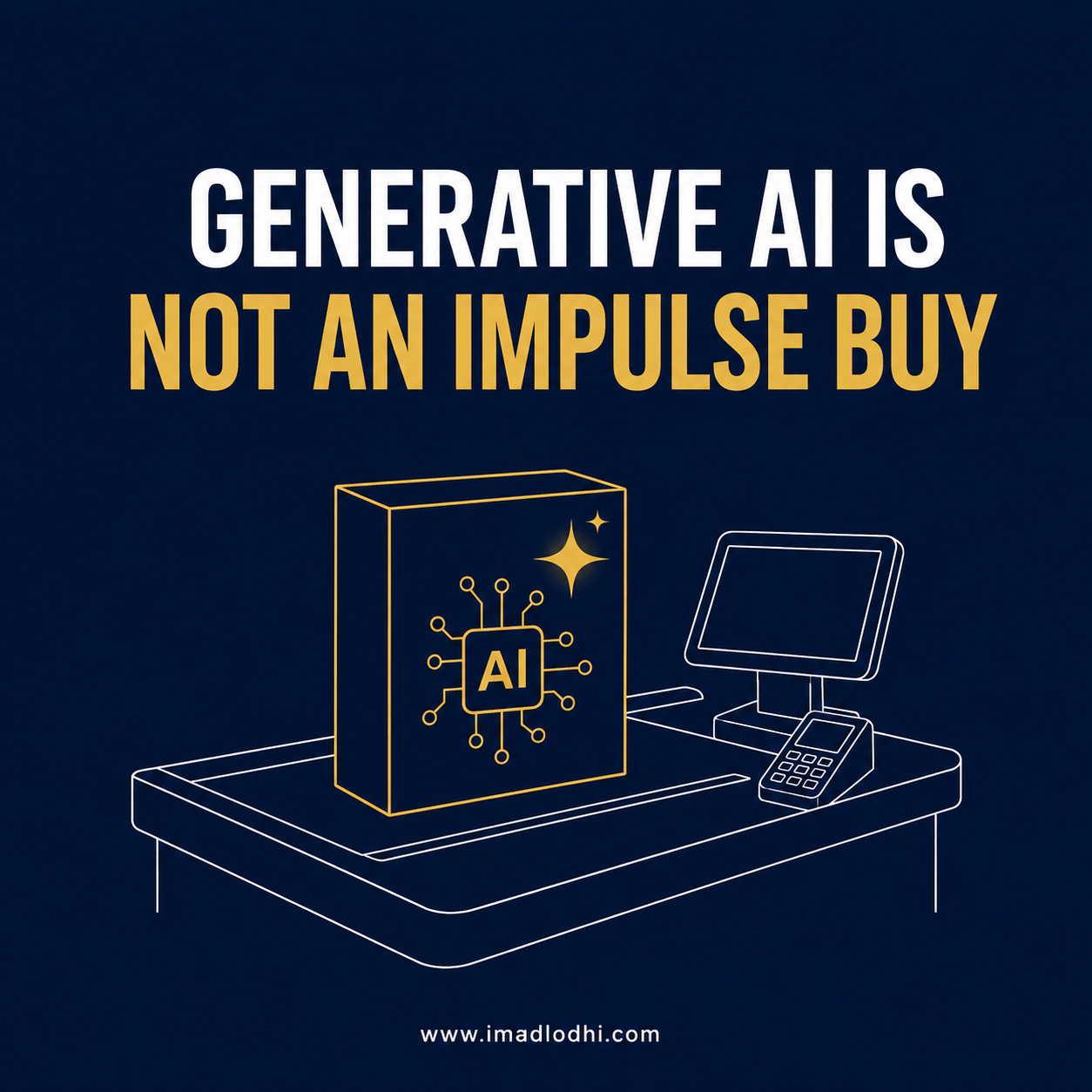
Too many organizations are purchasing the technology first—and searching for the business problem afterward.
Most organizations approach generative AI the way I sometimes shop at RONA or Home Hardware.
I walk into the store because I need something simple: a box of screws.
While waiting at the checkout, I notice a shiny new tool. It has impressive packaging and sits beside several other shiny objects. The box promises to make my life faster, easier, and more productive.
Suddenly, I am buying more than screws.
I did not enter the store with a problem requiring this tool. I saw it, became interested, and convinced myself it might be useful. When I get home, I start looking for something to do with it.
Eventually, I find—or manufacture—a use case. The result is underwhelming. It does not save enough time, solve an important enough problem, or create enough value to justify the cost.
But the investment has been made. I cannot return it. So it goes on a shelf beside other promising solutions waiting for problems that may never arrive.
This is how many organizations are approaching generative AI.
The technology comes before the problem
Organizations are investing in AI platforms, infrastructure, licences, and consulting engagements. They are hiring AI architects, data architects, machine-learning specialists, and analytics experts. They are creating centres of excellence and transformation offices.
Some investments are thoughtful and necessary. Others are driven by less strategic considerations:
- A budget must be consumed before fiscal year-end.
- An executive wants to demonstrate innovation to the board.
- A new transformation leader needs a visible program.
- Competitors have announced AI investments.
- No leader wants to appear technologically behind.
The organization buys the shiny object. Only afterward does someone ask: What problem are we actually trying to solve?
That is the wrong sequence.
Use-case hunting is not strategy
After the investment is approved, teams are told to identify use cases. Workshops are organized. Business units submit ideas. Consultants produce colourful matrices ranking opportunities by feasibility and value.
The process appears disciplined, but everyone understands the unspoken objective: find enough use cases to justify the investment already made.
The organization is no longer objectively evaluating whether generative AI is the right solution. It is trying to prove that a previous decision was correct.
Weak opportunities become strategic initiatives. Small productivity gains become “transformation.” Pilots are declared successful because the technology worked—not because the business achieved a meaningful outcome.
The question changes from “What is the best way to solve this problem?” to “Where can we insert generative AI?” Those are not the same question.
The enterprise IT example
Consider an organization that invests heavily in a generative AI platform to improve IT service delivery.
It purchases licences, builds infrastructure, and hires specialists. Then it asks the Service Desk, application teams, infrastructure teams, and service management organization to propose use cases.
The Service Desk develops an assistant that summarizes incidents. The application team generates technical documentation. The service management team automates summaries of major-incident calls.
All three capabilities work.
But summaries were never the primary constraint. The real problems were:
- Poorly documented applications
- Inaccurate configuration data
- Weak problem management
- Unclear service ownership
- Recurring incidents that were never permanently resolved
- Too many approval layers
- Inconsistent operating procedures
- Outdated knowledge articles
Generative AI does not make these problems disappear. In some cases, it makes them harder to see.
The organization can now summarize recurring incidents elegantly without preventing them. It can generate polished documentation based on incomplete information. It can produce impressive major-incident reports without addressing why the same failures continue.
The technology improves the appearance of the process while the operating model remains broken.
Employees attend workshops, support pilots, provide data, test outputs, and change workflows. Delivery capacity is diverted from operational improvements that might have produced greater value.
Eventually, adoption plateaus. Usage declines. Leaders stop mentioning the platform in quarterly updates.
The shiny object has reached the organizational shelf.
The cost is larger than the technology investment
A poorly targeted AI investment consumes more than money:
- Leadership attention
- Employee capacity
- Organizational credibility
- Change tolerance
- Data and architecture resources
- Time that could have been spent solving the real problem
It can also make employees resistant to future AI initiatives. When people repeatedly participate in poorly conceived transformations, they may conclude that transformation itself is theatre.
Start with the screw, not the shiny tool
Organizations should begin with a business or operational problem worth solving:
- Why are customers abandoning transactions?
- Why do critical incidents keep recurring?
- Why does employee onboarding take six weeks?
- Why do service agents spend 30% of their time searching for information?
- Why is revenue delayed?
- Why are operating costs increasing?
Only after understanding the problem should the organization evaluate solutions.
Generative AI may be the answer. Traditional automation may be better. The problem may require process redesign, cleaner data, clearer accountability, training, or a policy change.
Sometimes the answer may not involve new technology at all. That is not a failure of innovation. It is evidence of responsible leadership.
Lessons for managers and organizations
Before approving an AI investment, leaders should require clear answers to five questions:
- What specific problem are we solving?
- Who experiences it, and how significant is it?
- What measurable outcome should improve?
- Why is generative AI better than the alternatives?
- What must already be true about our processes, data, and operating model for it to succeed?
If those questions cannot be answered, the organization is probably not making a strategic investment. It is standing at the checkout holding a shiny object and imagining reasons to buy it.
Generative AI can create extraordinary value—but only when the organization understands what it needs to build before it goes shopping.
Key takeaways
- Buying AI before defining the problem reverses the proper sequence of transformation.
- Use-case hunting can become an exercise in justifying an investment already made.
- A technically successful pilot is not necessarily a valuable business outcome.
- AI can automate, accelerate, and even conceal broken operating practices.
- The true cost includes diverted capacity, lost credibility, and resistance to change.
- Responsible leaders begin with a measurable problem and accept that AI may not be the right answer.
Discussion question: Is your organization solving a business problem with AI—or searching for a problem that justifies its AI investment?