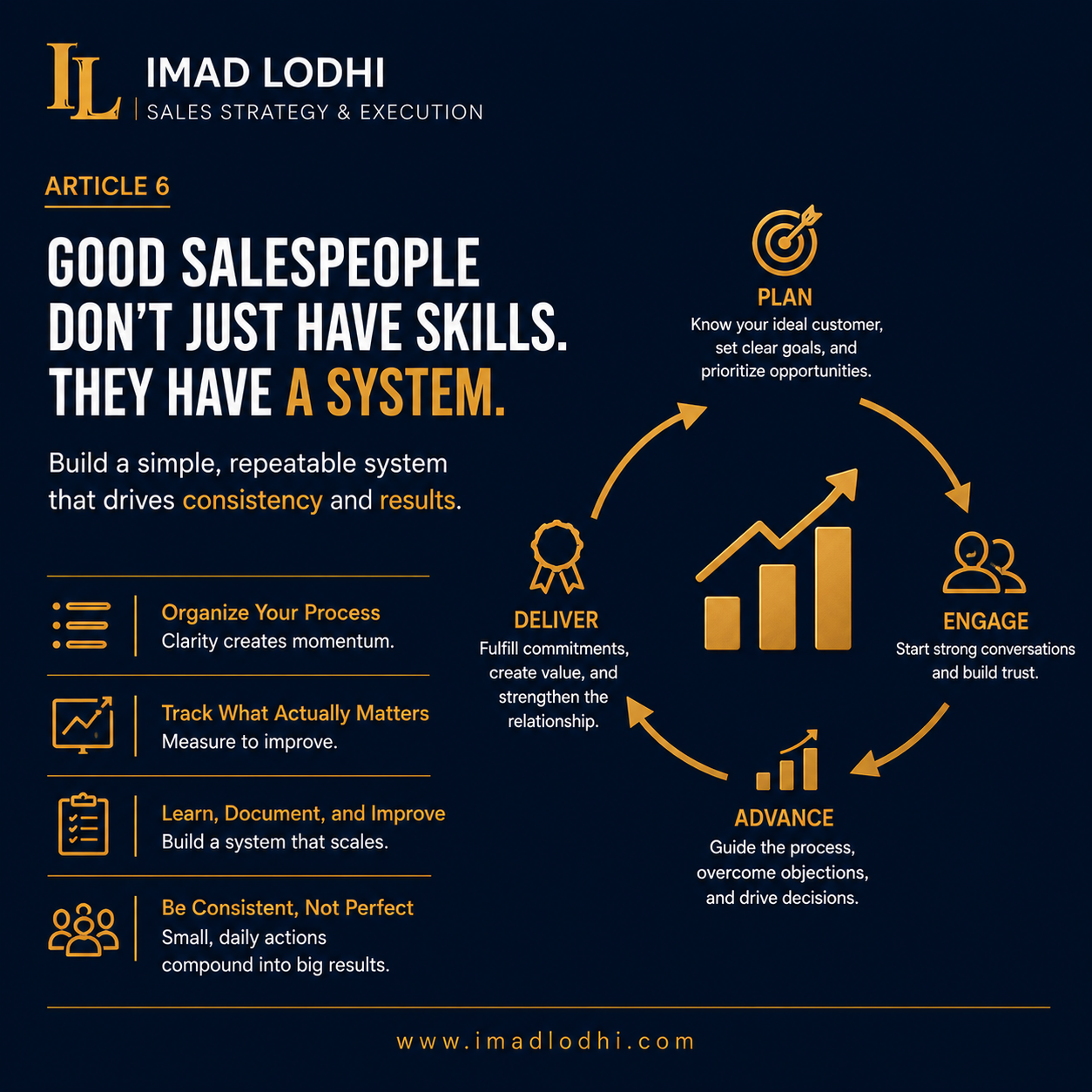
Talent can win a deal. A system helps you do it again.
We spend a lot of time talking about sales skills.
Discovery. Storytelling. Negotiation. Relationship building. Closing.
All important.
But if those skills live only inside the salesperson’s head, performance becomes difficult to repeat, difficult to coach and difficult to improve.
That is why every salesperson eventually needs a personal sales operating system.
Consistency is rarely the result of remembering to be brilliant every Monday morning.
Your CRM is not the system
Let me start there because this gets confused all the time.
A CRM is a tool inside the system. It should preserve account history, stakeholders, opportunity stages, next actions, commitments and evidence.
But filling in CRM fields does not create sales discipline.
If an opportunity sits at 70% because the salesperson feels good about it, the CRM has simply digitized optimism.
A useful pipeline should tell us what is happening with the buyer. What changed since the last review? Who has been engaged? What decision step occurred? What is the next commitment? What evidence supports the forecast?
Pipeline value is not the same thing as pipeline quality.
Build a weekly rhythm
A personal operating system starts with routine.
Protect prospecting time. Review active opportunities. Update next steps while the conversation is still fresh. Look for stalled deals. Prepare deliberately for discovery. Record what worked and what did not.
Then measure enough of the funnel to see where the problem actually is.
If meetings are low, perhaps prospecting is weak. If meetings are strong but qualified opportunities are low, perhaps targeting or discovery is the issue. If proposals are plentiful but wins are poor, perhaps qualification, value articulation, stakeholder coverage or commercial strategy needs attention.
The number tells you where to look. It does not automatically tell you why.
Turn experience into reusable knowledge
One of the biggest advantages experienced salespeople have is pattern recognition.
But pattern recognition becomes much more valuable when it is captured.
What objections keep appearing? Which discovery questions open better conversations? Which customer stories resonate with Finance? What signals usually appear before a deal stalls? What mistakes repeatedly show up in lost opportunities?
Write them down. Build your own playbook. Review wins and losses. Improve the system.
This is where AI can help as well—account research, meeting preparation, role-play, opportunity analysis and after-action review. But technology should strengthen judgment, not replace it.
Sales performance is a feedback loop
The operating model I like is simple:
Evidence → Analysis → Action → Buyer Response → Pipeline Update → Improvement.
That cycle matters because activity by itself is not the objective.
You can make 100 calls and learn nothing. You can hold ten meetings and progress no deals. You can maintain a beautiful CRM and still miss the number.
The system exists to connect behaviour to evidence and evidence to improvement.
Key Takeaways
- Build repeatable routines around prospecting, opportunity review and follow-up.
- Use CRM as an evidence system, not an administrative diary.
- Track funnel metrics to locate bottlenecks.
- Capture lessons, objections, patterns and reusable practices.
- Continuously adjust behaviour based on buyer evidence.
Good salespeople develop skills. Great sales professionals build a system that keeps making those skills better.