Generative AI does not have to replace human thinking. Used properly, it can challenge, refine and strengthen it.
A recent discussion about AI watermarking made me think about a larger question.
If generative AI helped me work through a problem, challenge assumptions, refine a strategy and summarize the discussion, is the resulting thinking mine, the AI’s, or something in between?
I personally do not have an issue with watermarking, regardless of the underlying reasons behind it. In my own work, I am already transparent about using generative AI.
But I also do not think the simple labels of human-generated and AI-generated adequately describe how many experienced professionals are beginning to use these tools.
For me, the relationship is closer to a partnership.
My process: AI as a thinking partner
My process generally looks like this:
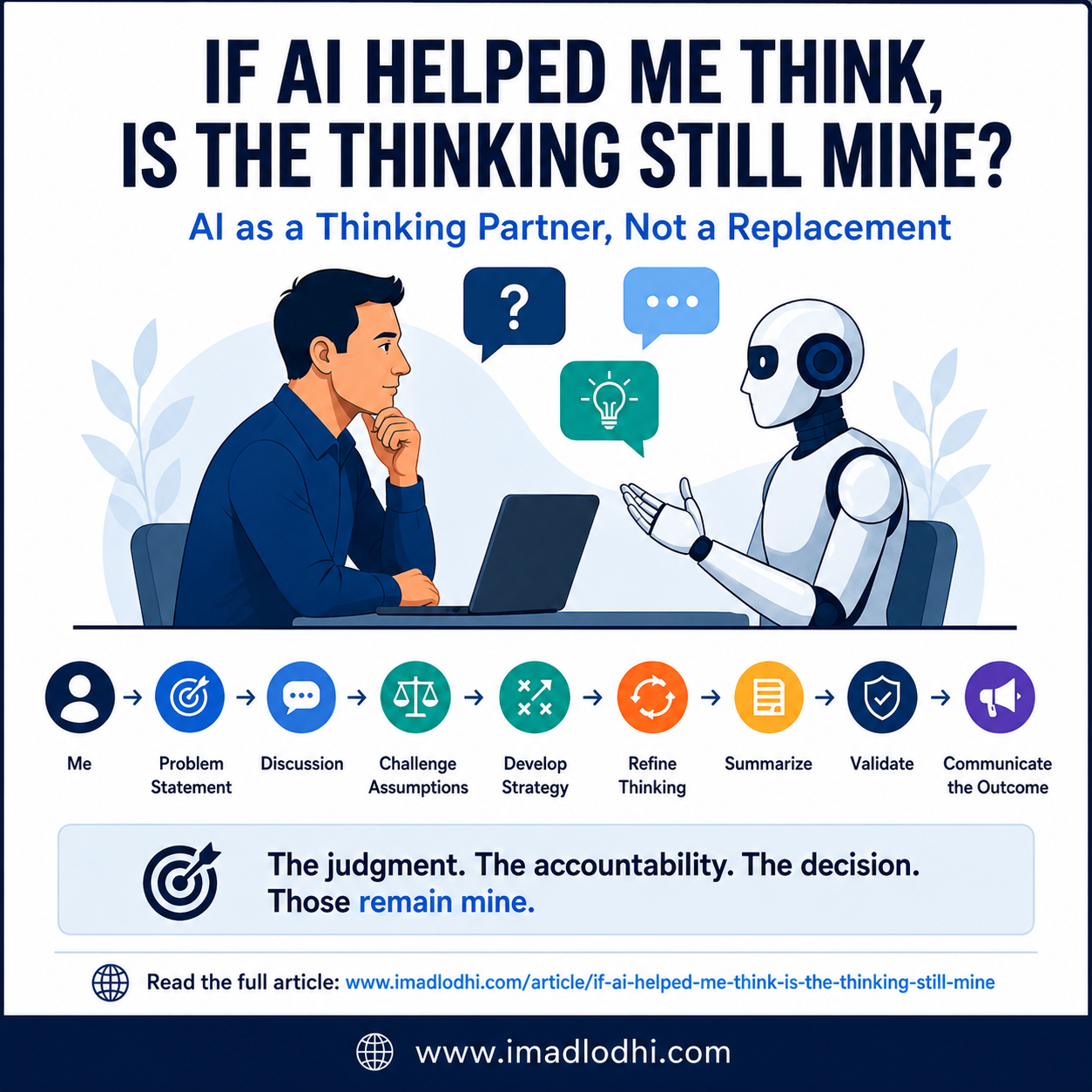
Me → Problem statement → Discussion → Challenge assumptions → Develop strategy → Refine thinking → Summarize → Validate → Communicate the outcome
I bring the problem, context, experience, constraints and organizational realities into the conversation.
I may ask the model to challenge my diagnosis. I may ask what assumptions I am making. I may present several approaches and ask it to stress-test them. I may disagree with its recommendations, introduce additional context and continue the discussion.
Eventually, I may ask it to summarize where we landed.
But the judgment remains mine. The accountability remains mine. And the decision remains mine.
That is very different from substitution
There is another workflow that looks like this:
Prompt → Generate → Copy → Paste → Send
That can create the appearance of expertise without the underlying knowledge, experience or judgment.
The difference is not whether AI touched the final document. The difference is the role the human played in producing the thinking behind it.
Consider a senior executive working through a difficult problem with their leadership team. They discuss the situation for two hours, challenge one another, evaluate alternatives and agree on a direction. Someone then summarizes the discussion into five points for communication.
We would not conclude that the executive contributed nothing intellectually because someone else prepared the summary.
Generative AI changes who—or what—can participate in that collaborative process. It does not automatically eliminate human intellectual ownership.
An IT delivery example
Imagine I am dealing with a deteriorating client account.
Critical incidents are increasing. SLA performance is slipping. The client is frustrated. Application and infrastructure teams disagree about the root causes. Delivery costs are rising. The account team wants an immediate recovery plan.
I could ask an AI model: “Give me an account recovery strategy.”
That would be delegation.
Or I could use it differently.
I explain what I am seeing and ask it to challenge my diagnosis. I provide SLA trends, incident themes, stakeholder concerns and organizational constraints. I ask what assumptions I may be making. I describe what the application team believes, what infrastructure believes and what the client believes.
Then I ask: What questions have I not asked?
I develop three possible recovery approaches and ask the model to stress-test them. What could fail? What unintended consequences could option two create? What dependencies am I underestimating? What would the client challenge?
I reject recommendations that do not fit the environment. I develop others further. I introduce experience from similar situations.
Eventually, I ask the model to summarize the strategy we have developed.
That is not AI replacing 25 or 30 years of experience. It is technology helping me interrogate and organize that experience more effectively.
The leadership imperative
This distinction matters for managers.
AI does not remove accountability from the leader. If anything, it can increase a leader’s capacity to think—provided the leader is capable of critically evaluating what the technology produces.
An experienced leader can use AI to expose blind spots, test assumptions and explore alternatives faster.
An inexperienced user can use the same technology to produce a very convincing explanation of something they do not actually understand.
The technology is identical. The human capability surrounding it is not.
Transparency should not be threatening
When I communicate work developed with the assistance of generative AI, I am comfortable telling my teams that I use the available technology to supplement and complement my experience and thinking.
I do not see that disclosure as diminishing the work.
We routinely use spreadsheets to model financial decisions, analytics platforms to identify trends, search engines to find information, presentation software to communicate ideas and teams of people to challenge our thinking.
Generative AI is another capability in that toolkit—albeit a particularly powerful one.
This is why the watermarking debate raises a more interesting question than whether something was “made with AI.”
What exactly did the AI contribute?
Did it originate the thinking? Did it edit the language? Did it summarize a human discussion? Did it challenge assumptions? Did it organize ideas? Did it help explore alternatives?
Those are materially different forms of contribution.
Lessons for managers and organizations
- Distinguish augmentation from substitution. Using AI to challenge and strengthen thinking is different from outsourcing the thinking itself.
- Keep human accountability explicit. The person making the decision remains responsible for validating the information and consequences.
- Teach people how to challenge AI. Effective use requires questioning outputs, adding context and recognizing when recommendations do not fit reality.
- Value domain experience more, not less. AI becomes more useful when the person interacting with it knows enough to identify weak reasoning.
- Be transparent. Organizations should normalize responsible disclosure rather than treating AI use as something employees need to conceal.
Key takeaways
- AI-assisted work is not automatically AI-owned thinking.
- Intellectual contribution depends on the process, not merely the tool used to produce the final words.
- Generative AI can function as a thinking partner that challenges assumptions and accelerates iteration.
- Human validation, judgment and accountability remain essential.
- The dangerous workflow is not AI involvement; it is uncritical prompt-generate-copy-paste decision making.
If I bring decades of experience to a problem, spend an hour working through it with AI, challenge its recommendations, reject some, develop others, validate the conclusion and remain accountable for the decision—who did the thinking?
Perhaps the better question is not whether AI was involved.
Perhaps it is whether the human remained meaningfully in the loop.