Let me describe a familiar talent discussion.
Someone says, “We need more diverse voices in leadership.” Everyone agrees.
Then a visible assignment comes up, and the work goes to the same person who handled the last three visible assignments.
The reason usually sounds responsible: “We need someone proven.”
But there is a trap in that thinking.
The people we call proven are often the people we have repeatedly given the chance to prove themselves.
That is not always a talent problem. Sometimes it is an opportunity problem.
We can confuse polish with potential. Polish often comes from exposure: being in the room, presenting to senior leaders, making decisions, recovering from mistakes, and receiving useful feedback.
If someone has never been given those experiences, we should not be surprised when they do not yet look like the person who has.
This matters beyond fairness. When every critical assignment goes to the same trusted few, those people become overloaded, the broader team stops growing, and the organization creates the very succession gap it later complains about.
There is a practical human-behaviour insight here. Confidence in a specific capability is strengthened through mastery experiences—actually doing progressively challenging work and learning from it. Encouragement helps, but encouragement without opportunity eventually becomes a promise the employee cannot use. This reflects Albert Bandura’s foundational work on self-efficacy.
That does not mean throwing someone into the deep end and calling it empowerment.
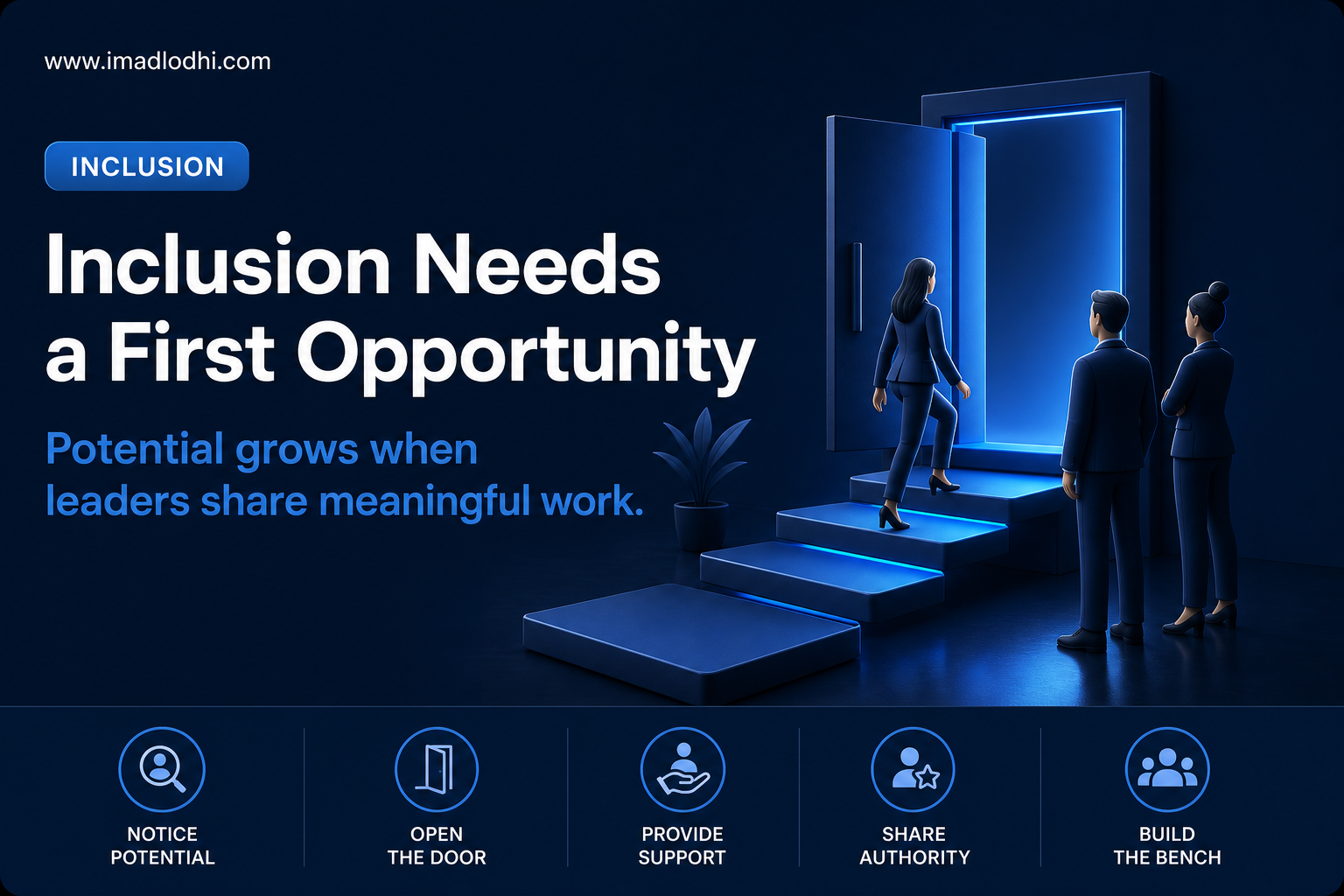
It means giving real responsibility with clear outcomes, sensible guardrails, access to context, a sponsor who will open doors, and checkpoints that support learning without taking the work back.
Faith in people is not the absence of standards. It is the disciplined choice to see capacity before the proof is complete—and then help someone build that proof.
So, for the next visible assignment, ask a different question.
Not only, “Who has done this before?”
Also ask, “Who could do this well if we gave them the opportunity and the right support?”
Who on your team may be ready for a first opportunity, but keeps losing it to someone who already has a fourth?
For more reflections on leadership, enablement, and helping people succeed, visit https://www.imadlodhi.com.
#Leadership #Inclusion #EmployeeEmpowerment #EmployeeEnablement #Mentoring #WorkplaceCulture #OrganizationalEffectiveness