Let’s stop pretending this doesn’t happen.
Almost every organization has one employee who seems to operate under a completely different employment contract from everyone else.
They miss deadlines. Dodge responsibility. Create extra work. Ignore processes. Behave in ways that would get somebody else hauled into a performance discussion.
And somehow? Nothing happens.
Protected. Excused. Accommodated. Again and again.
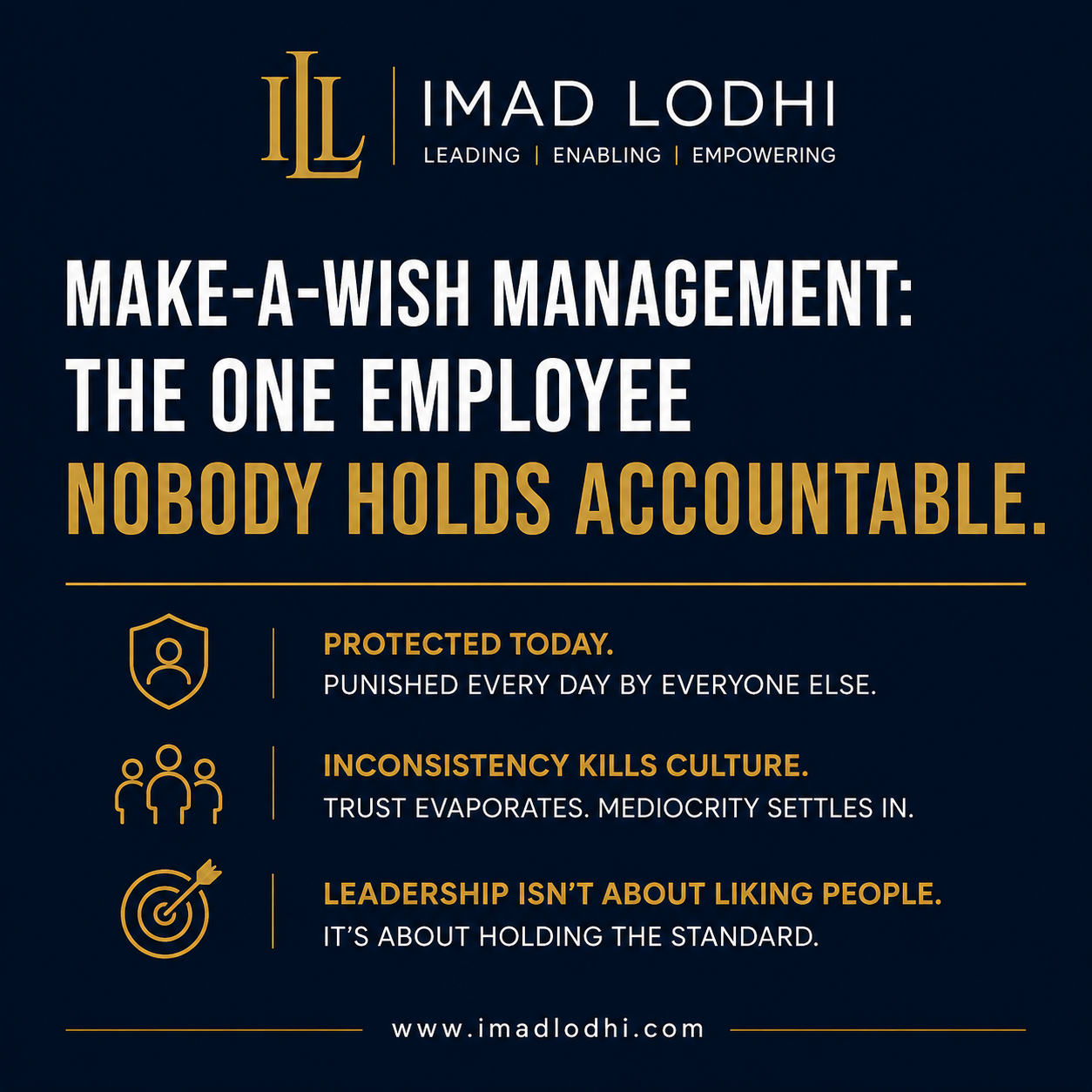
The fastest way to destroy accountability is to demonstrate that accountability is selectively applied.
Here’s the part leadership often misses: when you protect one person from reasonable consequences, you are not protecting one employee. You are punishing everybody who has to compensate for them.
The reliable employee gets another task. The strong performer fixes another mess. The manager who actually enforces standards becomes the bad guy. And the rest of the team watches the theatre and learns the real organizational rules.
Not the ones in the policy manual. The real ones.
Performance matters — unless you are protected. Deadlines matter — unless yours don’t. Behaviour matters — depending on who you are.
People can tolerate a demanding workplace. What destroys them is a workplace where the rules depend on who is standing in front of them.
Then leadership acts surprised when engagement drops.
Why wouldn’t it?
Your best people are not stupid. They can see when mediocrity is being subsidized by their effort.
Eventually they stop volunteering. They stop stretching. They stop caring. Or they leave.
Meanwhile, the protected employee learns the worst possible lesson: there is no reason to change.
This isn’t compassion. It isn’t employee engagement. And it certainly isn’t leadership.
It is management cowardice disguised as accommodation.
Good leadership does not mean treating every employee identically. Circumstances matter. Support matters. Context matters. But fairness requires that expectations remain explainable, consequences remain credible, and nobody becomes organizationally untouchable.
Protect the person when they genuinely need support.
Protect the standard when the organization needs leadership.
Know the difference.