AI Has a Credibility Problem
I keep having conversations with intelligent, capable business people who are genuinely interested in AI. Healthcare professionals. Managers. Entrepreneurs. Operations people.
And the same question keeps coming back:
How does AI actually help me?
Not: What is an LLM? Not: What is RAG? Not: How many tokens does a model consume? Not: What is the latest agentic framework?
They want to know how AI helps them diagnose more thoroughly, schedule people better, anticipate customer demand, consolidate fragmented information, reduce waste, improve decisions, increase revenue or lower operating costs.
And far too much of the enterprise AI conversation still cannot answer those questions without retreating into jargon.
If your AI strategy cannot be explained to the people running the business, you do not have an AI strategy. You have a technology presentation.
AI Leadership Is Not About Knowing the Most Acronyms
I do not believe the person leading enterprise AI needs to be a Python developer, data scientist or machine-learning engineer.
But I do believe they need credible experience applying technology to real business problems.
If an organization is going to hand someone millions of dollars to lead an AI transformation, it is reasonable to ask: Where have you done this before? Where have you taken a business problem, understood the operation, applied technology, changed the workflow and demonstrated measurable value?
Theoretical knowledge matters. Technical literacy matters. But leadership credibility comes from application.
I do not need the person teaching me to fly to have designed the aircraft. I would, however, be concerned if they had never flown one.
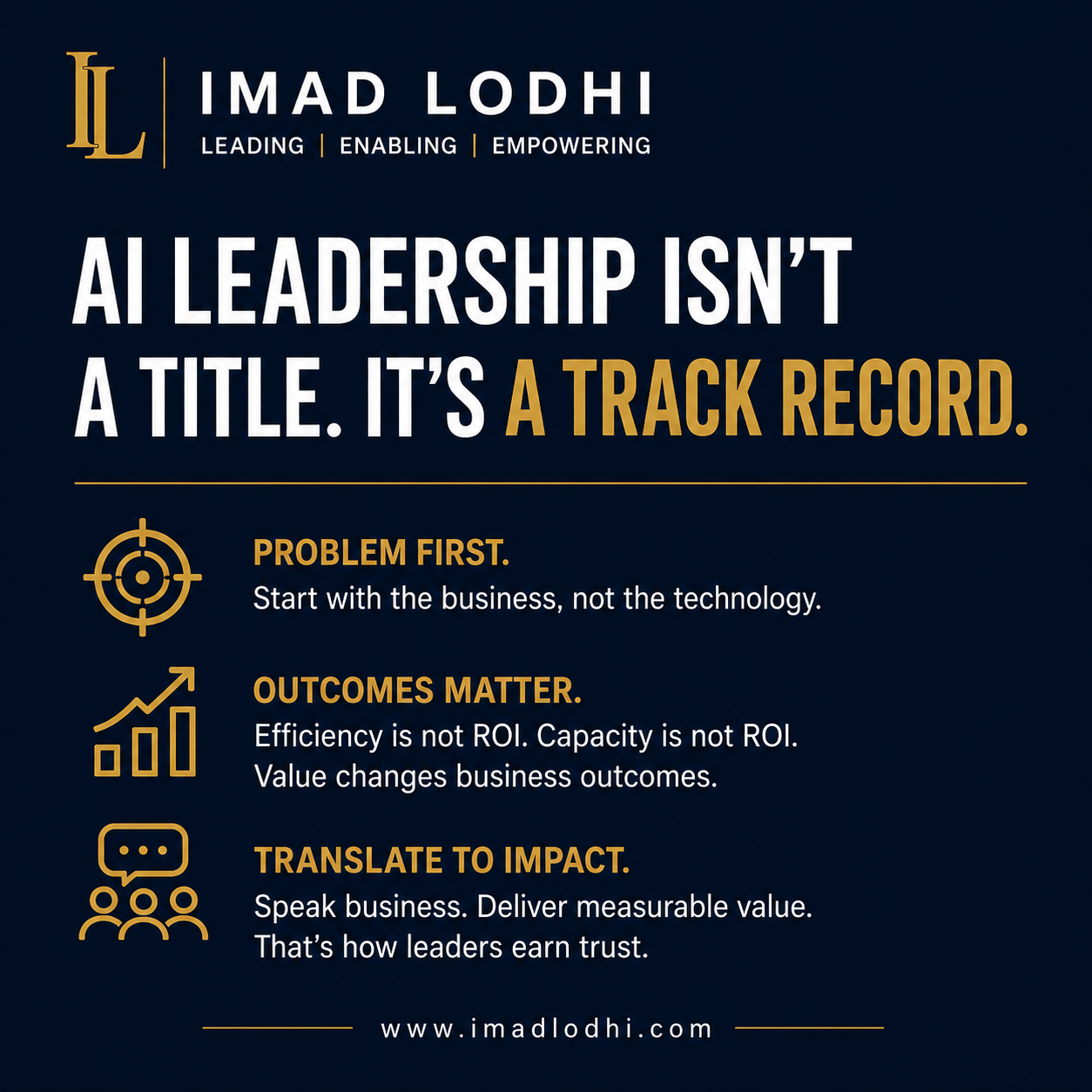
Efficiency Is Not ROI
This distinction becomes especially important when organizations start celebrating AI productivity statistics.
Suppose an AI coding assistant reduces a six-hour development activity to four hours. That sounds impressive: a 33 percent productivity improvement.
But what happened to the two hours?
If the developer is salaried, no headcount is avoided, no additional work is delivered, no backlog is reduced, no release moves earlier and no revenue changes, the organization may have created capacity without creating measurable economic value.
Efficiency is not ROI. Capacity is not ROI. AI usage is certainly not ROI.
Capacity becomes valuable when it changes an outcome: more releases with the same workforce, avoided hiring, reduced contractor expense, faster time to market, increased revenue, improved service levels or reduced operational risk.
That is the business conversation AI leaders need to be able to have.
Stop Starting With AI
Walk into an operation and ask people to show you their work.
Where are people repeatedly searching for information? Where are they making repetitive decisions? Where are they manually moving information between systems? Where are they trying to predict demand? Where are errors occurring? Where are customers waiting? Where is expensive human capacity being consumed by low-value work?
Now we have something useful to discuss.
The solution might involve generative AI. It might involve predictive analytics, optimization, workflow automation, an agent, conventional software or simply fixing a terrible process.
That last possibility seems to get forgotten surprisingly often.
Before we obsess over the economics of every token, demonstrate that the business outcome produced by the entire AI investment was worth more than what we spent producing it.
The Missing AI Leadership Competency
Enterprise AI leadership sits at the intersection of several disciplines: business acumen, operational experience, transformation experience, AI literacy, governance and communication.
Technology tells us what is possible. Operations tells us where it can be applied. Business acumen tells us whether it is worth doing. Leadership gets people from the current state to the future state.
Remove any one of those and the transformation becomes significantly harder.
Perhaps we have spent too much time trying to teach business leaders how to speak the language of AI.
Maybe it is time for AI leaders to become much better at speaking the language of business.
Key Takeaways
- AI leadership does not require deep engineering expertise, but it does require credible applied transformation experience.
- Technical productivity improvements are not automatically business ROI.
- AI investments should begin with operational problems and measurable outcomes, not technology capabilities.
- Enterprise AI leaders must translate between technology, operations and business economics.
- The ultimate question is simple: What changed in the business, what was it worth, and what did it cost?


