I’ve been running a little experiment on myself for the last few days.
I started wearing a continuous glucose monitor.
At first, it was easy to become fascinated by the numbers.
5.8. 7.1. 9.0.
But pretty quickly I realized: the individual numbers weren’t nearly as interesting as the behaviour of the system.
What happens when I eat rice? How quickly does the number rise? Does it stay elevated? Does it crash afterward? What happens if I eat vegetables first? What happens after exercise?
And here’s where my IT brain kicked in. 😂
This is exactly what we do wrong with technology, data and analytics all the time.
We collect enormous amounts of data. We build dashboards. We establish KPIs. We add AI. Then everyone sits around staring at numbers.
But data without context doesn’t tell you very much.
The problem is not the number
My spinach-and-feta wrap is a great example.
I ate essentially the same thing a few days apart. Different glucose response.
So the question isn’t simply: “What number did the food produce?”
The better questions are: What was happening before the event? What changed? What other variables were present? What pattern followed? And does that behaviour repeat?
That’s process behaviour analysis.
And that’s also how I think organizations should approach AI and analytics.
Start with the problem
Start with the problem.
Use technology to create visibility.
Turn visibility into data.
Turn data into patterns.
Turn patterns into insight.
And then use those insights to make better decisions.
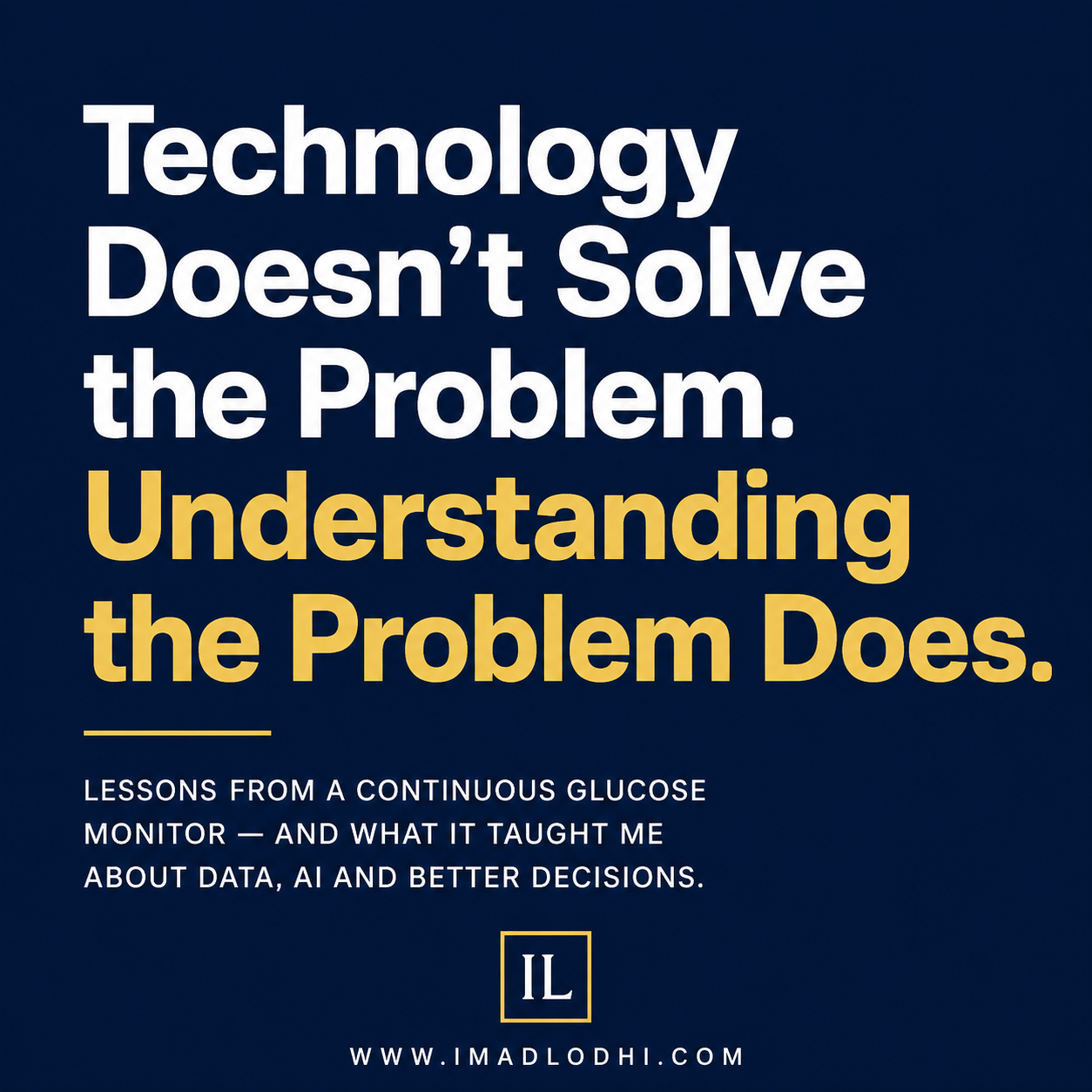
The CGM isn’t solving anything for me. It’s a sensor.
The value comes from understanding what the sensor is telling me and changing my decisions accordingly.
The same applies to AI.
The technology is rarely the business outcome.
Better decisions are.
Key takeaway
Before investing in another dashboard, analytics platform or AI solution, ask a very simple question:
What decision will we be able to make better because of it?
If nobody can answer that, you may be collecting data rather than creating value.