Available hours mean little when critical skills and judgement are missing.
I have reviewed capacity plans that looked reassuring.
The work required twelve people. Twelve people had been assigned. The spreadsheet showed names, roles, utilization and start dates. Every position was filled.
Then delivery began.
Two people understood the customer environment. One had the authority to make the difficult decisions. Several were still learning the technology. The person everyone depended on was split across three accounts.
The capacity plan was accurate.
The capability was not there.
A person on a plan is not the same as a capability in the operation.
This distinction is easy to lose when Sales, Delivery and Operations are working under pressure.
Sales needs confidence that the organization can fulfil the promise. Delivery needs enough people to mobilize. Operations needs coverage across shifts, customers and services. Finance needs a model that explains cost.
Headcount becomes the common language because it is easy to count.
But customers do not experience headcount.
They experience whether the team can diagnose the problem, exercise judgement, coordinate across boundaries, communicate with credibility and recover when the plan meets reality.
Ten available people may still represent only one person who can approve a change, calm a difficult customer or recognize that a technical symptom is pointing to a wider service failure.
That is not a small planning error.
It is an operating risk disguised as staffing.
I have also seen the opposite problem. Organizations protect the same experienced people because the work is too important to give anyone else. Those experts become permanently overloaded while the rest of the team never develops the capability the operation keeps claiming it has.
The immediate risk is delivery failure.
The longer-term risk is dependency.
A sensible capability plan should answer more than “How many people do we have?”
It should make clear what outcomes the work requires, which skills and decision rights are essential, where judgement must sit, how much of the capability is concentrated in one person and how the next layer will be developed.
That does not mean every assignment needs a complicated skills matrix.
It means management must stop treating interchangeable hours as proof of readiness.
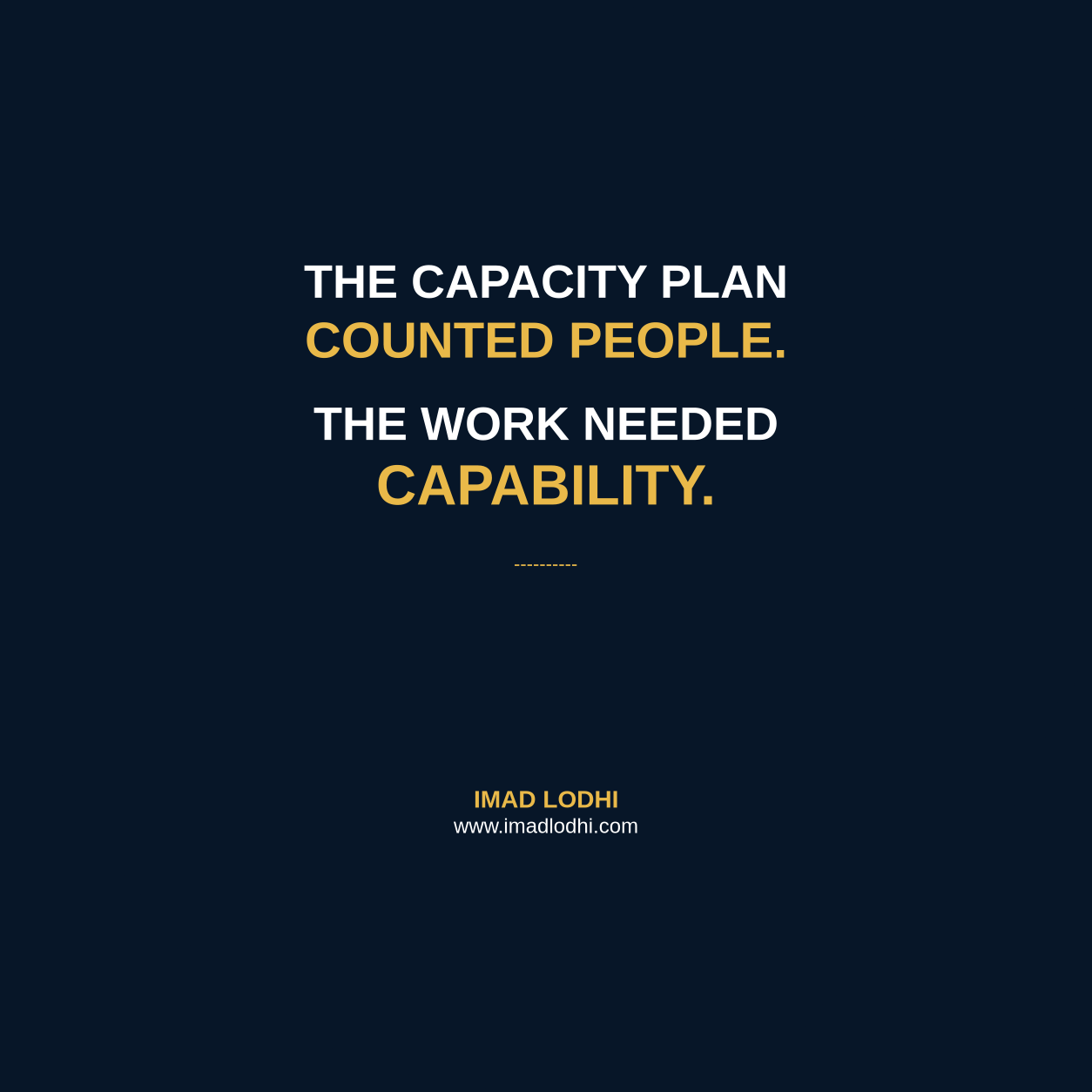
Capacity tells you whether people are available. Capability tells you whether the outcome is credible.
This is where the management systems connect.
Roles should define accountability and decision authority, not just job titles. Processes should expose the points where specialist judgement is required. Tools should support the work without becoming a substitute for experience. Meetings should test readiness and dependency honestly. Reporting should show skill coverage, concentration and intervention—not only utilization. Analytics should identify where work repeatedly waits for the same few people. Continual improvement should turn those dependencies into development, redesign or automation priorities.
The purpose is not to slow every commitment until the perfect team exists.
Most operations will always contain gaps.
The purpose is to know which gaps can be managed, which must be closed and which should change the promise before the customer discovers them.
A capacity plan can tell leadership that the seats are occupied.
A management architecture tells leadership whether the work can be delivered.
If your staffing plans look complete while execution still depends on a handful of people, The 7 Essential First-Line Management Systems offers a practical way to examine the roles, measures and improvement mechanisms behind real operational capability. You can find it at www.imadlodhi.com/flm1.