You know the announcement.
“Good news. They’re back Monday.”
The calendar is updated. Access is restored. A welcome message is prepared. Then the person returns to the same meeting load, the same deadlines, and the same escalation pattern—only now squeezed into reduced hours.
Here is the uncomfortable truth: a return date tells you when someone is coming back. It does not tell you whether the work has been made workable.
Returning to Work Is Not Returning to Everything
Consider this explicitly hypothetical IT-delivery example.
A delivery manager returns after an approved health-related leave through a phased schedule. Their hours are temporarily reduced, but their portfolio is not. They are again assigned three concurrent releases, daily client calls, team approvals, and overnight escalation coverage. Colleagues are told to “be supportive,” yet no decision is made about which responsibilities will move.
The issue is not whether anyone can infer a diagnosis. They cannot. The observable problem is that the organization reduced time without reducing the demands placed inside it.
The Canadian Centre for Occupational Health and Safety describes return to work as a collaborative process for finding meaningful, suitable work after injury or illness. Its guidance says the process should focus on functional abilities rather than diagnosis, protect medical confidentiality, consider the demands and conditions of the job, and monitor the plan.
The World Health Organization describes return-to-work programmes as combining work-directed support—such as reasonable accommodation or phased re-entry—with appropriate clinical care. Its broader policy guidance emphasizes that these are multi-component, individualized arrangements requiring coordination and regular review. This does not mean every person needs the same plan, or that a manager should direct healthcare. It means work cannot be treated as a fixed object while the individual is expected to do all the adapting.
Ontario Human Rights Commission guidance similarly centres dignity, individualization, and full participation. A standard template may help organize a process, but it cannot replace attention to the person’s actual restrictions, essential duties, and circumstances. Case-specific rights and obligations require qualified review.
Three Leadership Actions
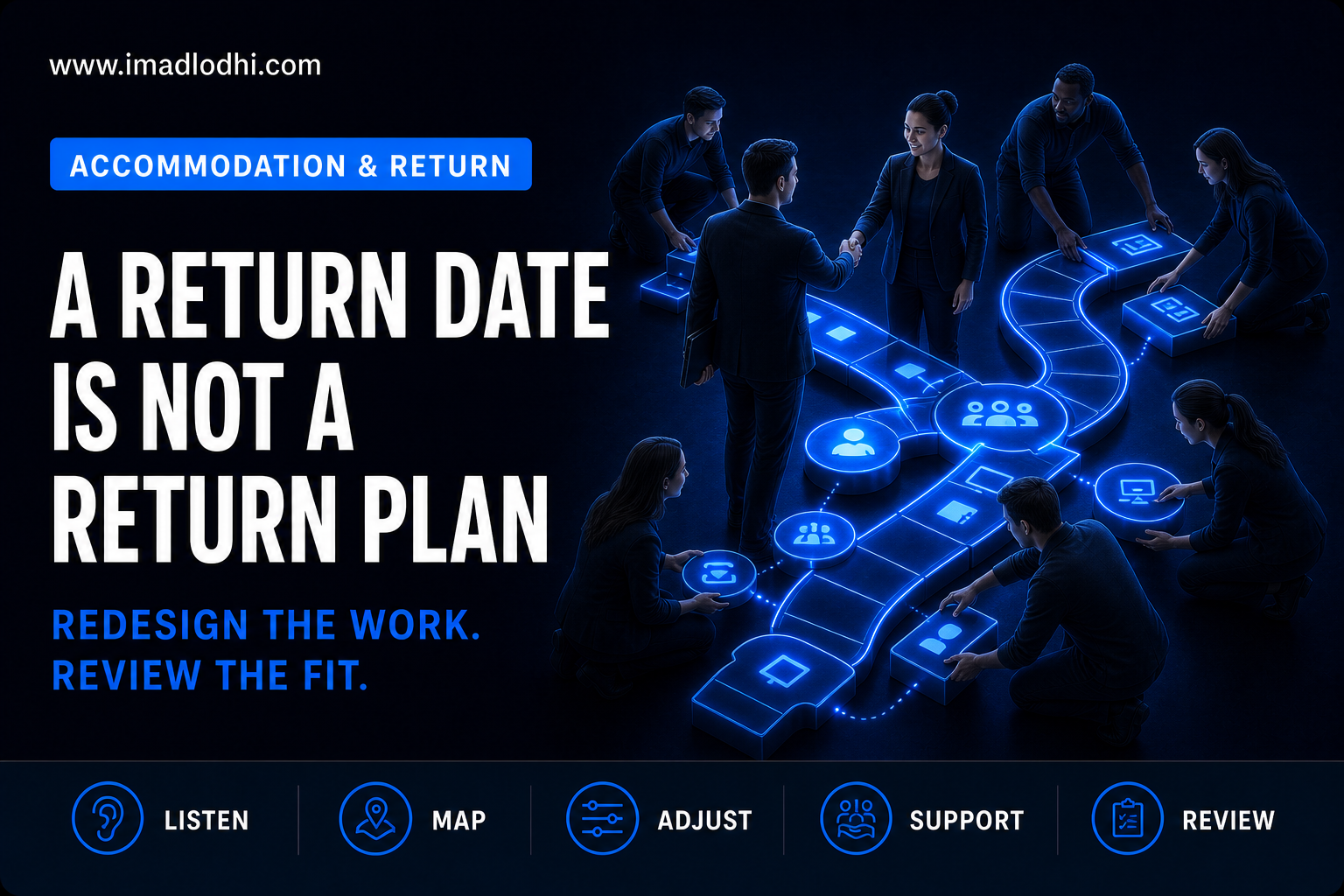
1. Map the work before the return.
Identify essential duties, current demands, deadlines, meeting load, travel, escalation coverage, and decision pressure. Ask what work-related support is needed through the proper confidential process. Do not seek unnecessary diagnostic or treatment details.
2. Make the trade-offs visible.
If hours, duties, pace, or exposure are changing, name what will be reassigned, deferred, or removed. A reduced schedule with a full workload is not a phased return. It is compression.
3. Review the fit, not the person.
Set agreed check-in points. Examine whether the work arrangement is functioning and adjust it collaboratively. Managers can discuss duties, observations, and support; healthcare belongs with qualified professionals, while formal accommodation belongs in the governed organizational process.
Individual support matters. Organizational responsibility is different: leaders control job design, priorities, coverage, confidentiality, and whether an agreed plan exists beyond the calendar entry.
Three Takeaways
- A welcome back is not a work redesign.
- Reduced hours require explicit workload decisions.
- Review the arrangement without turning the employee into the problem.
Discussion question: When someone returns, does your organization change the work—or only the date beside their name?