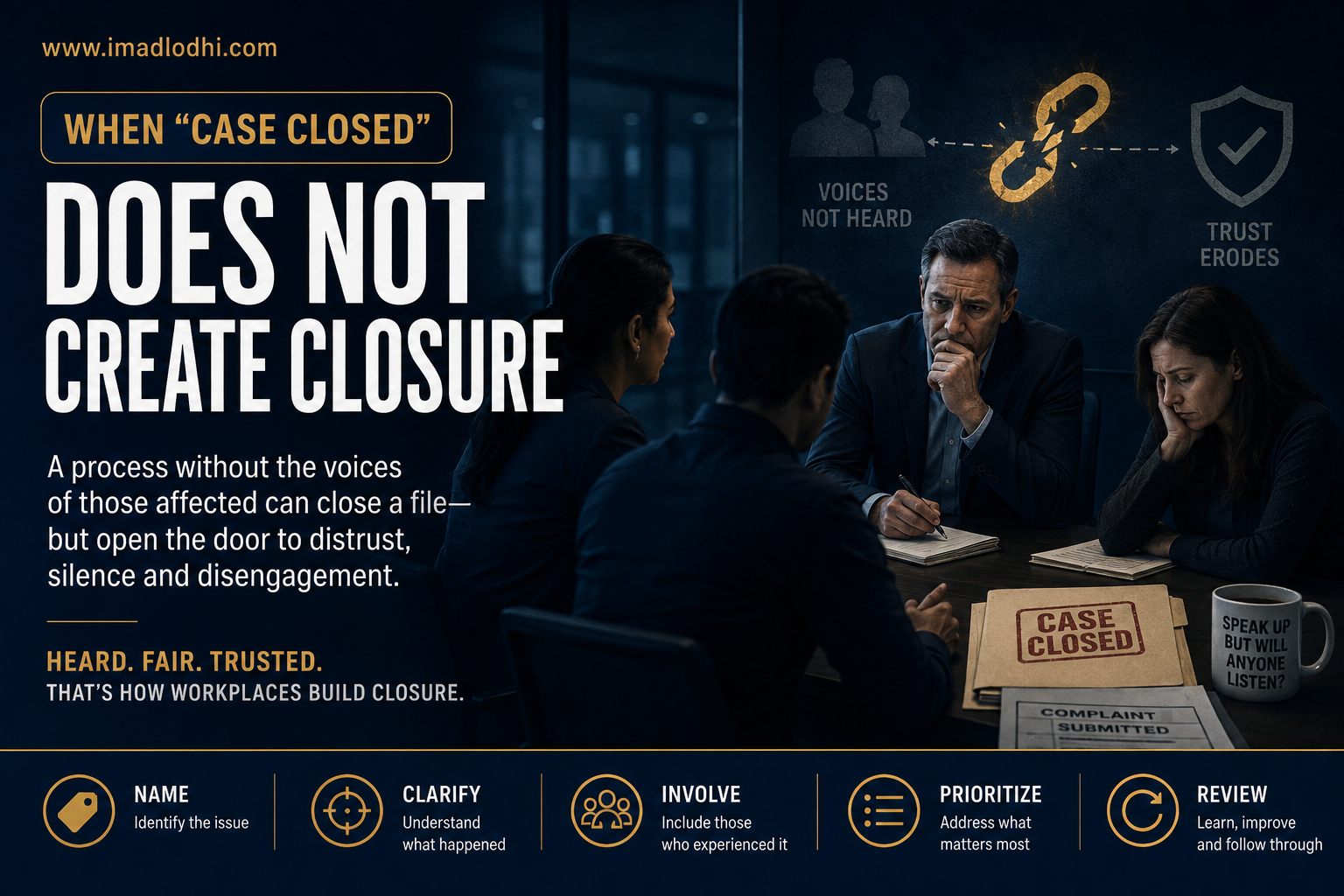
An investigation may complete a process, but if the people who raised the concerns are never heard, it may never restore trust.
Organizations encourage employees to speak up when they experience intimidating, disrespectful or inappropriate behaviour. Managers are expected to listen, document concerns and escalate them through the appropriate channels.
But reporting a concern is only the beginning.
What happens next determines whether employees continue to trust the organization—or decide that remaining silent is the safer option.
A workplace investigation does not need to validate every allegation. Fairness requires listening to the person responding to the complaint as well. However, a process becomes difficult to view as credible when the people who reportedly experienced the behaviour are never asked what happened.
A file may be closed.
The organizational issue may not be.
An IT Delivery Example
Imagine a Service Desk supporting a large, business-critical environment.
Over several months, multiple analysts independently approach their manager about interactions with a stakeholder from another technology team. They describe meetings where they are interrupted, spoken down to and publicly challenged before the facts surrounding incidents are fully understood.
Rather than reaching conclusions, the manager documents the reported behaviours, looks for patterns and escalates the concerns through the organization’s established process.
The reviewing function interviews the manager and the stakeholder.
The analysts who reportedly experienced the behaviour are not interviewed.
Weeks later, the investigation concludes there is insufficient evidence to substantiate the allegations. The findings also suggest that communication practices within the Service Desk may have contributed to the conflict.
Administratively, the process is complete.
Operationally, the consequences are only beginning.
The analysts quietly conclude that speaking up does not necessarily mean being heard. The manager begins questioning whether advocating for employees creates personal risk. Future concerns become less likely to be reported, meetings become quieter, and silence is mistaken for improved collaboration.
Over time, employees stop challenging questionable decisions, fewer risks are escalated early, experienced staff begin looking elsewhere and service quality gradually declines—not because technical capability has changed, but because trust has.
The Evidence Paradox
There is an important difference between these two conclusions:
We examined the available firsthand evidence and could not substantiate the allegation.
And:
We did not obtain firsthand accounts and therefore found insufficient evidence.
They may sound similar in an executive summary, but they describe very different investigative processes.
An absence of evidence does not automatically support an allegation.
Nor does it automatically disprove one.
When the people who reportedly experienced or witnessed the conduct are never interviewed, the conclusion may reflect the evidence collected rather than all the evidence that could reasonably have been gathered.
A credible investigation should not begin with a predetermined outcome. It should seek relevant firsthand accounts before reaching one.
Why Employees Stop Speaking Up
Reporting workplace concerns involves professional and personal risk.
Employees may worry about damaging relationships, harming their reputation or becoming the focus of unwanted attention. When they decide to speak anyway, they are testing whether the organization is psychologically safe.
If the process leaves them feeling unheard—or responsibility appears to shift toward those who reported the concern—they may conclude that silence offers greater protection than honesty.
The result is often not open resistance.
It is quiet disengagement.
Lessons for Managers
Managers should:
- Document specific behaviours, dates and operational impacts.
- Separate observed facts from assumptions.
- Encourage employees to provide firsthand accounts.
- Confirm how concerns will be assessed and who will be interviewed.
- Maintain factual records throughout the process.
- Continue protecting employees from retaliation while allowing the investigation to remain impartial.
Supporting employees does not require accepting every allegation as fact.
It requires ensuring their experiences receive fair consideration.
Lessons for Organizations
Trustworthy investigations should include:
- Interviews with relevant complainants and witnesses.
- Clear separation between allegations, evidence and findings.
- Procedural fairness for everyone involved.
- Protection against retaliation.
- Sufficient communication to demonstrate procedural integrity while respecting confidentiality.
Organizations should also resist confusing administrative closure with organizational closure.
A file may be closed.
The employees still have to return to the same meetings, relationships and workplace the next morning.
Key Takeaways
- Completing an investigation is not the same as creating closure.
- Employees who experienced the reported conduct are important sources of evidence.
- An unsubstantiated allegation is not necessarily a false allegation.
- Psychological safety depends as much on how concerns are handled as on encouraging employees to report them.
- A quieter workplace is not always a healthier one. Sometimes people have simply learned that remaining silent feels safer than speaking up.