You know the town hall.
The slide deck is polished. The transformation has a confident name. Leaders explain where the company is going, thank everyone for their flexibility, and promise more information soon.
Then the meeting ends, and the real questions begin.
Does my role still exist? Which deadline still matters? Who now makes the decision? What should my team stop doing?
Here is the uncomfortable truth: an organization can communicate constantly and still leave people without clarity.
Change communication is not measured by how many messages leaders send. It is measured by whether people can understand what the change means for their work.
Uncertainty Becomes Part of the Job
Consider this explicitly hypothetical IT-delivery example.
A company combines two technology portfolios. Leaders announce the new structure, but reporting lines remain unsettled. Product owners and delivery managers receive overlapping direction. Existing commitments stay in place while new priorities arrive. Teams spend hours reconciling instructions because nobody knows which decision has authority.
No diagnosis belongs in this story. The visible issue is work design: unclear roles, conflicting demands, weak decision rights, and limited influence over changes that affect daily work.
The Canadian Centre for Occupational Health and Safety identifies clear leadership and expectations, involvement and influence, and workload management among the psychosocial factors organizations should examine. It also advises workplaces to prioritize controls that address the source of a hazard and to communicate how changes may affect employees.
The World Health Organization similarly recommends organizational interventions that assess and modify psychosocial risks. Its guidance includes participatory approaches, while noting that the certainty of evidence for this recommendation is very low. That limitation matters. Participation is not a magic shield against every difficult reaction to change. But it is a disciplined way to learn what leaders may not see from the executive floor.
Three Leadership Actions
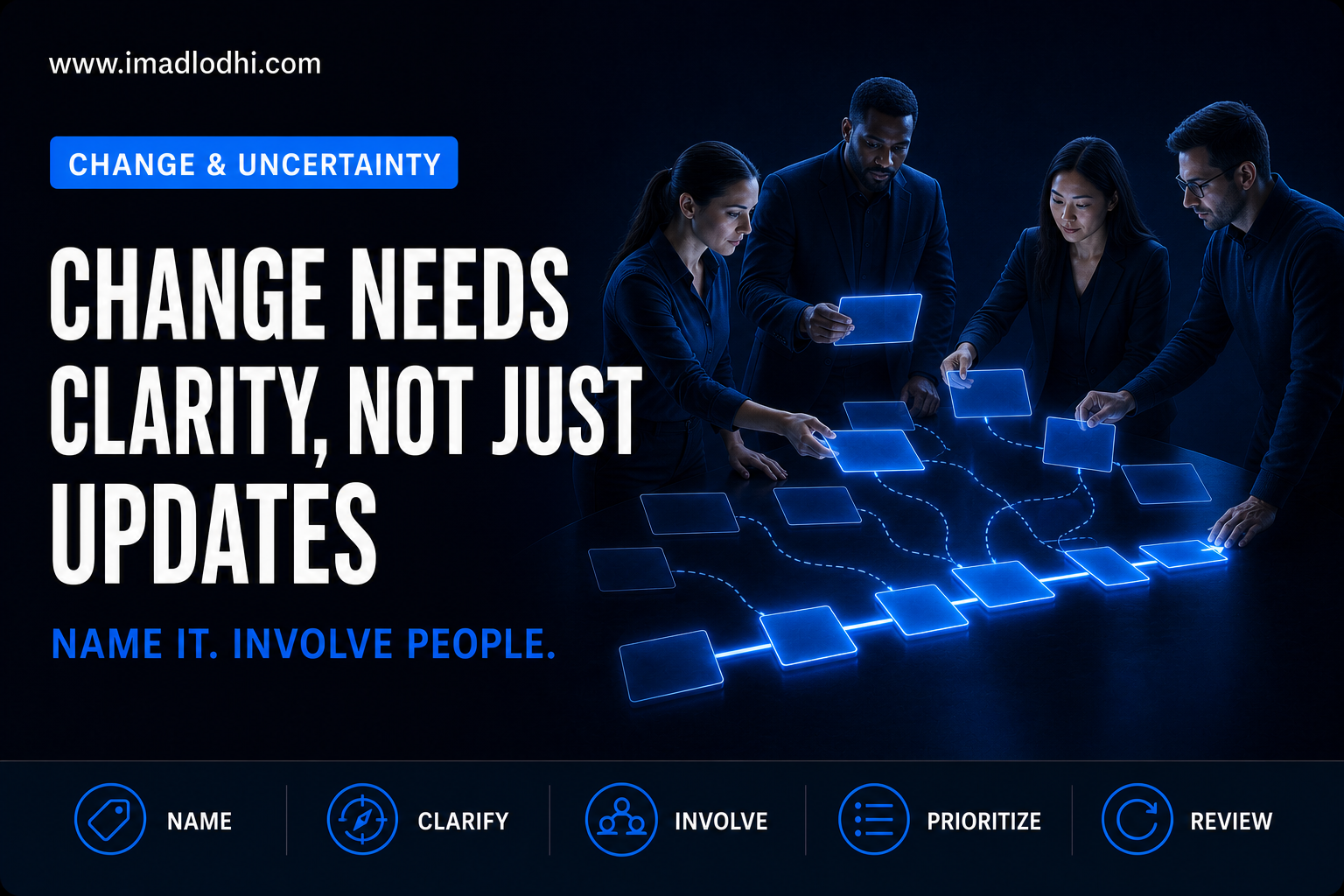
**1. Name what is known, unknown, and still being decided.**
Do not fill uncertainty with false confidence. Give each open question an owner and a date for the next update. Silence invites people to build their own explanations.
**2. Translate strategy into work.**
Clarify reporting lines, decision rights, priorities, and what will pause or stop. A new direction without changed commitments is not clarity. It is accumulation.
**3. Involve the people closest to the work.**
Ask where the proposed change creates collisions, gaps, or unintended load. Then show what changed because of that input. Consultation without visible response becomes theatre.
Individual support still matters. Managers can listen, discuss work-related needs, explain available resources, and connect employees with the appropriate workplace process. They should not diagnose, ask for private medical details, or try to become a counsellor.
Organizational responsibility is different. Leaders control the cadence of change, the quality of role design, the realism of priorities, and the mechanisms for participation and review.
Three Takeaways
- More updates do not automatically create clarity.
- Participation should shape the work, not merely validate a finished decision.
- Support people individually while fixing ambiguity organizationally.
The strongest change message is not “trust us.” It is evidence that leaders have made the work understandable.
**When your organization announces change, what becomes clearer the next morning?