You know the conversation.
An employee asks for a change to how the work is scheduled. The manager wants to help, but the first question becomes, “What exactly is wrong?” Suddenly, a discussion about work turns into a test of how much personal information someone is willing to reveal.
Here is the uncomfortable truth: support should not require an employee to surrender their privacy before a leader will examine a work-related need.
A Need Is Not an Invitation to Investigate
Consider this explicitly hypothetical IT-delivery example.
An analyst asks to step out of overnight on-call rotations for a period and requests protected focus blocks during the day. They explain that the current arrangement is affecting their ability to perform essential tasks consistently. Their manager asks for the diagnosis, treatment plan, and full medical history before discussing any option.
The request may require a formal accommodation process, appropriate documentation, and input from HR, disability management, a union, or qualified professionals. It does not give a manager permission to become an investigator or clinician.
Ontario Human Rights Commission guidance says accommodation is grounded in dignity, individualization, and full participation. It also says employers should limit information requests to what is reasonably related to a limitation or restriction. Generally, employers do not have a right to confidential details such as diagnosis, symptoms, or treatment unless those details clearly relate to the accommodation sought or the needs are complex or unclear. Every case depends on its facts, and qualified advice may be needed.
This is not about pretending that documentation never matters. It is about collecting what the process genuinely requires, through the right channel, and no more.
The World Health Organization describes reasonable accommodation as adapting work environments to a person’s capacities, needs, and preferences. CCOHS likewise advises leaders that they do not need an exact diagnosis to provide support; the focus should be on functional abilities.
The memorable line is simple: a diagnosis describes health information; it does not design the work.
Three Leadership Actions
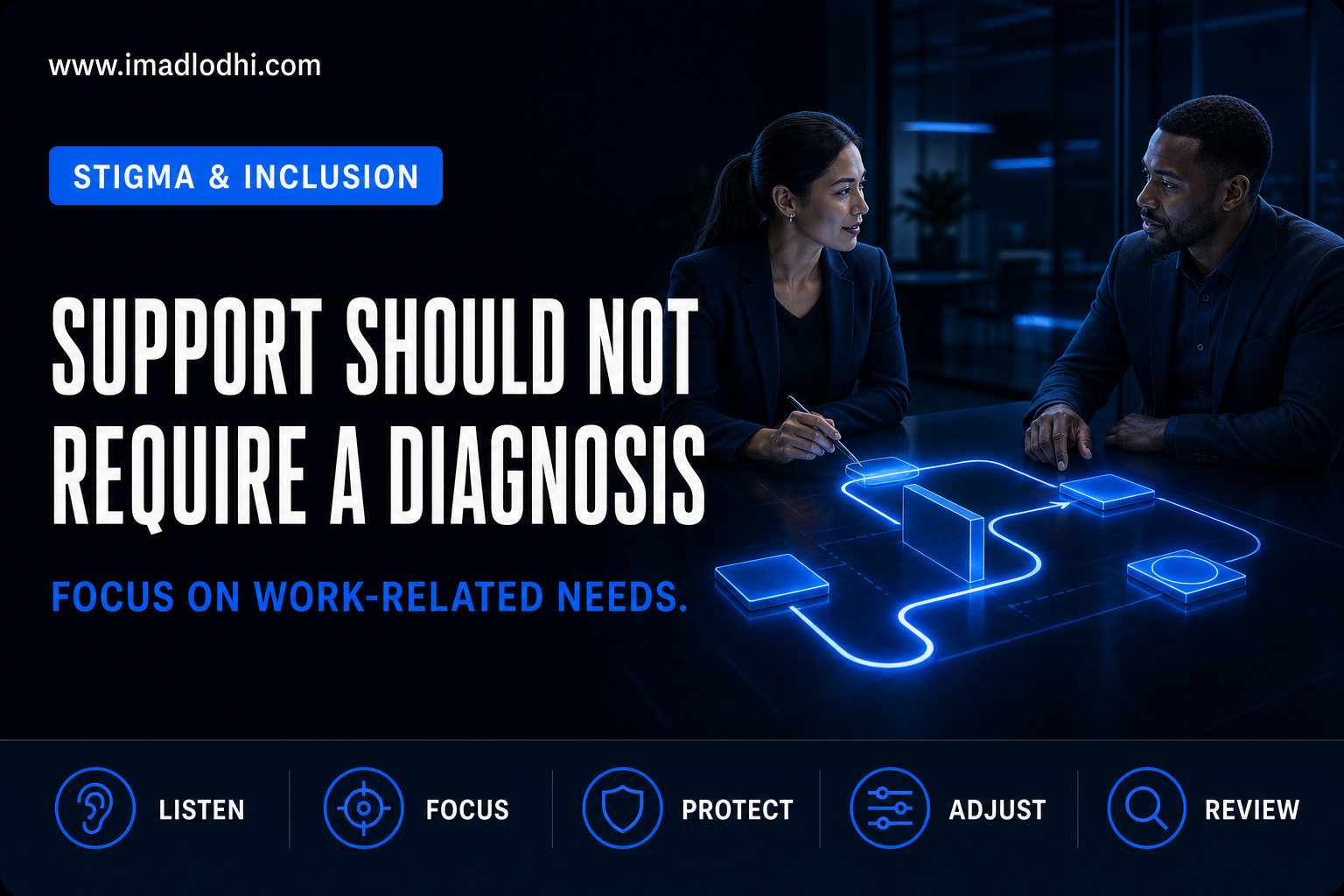
1. Focus the conversation on work.
Ask what task, schedule, environment, communication method, or workplace barrier needs attention. Describe essential duties clearly. Do not ask the employee to prove sincerity through personal disclosure.
2. Protect the information boundary.
Explain what information is needed, why it is needed, who will receive it, and which formal process applies. Keep health information with the appropriate function and share only what others need to implement the work arrangement.
3. Adjust, document, and review.
Explore options with the employee, record the agreed work-related plan, and set a review point. Do not assume one adjustment fits everyone—or that an initial arrangement will remain appropriate.
Individual support still matters. An employee may choose to use healthcare, community, union, or workplace resources. Organizational responsibility is different: leaders control the process, privacy safeguards, job design, manager training, and whether people can request support without stigma.
Three Takeaways
• Start with the work-related need, not a demand for a diagnosis.
• Protect privacy while using the right accommodation process.
• Support the individual and remove organizational barriers.
What does your organization ask people to reveal before it becomes willing to redesign the work?