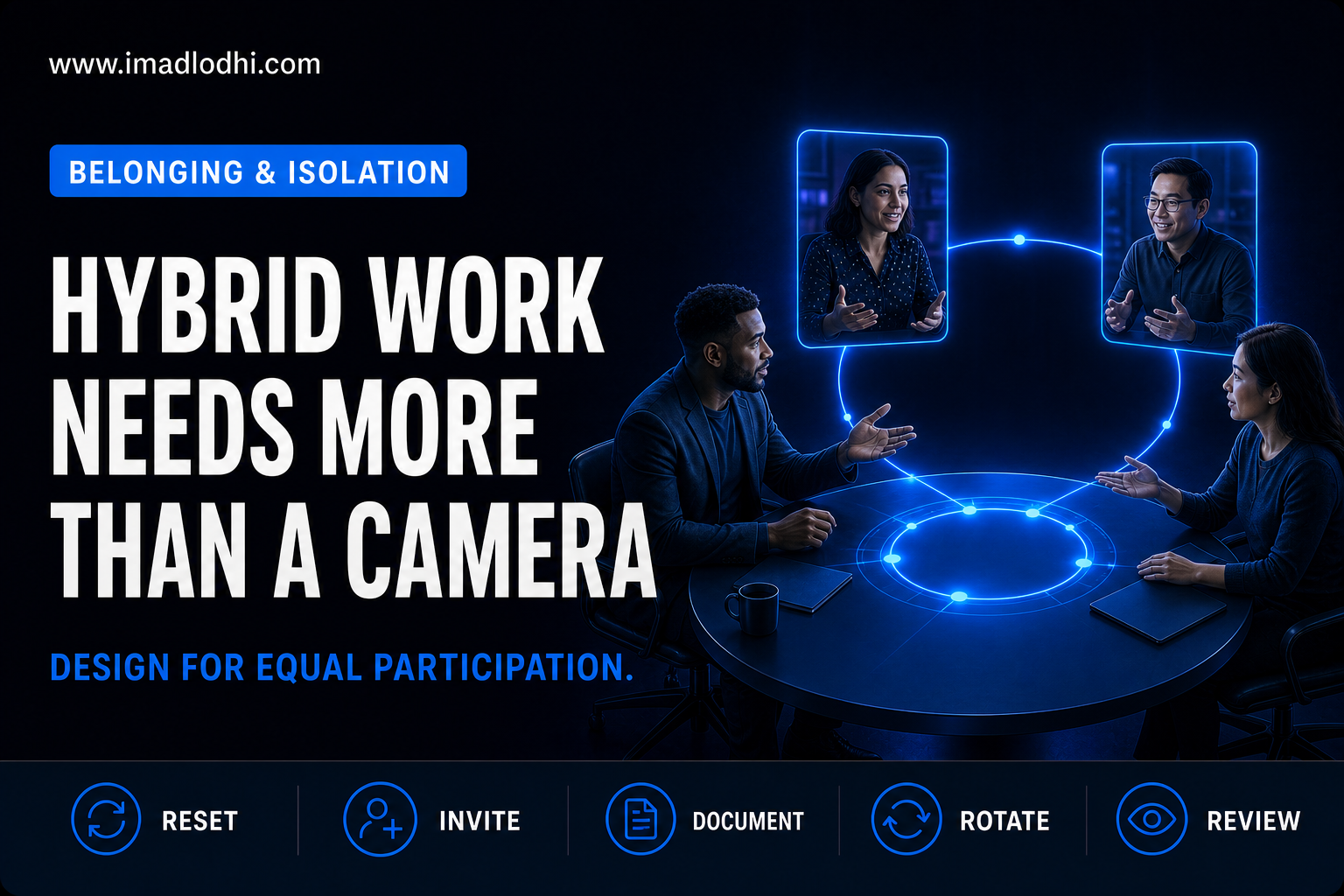
You know the hybrid meeting.
Three people are together in a conference room. Two more appear on a screen. Everyone can technically see and hear one another. Then the room starts moving faster than the call.
A side comment becomes a decision. A whiteboard fills beyond the camera’s view. Someone remote tries to enter the conversation, misses the opening, and hears, “We’ll catch you up later.”
Here is the uncomfortable truth: access to the meeting is not the same as access to influence.
## The Link Is Not the System
Consider this explicitly hypothetical IT-delivery example.
An architecture review includes engineers in the office and two specialists joining remotely. The in-room group has already discussed the options over coffee. During the meeting, they refer to a sketch the remote participants cannot read. One specialist raises a dependency in the chat, but the facilitator sees it after the preferred design has been accepted.
Nobody needs to be diagnosed, and nobody needs to be blamed. The observable problem is how participation was designed.
Canadian Centre for Occupational Health and Safety guidance lists isolation, lower awareness of organizational changes, and difficulty maintaining open communication as potential disadvantages of remote work. It also identifies involvement and influence, along with psychological and social support, among the workplace factors organizations should examine.
That does not mean remote work inevitably harms belonging or mental health. People experience work arrangements differently. It means leaders should not treat inclusion as a software feature.
The World Health Organization recommends organizational approaches that address psychosocial risks and includes participatory methods as an option, while rating the certainty of evidence for that recommendation as very low. That limitation matters. A well-run meeting cannot guarantee well-being. But leaders can still examine whether the way decisions are made repeatedly advantages one location.
## Three Leadership Actions
**1. Reset the room.**
Design for one conversation, not a main room and an audience. Make shared material readable to everyone, prevent side discussions from becoming decisions, and assign someone to watch the virtual hand and chat.
**2. Structure the invitation.**
Send the decision question and material in advance. Pause before closing a topic. Invite input from every location without forcing personal disclosure or putting one person on display. Rotate facilitation so inclusion does not depend on a single considerate manager.
**3. Document influence, then review it.**
Record the decision, reasoning, owner, and unresolved concerns where everyone can see them. Periodically ask whose input arrives too late and which work practices create that pattern. Canadian guidance on psychosocial controls prioritizes addressing hazards at their source and involving workers in designing and evaluating work processes.
Individual support still matters. A manager can check in, discuss work-related barriers, and connect someone with appropriate resources if requested. Organizational responsibility is different: leaders control meeting design, decision rights, technology, documentation, and whose participation counts.
### Three Takeaways
- Visibility is not the same as voice.
- Hybrid inclusion must be designed into decisions, not left to etiquette.
- Support individuals while correcting the system that distributes influence.
Hybrid work needs more than a camera. It needs a fair path into the decision.
**In your hybrid meetings, who can attend—and who can actually shape the outcome?