There is a revealing pattern in many organizations:
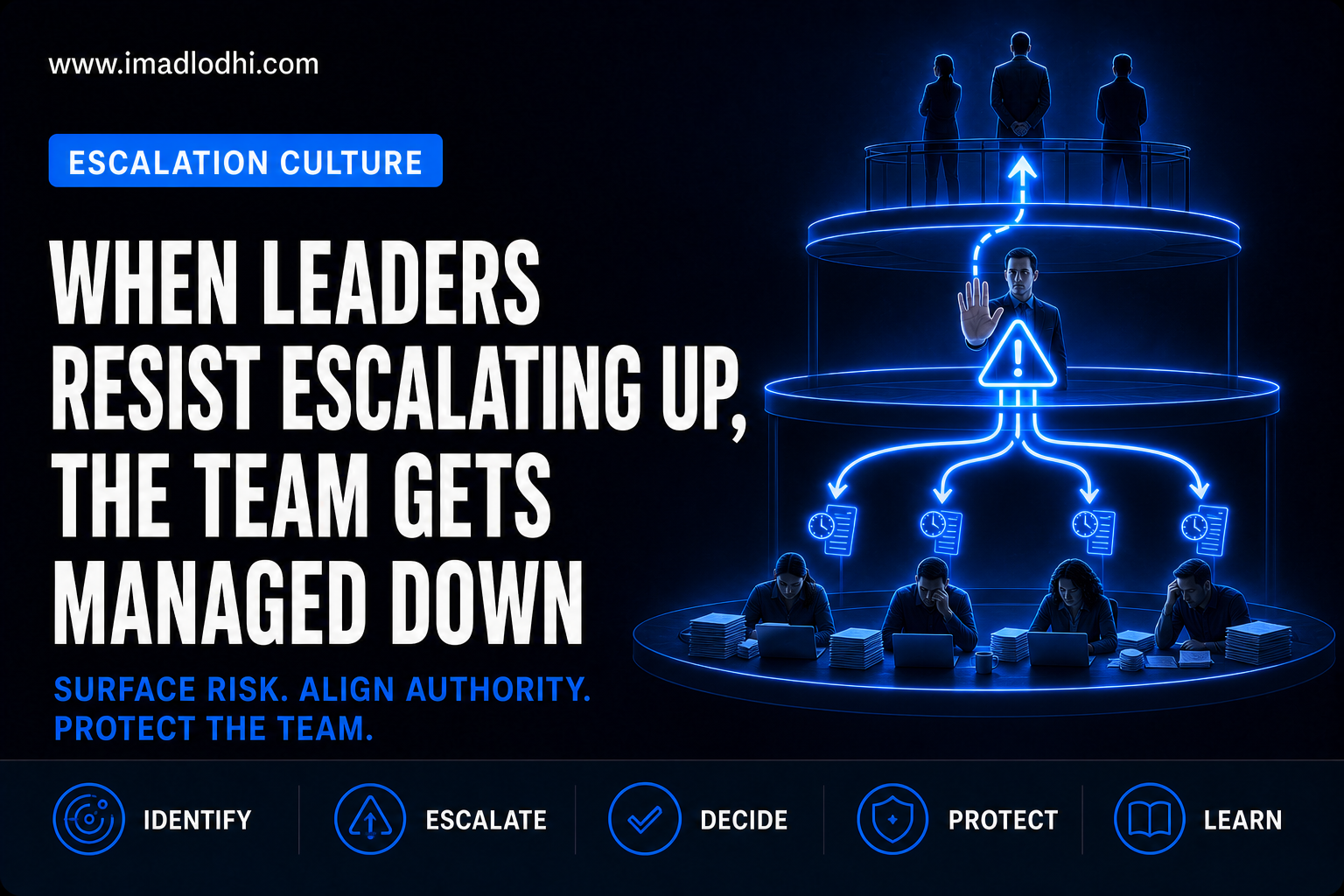
When leadership resists escalating up, they may be resisting because they do not want to be managed down.
The sentence is intentionally uncomfortable. It points to a hidden cost of escalation avoidance.
Escalating an issue exposes it to a higher level of attention. That attention may bring questions, reporting expectations, direction, or intervention. A leader who values autonomy may worry that asking for help will be interpreted as losing control. So the issue stays contained.
But the pressure does not disappear. It moves.
The team is asked to absorb a capacity gap. A delivery risk becomes a request to push harder. A conflict in priorities becomes an expectation that employees will somehow satisfy both. A decision that requires executive authority is quietly converted into extra effort by people who do not have that authority.
The leader preserves autonomy upward by reducing autonomy downward.
That is the escalation paradox.
Escalation is not failure. It is governance.
Healthy escalation moves information, risk, and decisions to the level that has the authority to act. It is not an admission that a manager cannot manage. It is part of managing.
The difficulty is that escalation can feel personally risky. It can expose missed commitments, competing priorities, weak dependencies, or an unresolved decision. It may invite oversight from a senior leader who responds by becoming highly directive. In organizations where escalation has historically been punished or treated as incompetence, reluctance can become a learned survival strategy.
That context matters. Not every failure to escalate is an attempt to protect territory. Leaders may be working with incomplete information, trying to give a team room to solve a problem, or following a culture that rewards containment. The point is not to diagnose motive from a distance. The point is to examine what happens when a leader's need to avoid upward intervention becomes more important than the team's need for authority, capacity, or protection.
A familiar IT-delivery pattern
Consider a hypothetical but familiar situation.
An application team is supporting a critical service while also delivering a major change. A dependency owned by another group is late. The delivery manager knows that the deadline and operational workload can no longer coexist safely, but does not take the conflict to the steering committee.
Instead, the team is asked to find efficiencies, compress testing, and work around the dependency. Status reporting remains cautiously optimistic. When technical leads raise the risk again, they are asked to return with solutions rather than just problems.
On the surface, the manager is protecting the team from executive interference. In practice, the team is now making trade-offs that belong to people with greater authority:
- Which commitment should move?
- What risk is the organization willing to accept?
- Who can reset the cross-functional dependency?
- Is additional capacity justified?
The team can recommend. It cannot authorize.
If the manager will not move those questions upward, pressure moves downward as overtime, shortcuts, hidden risk, and personal accountability without matching decision rights. The organization may eventually see a late delivery or operational incident. What it may not see is that the failure began earlier, when a governance decision was disguised as a performance problem.
Why people stop raising the issue
Research on employee voice helps explain what can happen next. Amy Edmondson's study of work teams found that psychological safety was associated with learning behaviours such as discussing errors and seeking feedback. Research by James Detert and Ethan Burris found that managerial openness was consistently related to improvement-oriented employee voice. Detert and Edmondson later documented implicit beliefs employees hold about when speaking up is risky or inappropriate.
These findings do not prove what any particular leader or employee is thinking. They do support a practical conclusion: people read leadership responses for evidence about whether raising an issue is useful and safe.
If the first escalation produces more pressure but no added authority, employees learn something. If the second produces a challenge to their competence, they learn something else. Eventually, silence can look rational.
There is also a carefully bounded neuroscience perspective. Research reviewed by Amy Arnsten shows that uncontrollable stress can impair functions of the prefrontal cortex involved in working memory and flexible, goal-directed thinking. It would be inappropriate to infer a specific brain state from a workplace anecdote. The useful leadership lesson is simpler: when an unresolved risk is paired with low control and repeated pressure, we should not expect people to do their clearest thinking merely because the stakes have increased.
The control trap
The leader who avoids escalating may believe they are preserving control. Often, they are preserving only the appearance of control while losing control of the conditions that determine the outcome.
This creates an autonomy asymmetry:
- The leader protects freedom from senior oversight.
- The team loses freedom to make honest trade-offs.
- Senior leaders lose the information required to govern.
- The organization carries risk it has not consciously accepted.
Containment looks like ownership until the contained issue exceeds the team's authority.
What managers can do differently
1. Define escalation thresholds before pressure rises
Agree on the conditions that require upward visibility: safety exposure, material customer impact, unresolved cross-functional dependencies, capacity beyond an agreed tolerance, or decisions outside the team's authority. Predetermined thresholds make escalation less personal.
2. Escalate decisions, not anxiety
Bring a concise statement of the issue, impact, options, recommendation, and decision required. A well-formed escalation does not surrender ownership. It identifies where ownership must be shared.
3. Pair upward visibility with downward protection
When a risk goes upward, do not make the team pay for the attention it creates. Shield employees from duplicated reporting, uncontrolled scope changes, and blame-seeking. Translate executive questions into clear decisions and return those decisions to the team.
4. Name the authority gap
Ask: Are we requesting effort from the team to compensate for a decision they are not authorized to make? If the answer is yes, the problem has crossed a governance boundary.
5. Close the loop
Tell the team what was escalated, what was decided, what remains unresolved, and what has changed. Without that loop, speaking up can feel like sending information into a void.
What organizations can do differently
Organizations create escalation behaviour through their response to bad news.
They can improve it by:
- clarifying decision rights and escalation paths;
- treating early risk visibility as competent management, not disloyalty or failure;
- distinguishing supportive oversight from operational takeover;
- reviewing whether managers are rewarded for accurate visibility or merely for quiet status reports;
- tracking how long material risks remain at levels without authority to resolve them; and
- using skip-level conversations to surface system constraints without bypassing or humiliating the manager.
The goal is not more escalation. The goal is escalation at the right time, with the right information, to the right level.
Key takeaways
- Risk that is not managed upward is often transferred downward.
- A team should not be held accountable for decisions it lacks the authority to make.
- Escalation is a governance mechanism, not a confession of managerial failure.
- Repeatedly raising issues without receiving authority or support can teach employees to stay silent.
- Healthy leaders preserve team autonomy by making risk visible, not by hiding it.
When your organization says it wants people to speak up, what happens to the first person who escalates a problem that leadership would rather keep contained?