How unresolved cross-departmental misconduct erodes employee engagement, trust, and the willingness to contribute
Employee engagement is often discussed as though it is primarily about recognition programs, career development, town halls, surveys, or whether employees feel connected to the organization.
Those things matter.
But engagement can be damaged much faster by something far more basic:
An employee repeatedly experiences unprofessional behaviour from a colleague, raises the concern appropriately, and discovers that management will not meaningfully address it.
The original problem may be one difficult colleague. The larger problem becomes what happens when the organization allows the behaviour to continue.
That distinction matters.
The Employee Engagement framework asks a deceptively simple question: Do people want to contribute?
Trust, communication, morale, belonging, and psychological safety are all factors that influence the answer.
When employees conclude that professionalism is expected from them but apparently optional for someone else, the answer can gradually become: Not as much as I used to.
The Problem Is Bigger Than Two People
Imagine two departments that depend heavily on one another.
A manager in the Applications team regularly needs assistance from someone in the Middleware team.
The Middleware colleague is technically capable, but interactions have become increasingly difficult.
Requests are challenged unnecessarily. Emails are condescending. Meetings become adversarial. Information required to resolve incidents is withheld or delayed. Routine questions are treated as incompetence. Problems that should require a ten-minute conversation turn into three-day email exchanges.
Eventually, people begin avoiding the individual altogether.
The Applications manager raises the issue with management. Nothing meaningful happens. Another incident occurs. It is raised again. Still nothing.
Perhaps the response is: “You two need to work it out.” Or: “That's just how this person communicates.” Or: “Try not to take it personally.”
The intention may be to de-escalate the situation. The effect can be exactly the opposite.
Because the difficult employee has just learned something important: There are few meaningful consequences for the behaviour.
And everyone watching has learned something too.
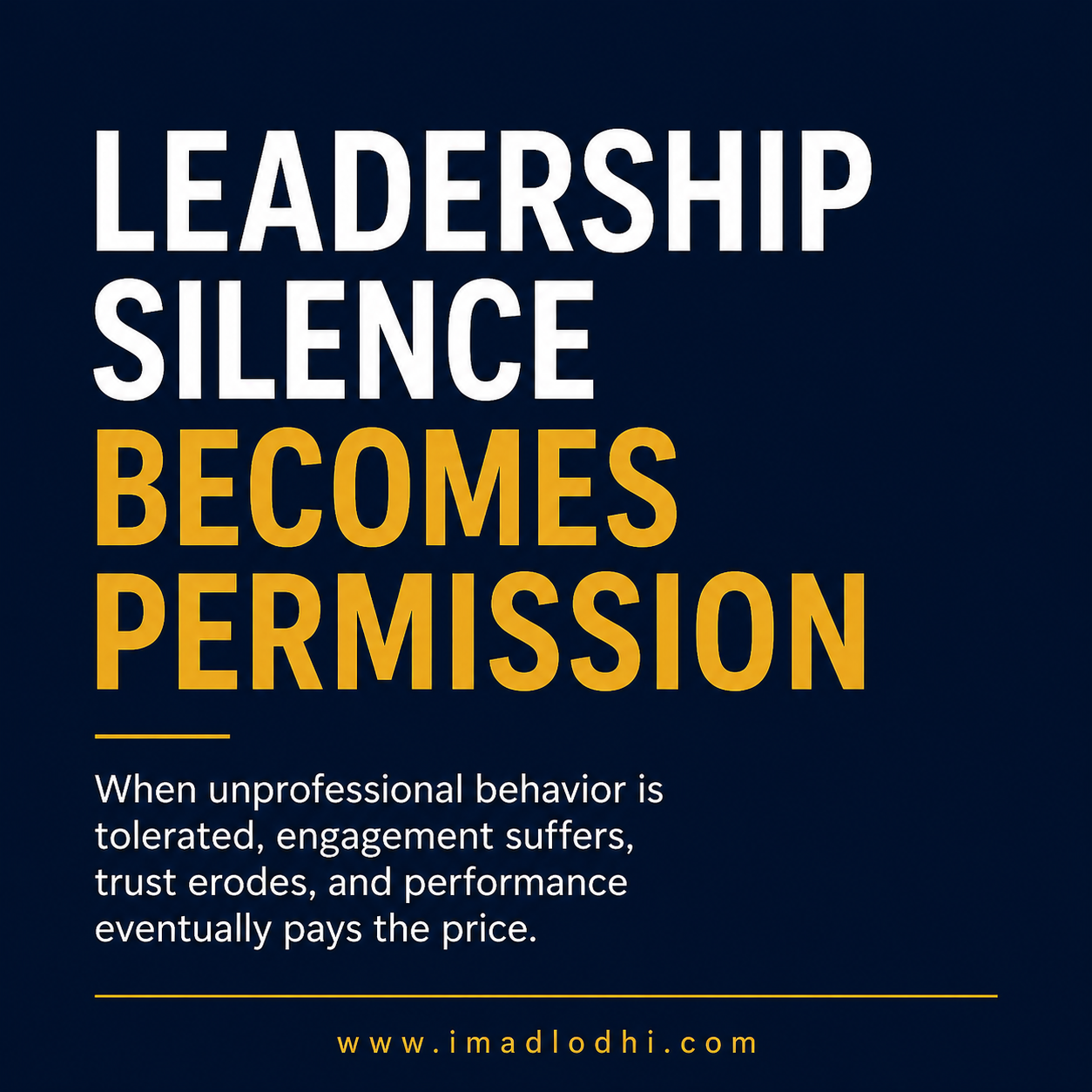
Leadership Silence Sends a Message
Organizations sometimes assume that doing nothing is neutral. It isn't.
When inappropriate behaviour is repeatedly visible, reported, and tolerated, employees begin interpreting management's lack of intervention as information about the organization's actual standards.
The formal message might be: We value collaboration, respect, teamwork, and professionalism.
The operational message becomes: We value those things until enforcing them becomes uncomfortable.
Employees generally pay more attention to the operational message.
And the difficult employee may interpret management's inaction differently: Apparently, I can keep doing this.
This is how behaviour can become progressively more aggressive. What began as occasional condescension becomes habitual dismissiveness. Dismissiveness becomes obstruction. Obstruction becomes open hostility.
Eventually the organization is no longer dealing with an interpersonal disagreement. It is dealing with an organizationally reinforced behaviour pattern.
What Happens to Employee Engagement?
The immediate employee may initially continue trying. They document incidents. They remain professional. They escalate through appropriate channels. They attempt different communication approaches. They ask management for help.
But if nothing changes, something important begins happening psychologically.
The employee starts recalculating the value of effort.
Why raise another concern if nothing happens? Why challenge inappropriate behaviour if management will not support you? Why volunteer for cross-functional initiatives involving that person? Why contribute an idea if speaking up creates another unpleasant interaction? Why go beyond your responsibilities when doing so exposes you to more frustration?
This is where disengagement is often misunderstood.
It does not necessarily begin with someone deciding: “I don't care anymore.”
It can begin with someone deciding: “There is no point.”
That is a much more dangerous sentence.
The Neuroscience Perspective: The Brain Starts Protecting Itself
Repeated hostile or unpredictable interactions can create an anticipatory threat response.
The employee may start preparing for conflict before the interaction even happens.
An email arrives from that colleague. Stress rises. A meeting invitation appears. The employee begins rehearsing arguments. A simple request needs to be sent. They rewrite it five times because they are anticipating how it might be attacked.
Cognitive resources that should be devoted to solving customer problems, improving services, coaching employees, or delivering projects are now being consumed by interpersonal risk management.
The brain essentially starts asking: “How do I get through this interaction safely?” instead of: “How do we solve this problem?”
That distinction has operational consequences.
Repeatedly raising legitimate concerns without seeing meaningful action can contribute to something resembling learned helplessness: My actions do not materially change the outcome.
So the employee adapts. They stop trying to change it.
The Hidden Organizational Cost
This is where a “people problem” becomes an IT delivery problem.
Suppose the Applications and Middleware teams support a business-critical platform.
Previously, engineers picked up the phone. They collaborated informally. They shared knowledge. They challenged one another constructively. They solved incidents quickly.
After months of hostile interactions, behaviour changes.
Everything becomes a ticket. Everything gets documented. People copy managers on emails. Teams protect their boundaries. Engineers hesitate before contacting one another.
Requests become defensive: “As previously stated...” “For clarity...” “Per the documented process...” “Please confirm in writing...”
The organization may interpret this as stronger governance.
Sometimes it is actually organizational scar tissue.
People are protecting themselves.
During a Severity 1 incident, those additional minutes matter. The Application team believes Middleware is delaying. Middleware believes Applications provided insufficient evidence. People argue about ownership. The incident clock keeps running.
Customers do not care which department won the argument. They care that the service is still down.
Sometimes good teams underperform for reasons that have very little to do with technical capability. The organization has allowed the human operating environment to deteriorate.
Then the Rest of the Team Starts Watching
The impact rarely remains confined to the original employee.
Other employees observe what happens. They see someone raise a concern. They see management's response. They see the behaviour continue. And they update their own behaviour accordingly.
This is how psychological safety deteriorates without anyone announcing that psychological safety has deteriorated.
Employees simply become quieter.
They stop challenging. They stop escalating. They avoid certain people. They keep meetings transactional. They share less information. They volunteer less frequently. They become extremely careful about what they say.
Eventually management may wonder: “Why isn't this team engaged anymore?”
The answer may be sitting in plain sight.
Employees learned that speaking up creates personal risk without producing organizational change.
Management Does Not Need to Take Sides
There is an important distinction here.
Supporting an employee does not mean automatically accepting their version of events.
Managers should investigate. They should seek context. They should hear multiple perspectives. They should distinguish between legitimate professional disagreement and genuinely inappropriate behaviour.
Strong organizations should not create environments where accusations automatically become conclusions.
But neutrality does not mean passivity.
Management can establish behavioural expectations without deciding that one person is “good” and another is “bad.”
Disagreement is acceptable. Condescension is not.
Challenging an approach is acceptable. Personal attacks are not.
Requesting evidence is acceptable. Obstructing reasonable work is not.
Escalating operational risk is acceptable. Intimidating colleagues is not.
Those are management standards, not personality judgments.
Lessons for Managers
When an employee repeatedly raises concerns about cross-functional behaviour, treat the situation as more than an interpersonal disagreement.
Look for patterns. Separate technical disagreement from behavioural misconduct. Establish explicit expectations for how the parties will interact. Document those expectations. Follow up. And most importantly, determine whether the behaviour actually changes.
Managers also need to recognize the organizational signal created by their response.
You are not only managing the person behaving poorly. You are communicating with everyone watching.
Lessons for Organizations
Organizations need mechanisms for resolving cross-functional behavioural problems before they become cultural problems.
That requires clear behavioural standards, credible escalation paths, impartial investigation, management accountability, and follow-through.
It also requires measuring more than whether a complaint was administratively “closed.”
The better question is: Did the workplace problem actually improve?
A case can be closed while the behaviour continues. From an employee engagement perspective, that distinction is enormous.
Key Takeaways
- Employee engagement depends heavily on trust and psychological safety, not just recognition and communication programs.
- Repeated unprofessional behaviour becomes an organizational problem when management knows about it but fails to address it.
- Leadership inaction can unintentionally embolden the offending behaviour while teaching others that speaking up has little value.
- Employees often disengage gradually by reducing discretionary effort, collaboration, risk-taking, and willingness to speak.
- Cross-functional hostility creates measurable operational consequences: slower incidents, defensive communication, silos, escalations, and weakened service delivery.
- Managers do not need to take sides to establish and enforce standards of professional behaviour.
Perhaps the most important lesson is this:
Employees watch what organizations tolerate.
Every time leadership responds to unacceptable behaviour—or fails to respond—it teaches employees something about what the organization actually values.
And eventually, employees adjust their engagement accordingly.