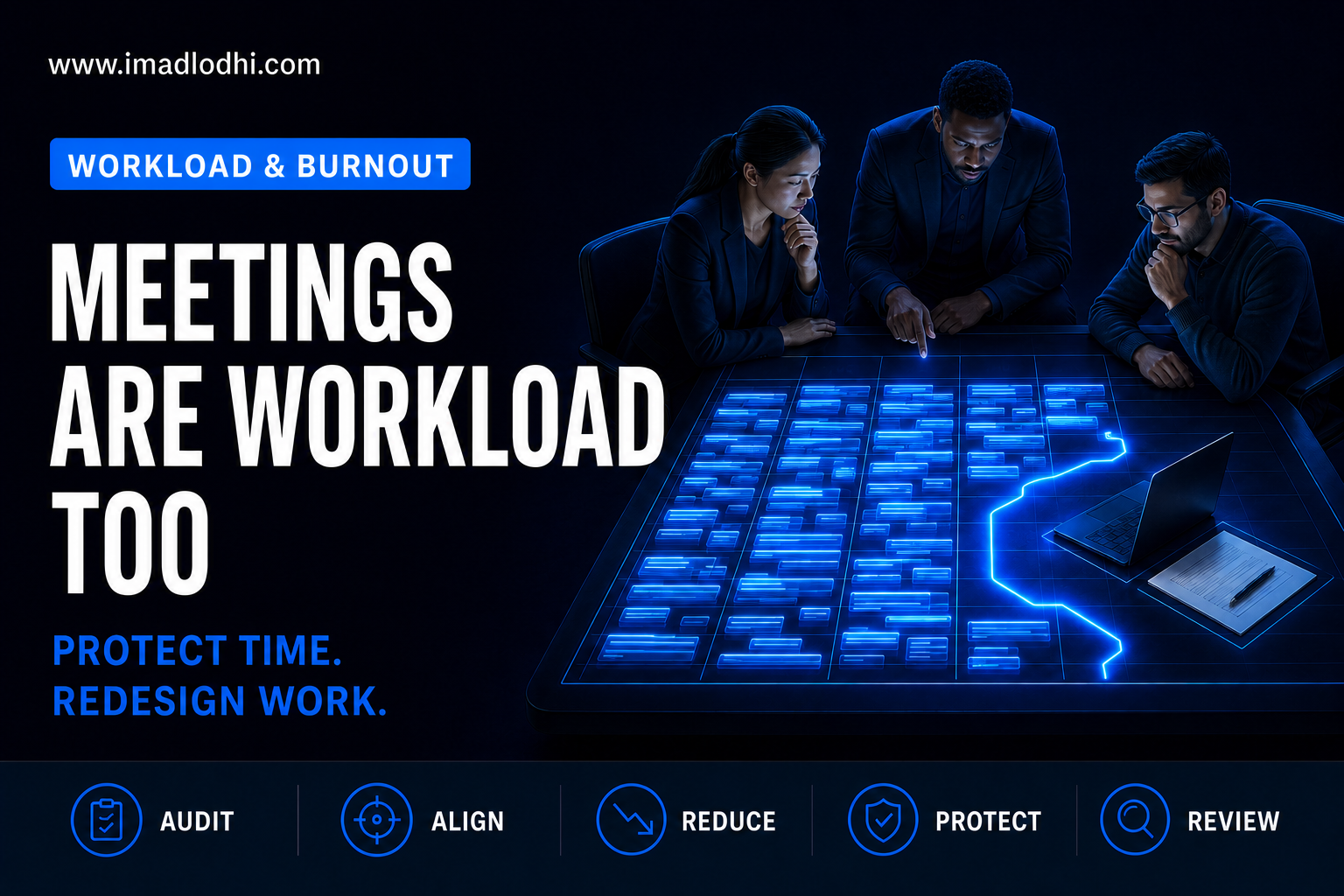
You know the calendar.
The day begins with a status meeting, moves into a steering committee, breaks for a “quick sync,” and ends with a call to prepare for tomorrow’s calls. The actual work—the analysis, writing, design, or problem-solving—gets pushed into the evening.
Then someone asks why delivery is slowing down.
Here is the uncomfortable truth: meetings are not around the workload. Meetings are part of the workload.
A Full Calendar Can Hide an Impossible Job
Consider this explicitly hypothetical example.
An analyst on a large technology transformation is accountable for a decision paper due Friday. That same week, she is expected in governance forums, vendor updates, risk reviews, team stand-ups, and separate preparation calls. Each meeting has a reasonable purpose. Together, they consume most of the time available to produce the paper.
Her manager suggests blocking focus time. But the invitations come from several senior leaders, attendance is treated as mandatory, and nobody has authority to decide which commitment should move.
That is not primarily a personal productivity problem. It is a work-design problem.
The Canadian Centre for Occupational Health and Safety describes workload management as work that can be completed within the time available, with the necessary time, equipment, and support. It also identifies involvement and influence—having meaningful input into how work is done and how important decisions are made—as a psychosocial factor.
The lesson is not that every meeting is harmful. Meetings can coordinate decisions, surface risk, and connect people. The question is whether the organization counts their full cost: attendance, preparation, follow-up, switching between tasks, and the focused work displaced.
Three Leadership Actions
1. Audit demand, not just calendars.
Review recurring meetings alongside deadlines, preparation time, decision outputs, and after-hours work. Ask affected employees what is consuming capacity. Do not infer a health condition from a crowded diary; assess the design of the work.
2. Align attendance with decision rights.
For every forum, name the decision, owner, essential participants, and information that could be shared asynchronously. Give people clear authority to decline, delegate, or leave when their contribution is complete. A meeting without a decision or learning purpose is occupying capacity without earning it.
3. Protect capacity through governance.
Create team-level focus periods, but do not make employees defend them one invitation at a time. Senior leaders should resolve cross-functional conflicts, remove low-value forums, and adjust delivery commitments when meeting demand expands. The World Health Organization recommends assessing psychosocial risks when planning organizational interventions and involving workers in that process; the recommendation is conditional and supported by very-low-certainty evidence, so changes should be tested and reviewed rather than sold as a cure.
Individual support still matters. People may choose workplace resources or qualified professional care. But an employee cannot self-care their way out of a calendar controlled by the organization.
The memorable line is simple: if meetings consume the time required to deliver, the calendar has become the workload plan.
Three Takeaways
- Meeting time must be counted as work, including preparation and follow-up.
- Focus time needs organizational protection, not individual negotiation alone.
- Leaders must choose which commitments move when demand exceeds capacity.
What would your organization stop scheduling if it treated attention as capacity rather than an unlimited resource?