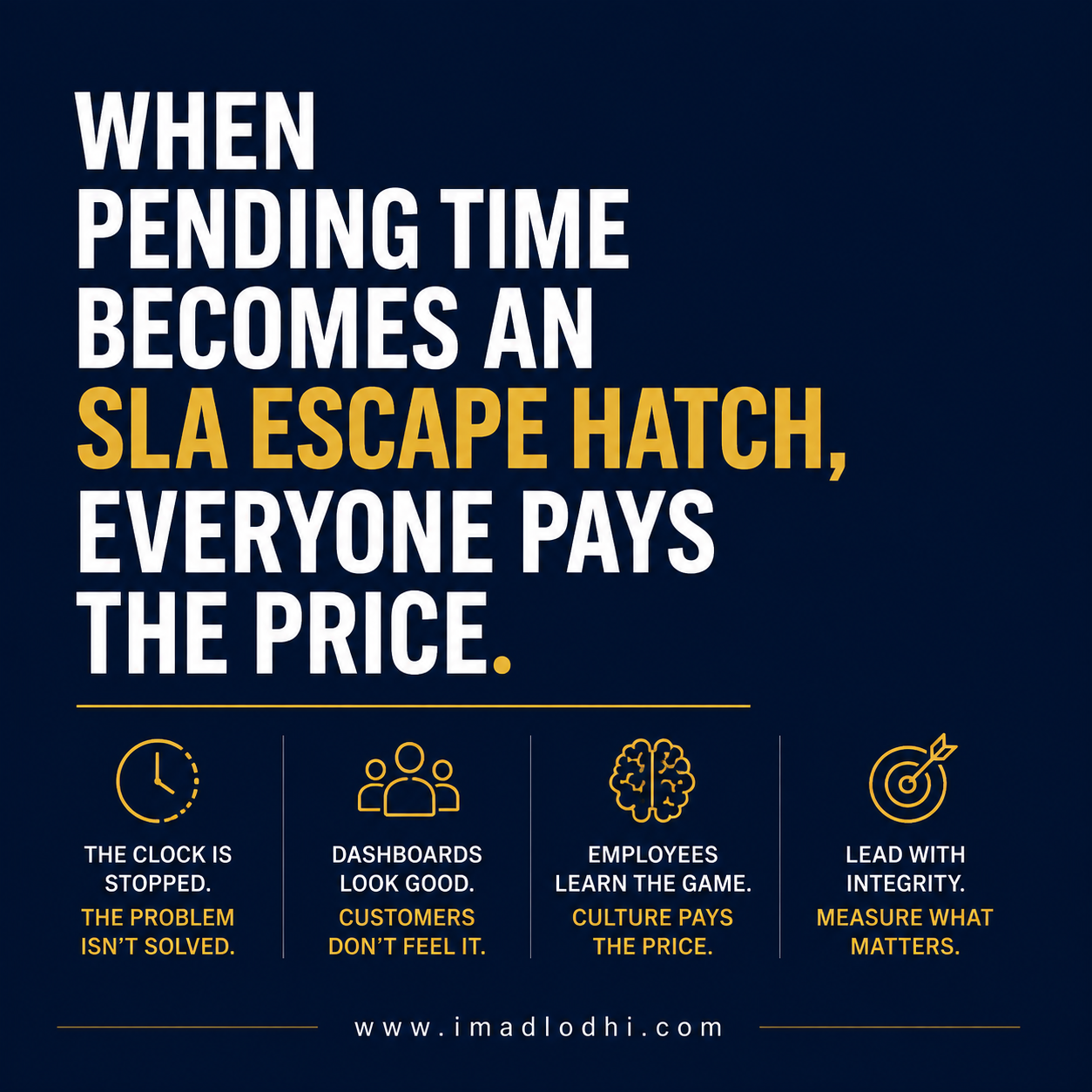
When teams learn that stopping the clock matters more than solving the problem, SLA management stops measuring service and starts shaping the wrong behaviour.
There is nothing inherently wrong with SLA hold time.
If a resolver genuinely cannot proceed because a customer must provide information, approve an action, provide access, or make a decision, excluding that period from the provider's resolution clock can be legitimate.
The problem begins when pending stops describing the state of the incident and starts becoming a mechanism for controlling the SLA clock.
Imagine a 24-hour resolution SLA.
A ticket is open for five days. The support team spends only a few hours actively working it. For most of those five days, it sits in queues, waits for assignment, waits because nobody has the right skill, or receives no meaningful activity.
Yet portions of that elapsed time are coded as pending customer, pending internal, pending vendor, or awaiting information.
The dashboard eventually reports: Resolution SLA: Met.
The customer experienced a five-day resolution. The measurement system experienced 18 hours.
That distinction matters enormously.
Why Teams Resort to It
Usually the manipulation is a symptom before it becomes a culture.
The organization may not have enough people. The skills mix may be wrong. L1 may send too much work to L2. Assignment groups may be overloaded. Tickets may bounce between infrastructure, applications, database, network, and other teams. Queue management may be weak. Managers may not see aging work early enough to intervene.
Those are enablement problems.
But rather than fixing capacity, capability, process, tooling, knowledge, or governance, management discovers another lever: stop the clock.
Initially, it may be rationalized as operational necessity. Then SLA attainment improves. Service credits decline. The monthly dashboard turns green. Executives stop asking uncomfortable questions.
Eventually, an operational workaround becomes an operating model.
What Employees Learn
Suppose I am an analyst on the Service Desk.
Management tells me our objective is to restore service quickly and provide an excellent customer experience.
But operationally I learn something different. When a ticket approaches breach, the important action is not necessarily resolving it. It is changing its status.
The organization has unintentionally created a competing objective: Don't solve the problem. Protect the metric.
People optimize around whatever system rewards them.
If employees watch managers celebrate 98% SLA attainment while knowing tickets routinely spend days artificially paused, eventually the SLA loses credibility.
The Impact on Engagement, Enablement, and Empowerment
Engagement deteriorates. Employees who care about customer outcomes begin questioning why they should push harder when the organization appears more concerned about the dashboard than the customer.
Enablement problems remain hidden. Inflated hold time conceals insufficient staffing, weak queue management, missing knowledge, poor escalation paths, and capability gaps. Because the SLA remains green, investment is not triggered.
Empowerment becomes distorted. Instead of empowering employees to resolve problems, the organization effectively empowers them to manipulate workflow states to protect contractual metrics.
Accountability becomes performative. A manager can report 98% SLA attainment while customers complain about slow resolution. Both realities coexist because the measurement system has become disconnected from the service experience.
Perhaps most damaging, good employees learn that integrity is optional when the number is important enough.
The Behavioural Reinforcement
Consider the incentive structure.
If an analyst properly leaves a difficult ticket active and breaches the SLA, that person may be questioned. Another analyst places similar tickets on hold and achieves 99% compliance.
Who looks better?
People do not need a policy document to understand what behaviour gets rewarded.
Behaviour → reward → repetition.
Eventually, employees stop asking, “What is the correct status for this ticket?” and start asking, “What status keeps this ticket from breaching?”
Conscientious employees can experience a particularly difficult conflict. They know the reported result does not represent the customer's experience, yet they are expected to participate in producing it.
Some challenge it. Some comply reluctantly. Some disengage. Others become extremely good at playing the game—and can ironically become the organization's highest performers according to the measurement system.
The Green Dashboard Paradox
The healthier the manipulated SLA dashboard becomes, the less incentive leadership has to fix the unhealthy delivery system underneath it.
Consider the chain:
Insufficient staffing → queue backlog → aging incidents → SLA risk → excessive hold usage → reported SLA success.
Management sees the end of that chain: 98.7% SLA attainment. GREEN.
So why approve additional headcount? Why invest in training? Why redesign assignment processes? Why improve knowledge management? Why automate repetitive work? Why investigate ticket aging?
The manipulation that protects today's SLA can prevent investment in fixing tomorrow's service.
Eventually the Customer Notices
A provider may avoid service credits by demonstrating contractual SLA attainment. But sophisticated customers do not look only at SLA attainment. They examine elapsed resolution time, reopen rates, backlog aging, ticket touches, reassignment counts, pending-time distributions, customer satisfaction, and recurring incidents.
Then comes the uncomfortable governance question:
“If you're achieving 98% of your resolution SLAs, why are my users telling me it takes four days to get anything fixed?”
At that point, the issue is no longer merely operational performance. It becomes credibility.
Credibility is much harder to recover than an SLA.
Lessons for Managers
- Do not eliminate legitimate hold time; make it auditable.
- Separate internal pending from genuine customer or external dependency time.
- Require meaningful reason codes and evidence for clock stops.
- Review aging within pending states, not only active ticket aging.
- Look for tickets repeatedly moved to pending shortly before SLA thresholds.
- Ask what capacity, capability, process, or governance problem excessive hold time is hiding.
Lessons for Organizations
Measure contractual SLA performance and actual elapsed customer experience.
Track internal pending separately from external pending. Examine hold-time distributions by team, analyst, priority, service, and reason. Compare SLA attainment with customer satisfaction and end-to-end resolution time.
Most importantly, do not use green SLA reporting as proof that the underlying operating model is healthy.
If a team needs excessive exclusions to achieve contractual performance, the organization may not have an SLA problem.
It may have a capacity, capability, process, governance, or management problem wearing an SLA costume.
Key Takeaways
- Legitimate pending time reflects a real dependency; manipulated pending time protects a metric.
- Excessive SLA holds can conceal staffing, skills, queue-management, and process deficiencies.
- Employees quickly learn whether the organization rewards customer outcomes or dashboard outcomes.
- Metric gaming damages engagement, professional integrity, and psychological safety.
- Green dashboards can suppress the investment needed to repair an unhealthy delivery model.
- Measure both contractual SLA time and the customer's actual elapsed resolution experience.
When employees know the numbers are being manipulated, you do not just corrupt the metric. You teach the workforce that appearing successful matters more than actually being successful.