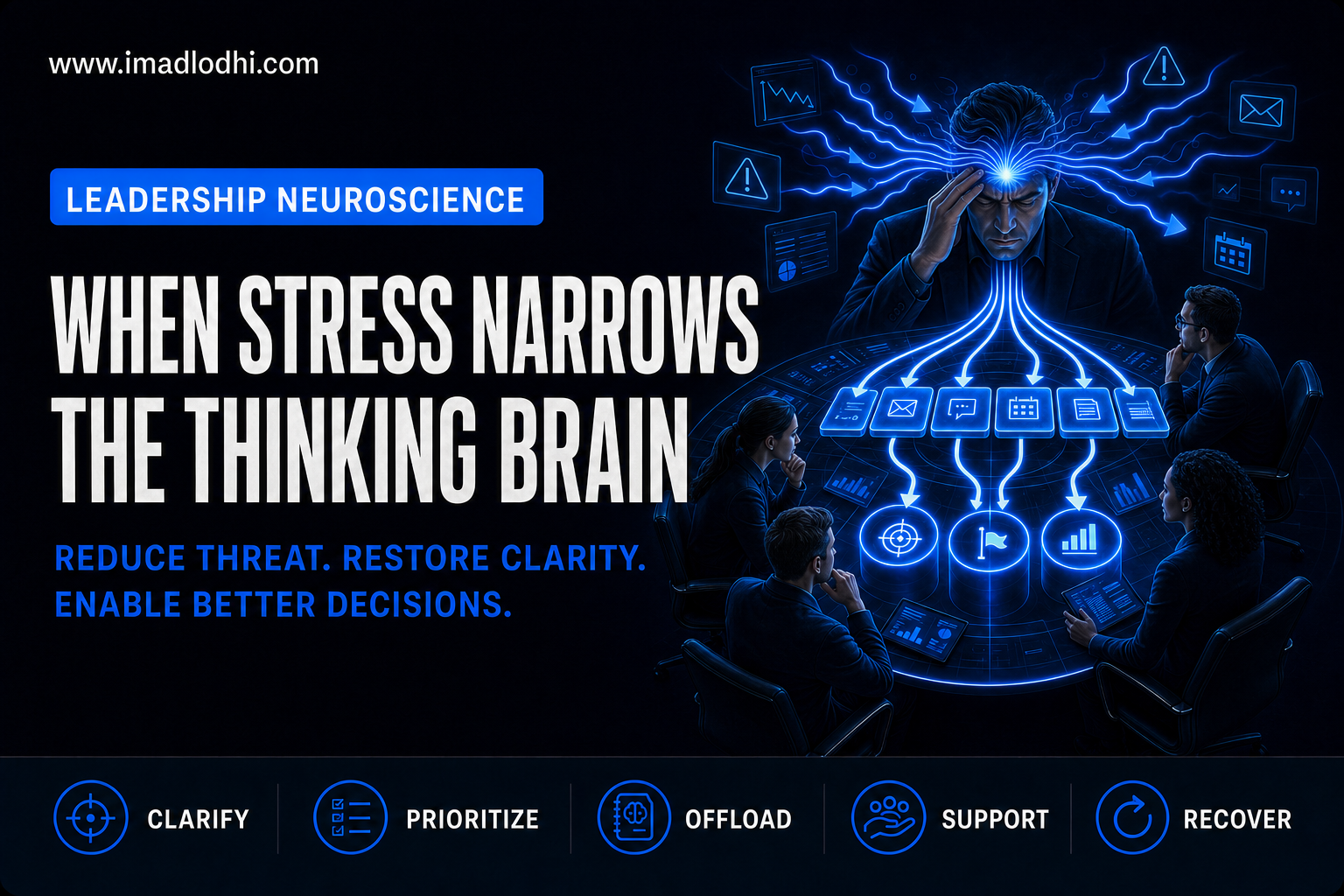
Here is a leadership problem we do not talk about enough: sometimes the person who appears scattered, rigid, or unusually reactive is not short on capability. They may be trying to think inside an environment that keeps triggering a stress response.
That distinction matters.
If leaders treat every mistake as an individual performance failure, they may add more pressure to the very conditions that are already making clear thinking harder. The better question is not only, “Why is this person struggling?” It is also, “What is happening around them that may be interfering with their ability to think?”
The observation: pressure changes how work gets done
Consider a hypothetical major incident in an IT organization.
The issue is moving quickly. Senior leaders want updates. Several technical teams are offering conflicting explanations. Priorities are changing every few minutes. The incident lead is expected to remember decisions, track actions, manage the bridge, brief executives, and prevent the conversation from turning into blame.
At first, the lead is calm and methodical. As the pressure becomes less predictable and less controllable, the pattern changes. Details are missed. The same options are revisited. New information is harder to integrate. The team falls back on the most familiar response, even though the situation calls for adaptation.
It is tempting to say the lead “could not handle pressure.” But that conclusion may be too simple. The environment demanded the very mental functions that stress can disrupt: holding information in mind, updating it, suppressing unhelpful reactions, and shifting strategy when conditions change.
The leadership analysis: uncontrollability is part of the problem
Not all pressure is harmful, and not every demanding day produces the same response. A clear challenge with adequate resources, decision authority, and support can focus attention. The risk grows when demands feel unpredictable, socially threatening, or outside a person’s control.
In workplaces, leaders can create that experience without intending to. They do it through constantly changing priorities, unclear decision rights, public criticism, unnecessary escalation, conflicting instructions, or expectations that exceed available capacity.
This is where engagement and enablement meet.
An employee may still want to contribute. But wanting to contribute is not the same as being placed in conditions where contribution is cognitively possible. When leaders overload the mental system and then criticize the symptoms of overload, they turn a design problem into a character judgement.
The neuroscience perspective: the brain’s mental workspace is vulnerable
The prefrontal cortex supports several higher-order functions involved in purposeful work, including working memory, attention control, planning, and flexible behaviour. Working memory is the brain’s short-term mental workspace: it allows us to hold relevant information in mind while using it to guide the next action.
That workspace is highly sensitive to stress. In a human brain-imaging study, experimentally induced acute psychological stress was associated with reduced working-memory-related activity in the dorsolateral prefrontal cortex. The authors described a reallocation of neural resources away from executive-function networks.
Broader research reaches a similar conclusion while also showing why leaders should avoid simplistic claims. A meta-analysis found that acute stress had an overall negative effect on working memory and cognitive flexibility, but effects can vary with factors such as timing, task demands, and the individual. Stress does not switch off every person’s reasoning in the same way.
The practical pattern is still important: under sufficiently intense or uncontrollable stress, thinking can become narrower. People may find it harder to keep several pieces of information active, consider alternatives, update a plan, or inhibit a familiar response.
Research on goal-directed behaviour also suggests that stress can shift decision-making toward more habitual responses. Some of this evidence comes from animal studies, and human findings require careful interpretation. The responsible leadership takeaway is not that a stressed employee has “lost” the prefrontal cortex. It is that stress may make flexible, deliberate thinking less accessible precisely when the organization needs it most.
This is an explanation to investigate, not a diagnosis to apply.
What managers can do
1. Stabilize the immediate priorities
When everything is urgent, working memory becomes a queue with no owner. Name the top priority, identify what can wait, and make changes deliberately rather than continuously.
2. Move information out of people’s heads
Use visible action logs, written decision records, checklists, and clear ownership. In an incident, one person should not be expected to facilitate, troubleshoot, document, and communicate at the same time.
3. Increase control where control is possible
Clarify decision rights. Give employees options about sequencing, methods, and escalation paths. Even when the outcome is uncertain, the process does not need to be chaotic.
4. Lower social threat
Challenge the issue without humiliating the person. Public blame, loaded questions, and surprise escalations may produce compliance in the moment while making honest reporting and flexible thinking less likely.
5. Change the performance conversation
Ask what conditions were present before deciding what the behaviour means. Was the workload realistic? Were priorities stable? Were the tools reliable? Did the person have authority equal to their accountability? Individual coaching may be appropriate, but it should not become a substitute for fixing the system.
6. Create a recovery step
After an intense event, do not move straight from adrenaline into another complex decision. A short reset, a second set of eyes, and a structured debrief can reduce avoidable errors and improve learning.
What organizations can do
Managers cannot solve chronic overload alone. Organizations shape the conditions in which managers operate.
First, capacity planning must reflect real demand. A permanently overloaded team does not become resilient because leaders call the work “fast-paced.”
Second, governance should reduce noise. Clear escalation thresholds, decision owners, communication roles, and incident protocols protect scarce cognitive capacity during critical moments.
Third, performance systems should look beyond outcomes. If people are rewarded for creating urgency, bypassing process, or escalating theatrically, stress becomes part of the operating model.
Fourth, leaders need training in how workload, autonomy, predictability, and psychological safety affect performance. Neuroscience should not become a new vocabulary for labelling employees. It should help leaders design better conditions for thinking.
Finally, organizations should examine patterns. Repeated errors after priority changes, during understaffed shifts, or inside blame-heavy escalations are not random events. They are signals about the system.
Key takeaways
- Uncontrollable stress can impair working memory and flexible thinking supported by prefrontal networks.
- A stressed employee may have difficulty accessing capability they still possess.
- Clear priorities, written supports, decision authority, and lower social threat can protect cognitive capacity.
- Performance conversations should examine system conditions as well as individual behaviour.
- Neuroscience can inform leadership decisions, but it should never be used to diagnose or excuse every workplace problem.
When pressure rises in your organization, do your leadership practices create enough clarity and control for people to think—or do they make thoughtful performance even harder?
Sources
Amy F. T. Arnsten, “Stress signalling pathways that impair prefrontal cortex structure and function,” Nature Reviews Neuroscience (2009):
https://doi.org/10.1038/nrn2648
Shaozheng Qin et al., “Acute psychological stress reduces working memory-related activity in the dorsolateral prefrontal cortex,” Biological Psychiatry (2009):
https://pubmed.ncbi.nlm.nih.gov/19403118/
Grant S. Shields et al., “The Effects of Acute Stress on Core Executive Functions: A Meta-Analysis and Comparison with Cortisol,” Neuroscience & Biobehavioral Reviews (2016):
https://pmc.ncbi.nlm.nih.gov/articles/PMC5003767/
Milena Girotti et al., “Prefrontal cortex executive processes affected by stress in health and disease,” Progress in Neuro-Psychopharmacology and Biological Psychiatry (2018):
https://pmc.ncbi.nlm.nih.gov/articles/PMC5756532/
J. M. Soares et al., “Stress-induced changes in human decision-making are reversible,” Translational Psychiatry (2012):
https://pmc.ncbi.nlm.nih.gov/articles/PMC3410630/