
Leadership
From Good to Great: Unleashing the Power of Guiding Principles in Leading and Managing People
Leaders and managers are both essential to the successful operation of any business. Leaders inspire people to do their best and work together towards common goals, while managers organize people and resources to achieve specific results.
Leading and managing people can be challenging, especially when it comes to effectively communicating with and motivating team members.
This can lead to misunderstandings, conflict, and a lack of productivity within the team. It can also create a negative work environment, causing morale to suffer and leading to high turnover rates.
The Guiding Principles of Leading People and Managing People provide a framework for addressing these challenges. These principles include effective communication, setting clear expectations, providing support and resources, recognizing and rewarding good performance, and creating a positive work environment. By following these principles, leaders and managers can effectively guide and support their team, resulting in improved communication, teamwork, and productivity.
Leaders and managers are both essential to the successful operation of any business. Leaders inspire people to do their best and work together towards common goals, while managers organize people and resources to achieve specific results. The most effective businesses have leaders who can see beyond the present and inspire others to follow them, as well as managers who are more tactical and focused on the day-to-day operations of the business.
By creating a culture where people feel valued and want to contribute their best efforts, leaders can ensure that everyone is working towards the same goal. And by establishing systems and procedures that ensure things get done efficiently, managers can keep the wheels turning smoothly. If you want to be successful in business, it’s important to learn to become both a great manager and an inspirational leader.
Leadership is about inspiring people to do their best and achieve common goals
Leadership is about inspiring people to do their best and achieve common goals. People need to feel like they are a part of something larger than themselves, and that they are working towards a common goal. This can be done by setting an example and communicating your vision for the future.
It's about listening to their team and providing feedback that will help them improve. It's about bringing out the best in people and helping them reach their full potential. It's about working together to make things happen. And it's about making a difference in the lives of others. That's what leadership is all about. It's not about power or prestige. It's not about having all the answers. It's about listening to others, learning from them, and then making decisions that are in the group's best interest.
When it comes to leadership, character matters. Integrity matters. Being honest and accountable and setting the right example, those are the things that matter most. Leaders need to be trustworthy and they need to be compassionate. They need to have a vision for what they want to achieve and they need to be able to articulate that vision in a way that inspires others to follow them.
That's what leadership is all about. They're looking for someone who can help us solve some of our problems by coming together around our shared values and our shared aspirations. That's what leadership is all about - bringing people together, finding common ground, and moving forward even when it's hard.
Management is about organizing people and resources to achieve specific results
As anyone who has ever managed a team knows, effective management is about more than just telling people what to do. It's also about organizing people and resources to achieve specific results. That means setting clear goals and objectives, and then developing a plan to achieve them. It also means making sure that everyone on the team understands their roles and responsibilities, and has the necessary skills and knowledge to do their jobs effectively. Finally, it requires regular communication and feedback to ensure that the team is on track and making progress. In today's fast-paced world, managing effectively is more important than ever.
Leaders are visionaries who can see beyond the present and inspire others to follow them
A leader is someone who can see beyond the here and now, and who has the courage to take others on a journey towards a better future. A leader is someone who can look at the world as it is, and imagine how it could be. And a leader is someone who can galvanize others around a shared vision of what is possible. That is the kind of leader I aspire to be. Throughout my career, I have always tried to lead by example, and to bring people together around a common purpose. I believe that leaders must be visionaries – they must be able to think big and to imagine a future that is different from today. And they must also be inspiring – they must be able to motivate others to follow them on the journey towards that future. That is the kind of leader I strive to be, and it is the kind of leadership that I believe people need right now.
Managers are more tactical and often focused on the day-to-day operations of a business
When you're running a business, there are a lot of different hats you have to wear. You need to be strategic, looking at the big picture and thinking about where your company is going in the long term. But you also need to be tactical, focused on the day-to-day operations and making sure that everything is running smoothly. That's where managers come in. They're the ones who are focused on the details and making sure that everyone is doing their job. And while it's important to have both strategic and tactical thinkers in a business, I believe that managers are essential to its success. After all, if you're not able to execute on your strategy, then it doesn't matter what your vision is. So if you're running a business, make sure you have a good manager by your side.
Leaders create a culture where people feel valued and want to contribute their best efforts
A good leader creates a culture within their organization where people feel valued and want to contribute their best efforts. When people feel valued, they are more likely to be motivated and committed to their work. This, in turn, leads to better performance and results. Furthermore, when people feel that their contributions are valued, they are more likely to be engaged in the work of the organization. This engagement is essential for an organization to achieve its goals. Good leaders recognize the importance of creating a culture within their organization where people feel valued and want to contribute their best efforts. This is because they understand that it is only through the engagement of all employees that an organization can reach its full potential.
Managers establish systems and procedures that ensure things get done efficiently
Managers play an important role in any organization. They establish systems and procedures that ensure things get done efficiently and effectively. They also motivate and support employees, help them to develop their skills, and resolve conflict. By doing these things, managers make a vital contribution to the success of their organizations. And while the job of manager can be challenging, it is also rewarding. After all, there is nothing more satisfying than knowing that you have helped to make your organization more successful. So if you are considering a career in management, remember that you can make a real difference.
Conclusion
Leaders and managers are both essential to the successful operation of any business. Leaders inspire people to do their best and work together towards common goals, while managers organize people and resources to achieve specific results. The most effective businesses have leaders who can see beyond the present and inspire others to follow them, as well as managers who are more tactical and focused on the day-to-day operations of the business. By creating a culture where people feel valued and want to contribute their best efforts, leaders can ensure that everyone is working towards the same goal. And by establishing systems and procedures that ensure things get done efficiently, managers can keep the wheels turning smoothly.
If you want to be successful in business, it’s important to learn to become both a great manager and an inspirational leader.
Subscribe To My Blog To Learn More: https://www.imadlodhi.com/subscribe

Leadership
Born or Bred - Comparing and Contrasting Trait Theory and Transactional Leadership
Trait theory is a personality theory that focuses on identifying and measuring specific personal characteristics that are relatively stable over time. This approach can be useful in predicting how individuals will behave in different situations, including leadership roles.
There is a need to understand and compare different leadership theories in order to effectively lead and manage others.
The trait theory and transactional leadership are two commonly studied leadership theories that present different viewpoints on what makes a leader effective. The trait theory suggests that leaders are born with inherent characteristics that make them effective leaders, while transactional leadership focuses on the exchange of rewards and punishments in order to motivate and guide followers.
By understanding and comparing these two theories, leaders can better understand the different approaches to leadership and determine which may be most effective in different situations. By considering both the inherent traits of leaders and the transactional exchanges with followers, leaders can develop a more well-rounded and effective leadership style.
Trait theory and transactional leadership are two different ways of looking at what it takes to be a leader. Trait theory looks at the inherent qualities that make up a leader, while transactional leadership focuses on the actions and behaviors that leaders take in order to achieve results. While both theories have their merits, which one is better for you and your team depends on your specific situation. If you need help determining which approach is best for you, our team of experts can provide guidance and support. Contact us today to learn more about how we can help you reach your leadership goals.
Defining Trait Theory and Transactional Leadership
There are a number of different leadership theories that have been proposed over the years. Two of the most popular theories are trait theory and transactional leadership. Trait theory suggests that leaders are born, not made. This theory focuses on the personal characteristics of leaders, such as intelligence, charisma, and ambition. In contrast, transactional leadership theory suggests that effective leadership is the result of a mutually beneficial exchange between leaders and followers. This theory emphasizes the importance of leader-follower relationships, and it highlights the role that followers play in shaping leader behaviour. While there is no single correct approach to leadership, understanding these different theories can help us to better appreciate the complex nature of this important topic.
The History of Trait Theory
Trait theory began with the work of psychologist Gordon Allport in the early twentieth century. Allport proposed that personality could be understood in terms of a small number of stable trait dimensions, such as Extraversion and neuroticism. This theory was further developed by Raymond Cattell, who identified 16 different personality traits. However, it was Hans Eysenck who really brought trait theory to the forefront of psychological research. Eysenck suggested that there were three core trait dimensions – Extraversion, neuroticism, and psychoticism – which he believed were biologically based. Although trait theory has been highly influential, it has also been criticized for its lack of specificity and its failure to explain how traits are expressed in behavior. Nevertheless, it remains an important approach to understanding personality.
The History of Transactional Leadership
Transactional leadership is a style of leadership that was first described by Max Weber in 1947. Transactional leaders motivate and encourage employees by offering rewards in exchange for good performance. This type of leader establishes clear expectations and provides guidance to employees. They also offer support and feedback to help employees meet their goals. Transactional leadership is often used in traditional businesses and organizations. It is a popular choice for leaders who want to maintain control and promote efficiency. However, some critics argue that transactional leadership can be too autocratic and does not encourage creativity or innovation. As the world changes, it will be interesting to see if transactional leadership remains popular or if other styles of leadership become more prevalent.
Comparing and Contrasting Trait Theory and Transactional Leadership
Trait theory and transactional leadership are two of the most common approaches to leadership. Both theories have their strengths and weaknesses, and it is important to understand both in order to be an effective leader.
Trait theory focuses on the personal characteristics of the leader, such as intelligence, charisma, and ambition. The main strength of this approach is that it can help to identify leaders who have the potential to be successful. However, trait theory also has its limitations. One major criticism is that it fails to take into account the context in which the leader is operating. This can lead to a false sense of confidence in the leader's abilities, which can ultimately be detrimental.
Transactional leadership, on the other hand, focuses on the leader's relationship with followers. The key idea is that the leader provides rewards or punishments in exchange for performance. This approach has the advantage of being very pragmatic and results-oriented. However, it can also be seen as manipulative and lacking in trust.
Ultimately, there is no single correct approach to leadership. The best way to lead will vary depending on the situation and the people involved. However, understanding both trait theory and transactional leadership can help you to be more Effective as a leader in a variety of different situations.
Which is Better for You and Your Team
There are countless factors to consider when choosing between email and face-to-face communication, but it ultimately depends on the context and what you hope to achieve. Email is great for conveying large amounts of information quickly and efficiently, but it can be easy to misread someone's tone or intentions. Face-to-face communication, on the other hand, allows for immediate feedback and collaboration, but it can be more time-consuming. Ultimately, the best option is to use a mix of both email and face-to-face communication depending on the situation. If you need to convey complex information or give instructions, email is probably the best option. But if you're trying to build relationships or resolve conflict, face-to-face communication will be more effective. By considering the context and your goals, you can choose the communication method that will be most successful for you and your team.
Applications of Trait Theory and Transactional Leadership
Trait theory is a personality theory that focuses on identifying and measuring specific personal characteristics that are relatively stable over time. This approach can be useful in predicting how individuals will behave in different situations, including leadership roles. Transactional leadership is a style of leadership that emphasizes task completion and rewards positive performance. This style of leadership is often used in business settings where there is a clear hierarchy and job role expectations. However, transactional leadership can also be effective in other settings, such as schools or government organizations. The trait theory can be used to identify individuals who are likely to be successful transactional leaders. For example, individuals who are high in agreeableness and conscientiousness may be more likely to be successful transactional leaders because they are more likely to follow rules and regulations and be concerned with meeting deadlines. In contrast, individuals who are low in agreeableness and conscientiousness may be less successful transactional leaders because they are more likely to break rules and regulations and be less concerned with meeting deadlines. Thus, the trait theory can be a useful tool for identifying individuals who are likely to be successful transactional leaders.
Trait theory and transactional leadership are two different ways of looking at what it takes to be a leader. Trait theory looks at the inherent qualities that make up a leader, while transactional leadership focuses on the actions and behaviors that leaders take in order to achieve results. While both theories have their merits, which one is better for you and your team depends on your specific situation. If you need help determining which approach is best for you, our team of experts can provide guidance and support. Contact us today to learn more about how we can help you reach your leadership goals.
Subscribe To My Blog To Learn More: https://www.imadlodhi.com/subscribe

Contact Center
Contact Center Rescue Series: Implementing Total Quality Management
A Jñāna Optimized Unified Delivery Model ensures that the Total Quality Management process focuses on ensuring that all supporting activities that are undertaken by IT to provide a service are adhering to the agreed-to-quality standards. It ensures that all interactions, whether a call, ticket (service request, incidents, problem, change), CSAT surveys, escalations and any other sources of work, align with the global standards and contract expectations.
The contact center is experiencing issues with a lack of quality management, which is negatively impacting customer satisfaction and employee morale.
These issues are causing frustration for both customers and employees, leading to negative feedback and reduced loyalty from customers and high levels of employee turnover. This constant churn of staff is disruptive and costly, and it reduces the overall efficiency and effectiveness of the contact center.
In order to address these issues and improve the effectiveness and efficiency of the contact center, the organization should establish a process for analyzing and improving quality in areas such as ticket, chat, and call monitoring, customer satisfaction, backlog management, and employee performance, including feedback and training updates.
The implementation of a Total Quality Management system guarantees the attainment of established quality standards across all facets of customer interactions, including but not limited to phone calls, chats, tickets, customer satisfaction surveys, escalations, and more. By conforming to worldwide standards and contractual agreements, this framework establishes a foundation for providing exceptional customer service.
In this blog, we will discuss the following:
1. Defining quality standards for IT services
2. Creating a process for measuring compliance to those standards
3. Analyzing the data to identify areas of improvement
4. Implementing changes to improve quality
5. Monitoring the results of those changes over time
6. Communicating the successes of the Total Quality Management initiative to stakeholders
Defining quality standards
Establishing quality standards may seem like a daunting task, however, it is a fundamental aspect of achieving business success. These standards establish performance targets and provide metrics that the entire organization can use to evaluate their performance. Furthermore, they guarantee that teams are consistently delivering products and services that meet both technical and user experience standards. Quality standards also provide direction that enables organizations to adapt to changes in technology, resulting in seamless transitions and minimal disruptions, thereby enhancing productivity and efficiency. Ultimately, by defining quality standards, organizations can reduce risks, increase customer and stakeholder trust, and ultimately drive success.
Creating a process for measuring compliance to those standards
Establishing a process to assess compliance with quality standards is a crucial step in ensuring their proper implementation. This process must establish clear and objective criteria for evaluating adherence to the standards and provide the ability to track progress over time. By developing a standardized, repeatable process for measuring compliance, organizations can ensure that quality targets are being met and identify areas for improvement. Furthermore, implementing a process to measure quality in areas such as ticket and call monitoring, customer satisfaction, first contact resolution, backlog management and employee performance, including feedback and training updates, can maximize efficiency while minimizing the risk of costly errors. By providing feedback to employees and incorporating input into skills, training, and knowledge management programs, organizations can improve documentation and share quality monitoring observations with the team, leading to continuous improvement and increased customer satisfaction.
- Establishing a process around quality ticket monitoring analysis: This involves regularly monitoring and evaluating customer service tickets to identify any areas of improvement in terms of efficiency, accuracy, and customer satisfaction. Subsequent actions can then be taken to address any issues that are identified.
- Establishing a process around quality call monitoring analysis: This involves regularly monitoring and evaluating customer service calls to identify any areas of improvement in terms of communication skills, problem-solving abilities, and customer satisfaction. Subsequent actions can then be taken to address any issues that are identified.
- Establishing a process around CSAT analysis: This involves regularly analyzing customer satisfaction survey data, both positive and negative, to identify areas of improvement in terms of customer service and experience. Subsequent actions can then be taken to address any issues that are identified.
- Establishing a process around FCR: This involves regularly monitoring and evaluating the percentage of customer service interactions that are resolved during the initial contact, in order to identify areas of improvement in terms of efficiency and customer satisfaction. Subsequent actions can then be taken to address any issues that are identified.
- Establishing a process around an analysis of backlogs, misroute tickets, reopened tickets, SLA HOLD tickets, P1/2 tickets and other key focus areas: This involves regularly monitoring and evaluating these specific areas of customer service interactions to identify areas of improvement in terms of efficiency, accuracy, and customer satisfaction. Subsequent actions can then be taken to address any issues that are identified.
- Providing feedback to employees regarding any areas of improvement related to them: This involves regularly providing feedback to employees about their performance and identifying areas where they can improve in order to enhance overall customer service and experience.
- Providing input into skills, training, and knowledge management programs to update documentation: This involves regularly incorporating feedback and observations into training and knowledge management programs in order to improve documentation and employee skills.
- Sharing quality monitoring observations with the team: This involves regularly sharing observations and findings from monitoring and evaluating customer service interactions with the team, in order to promote a culture of continuous improvement and increase overall customer satisfaction.
- Monitoring and evaluating incidents reported by customers to identify areas of improvement in terms of incident resolution time, incident classification, and customer satisfaction. Subsequent actions can then be taken to address any issues that are identified.
- Establishing process around problem management analysis: This involves regularly monitoring and evaluating problems reported by customers to identify areas of improvement in terms of problem resolution time, problem classification, and customer satisfaction. Subsequent actions can then be taken to address any issues that are identified.
- Establishing process around change management analysis: This involves regularly monitoring and evaluating changes made to customer service processes and systems to identify areas of improvement in terms of change implementation time, change impact on customers, and customer satisfaction. Subsequent actions can then be taken to address any issues that are identified.
- Establishing process around Self-service analysis: This involves regularly monitoring and evaluating the effectiveness of self-service options, such as online knowledge bases, FAQs, and chatbots, to identify areas of improvement in terms of customer satisfaction and usage. Subsequent actions can then be taken to address any issues that are identified.
- Establishing process around Root cause analysis: This involves regularly conducting root cause analysis on customer service issues to identify the underlying causes of problems, and implementing solutions to prevent them from recurring.
- Establishing process around Continuous improvement: This involves regularly reviewing and evaluating all processes, systems, and procedures to identify areas of improvement, and implementing changes to enhance the overall customer service experience.
Analyzing the data to identify areas of improvement
An integral aspect of any quality management strategy is the systematic analysis of calls, tickets, surveys, and escalations to identify areas for improvement. This process, when coupled with customer feedback, allows organizations to gain a comprehensive understanding of the underlying factors that contribute to suboptimal performance. To achieve success in this endeavor, it is essential to leverage advanced data mining technologies to uncover trends and performance gaps. By taking a proactive approach to implementing improvement strategies, leaders can avoid reactive crisis management and instead drive substantial positive changes in operations and customer experience. Regular analysis of calls, tickets, surveys, and escalations data is crucial to continuously improving performance and meeting business objectives.
Identifying specific issues impacting quality
Specific issues include:
- Inconsistent quality of customer service: Some customer service representatives are providing excellent service, while others are not meeting customer expectations. This inconsistency leads to confusion and frustration for customers, and can result in negative feedback and reduced loyalty.
- High employee turnover: The lack of quality management is causing high levels of employee dissatisfaction and burnout, leading to a high rate of turnover. This constant churn of staff is disruptive and costly, and it reduces the overall efficiency and effectiveness of the contact center.
- Poor training and development: Without a focus on quality management, the contact center is not providing adequate training and development opportunities for its employees. This leads to a lack of knowledge and skills among staff, which in turn affects their ability to provide high-quality service to customers.
- Inefficient processes and systems: Without a focus on quality management, the contact center may have inefficient processes and systems in place. This can lead to delays in resolving customer issues, increased workload for staff, and reduced overall efficiency.
- Lack of customer feedback: Without a focus on quality management, the contact center may not have an effective system in place for collecting and analyzing customer feedback. This can prevent the identification of areas for improvement and can result in poor customer satisfaction.
- Poor communication and collaboration among teams: Without a focus on quality management, the contact center may lack effective communication and collaboration among teams, leading to confusion and delays in resolving customer issues.
- Lack of employee engagement: Without a focus on quality management, the contact center may not have an effective system in place for engaging and motivating employees, leading to low morale and poor productivity.
- Lack of monitoring and reporting: Without a focus on quality management, the contact center may not have an effective system in place for monitoring and reporting on performance, making it difficult to identify areas for improvement and measure progress.
Overall, the lack of quality management in the contact center is having a negative impact on both customer satisfaction and employee morale. It is essential that the organization addresses these issues in order to improve the effectiveness and efficiency of the contact center, and to ensure that it is meeting the needs of both its customers and employees.
Implementing changes to improve quality
Implementing changes to improve quality is a critical part of the development process. From calls and tickets to surveys and escalations, each factor must be examined in order to identify areas of change that can help enhance the customer experience. Vocalizing customer feedback and closely investigating calls, tickets, surveys, and any necessary escalations are essential components of developing training programs or products that meet industry standards. Doing so allows for a quick turn-around for improvement with minimum disruption. Properly implemented changes will ensure quality products, services, and experiences for customers.
Monitoring the results of those changes over time
Taking the time to regularly monitor results of changes over time can help optimize future calls, tickets, surveys, and escalations. Understanding how different changes affect customer satisfaction and operational efficiency is critical for addressing customer expectations. By utilizing comprehensive metrics and insights from calls, tickets, surveys, and escalations over a period of time allows stakeholders to establish a baseline that can be compared across any given set of data. Using this method gives teams the unique ability to quickly understand what factors are affecting their customers’ experience and solutions that can help improve customer satisfaction.
Communicating the successes of the Total Quality Management initiative to stakeholders
The Total Quality Management initiative has proven to be highly successful in improving customer satisfaction and efficiency across many departments. The calls, tickets, surveys, and escalations have seen drastic reductions in volume due to the effectiveness of our new quality management plan. As a result of the decreased calls, tickets and escalations, we are able to devote more resources to providing excellent service for our customers. Our management team is committed to keeping stakeholders informed about the accomplishments of the Total Quality Management initiatives on an ongoing basis.
As you can see, there is a lot that goes into creating and maintaining quality standards for IT services. However, the benefits of doing so are clear. By establishing and following a process for measuring compliance to those standards, organizations can identify areas where they need to make improvements and take steps to improve the quality of their IT services. And by communicating the successes of this initiative to stakeholders, organizations can help build support for continuing its implementation and ensuring its success in the future. If you would like to learn more about Total Quality Management or any other aspect of information technology, I invite you to subscribe to my blog or contact me directly. I would be happy to share my insights with you and answer any questions you may have.


The Objective of The Process:
The objective of the Quality Management Process is to have a framework and set of actions that can help to improve the quality of the work that is being performed. Thereby improving the client experience.
Sample List of Benefits:
- Improved call metrics – reduced AHT, ABDN, ACW, and various other AUX codes
- Improved ticket documentation, reduced misrouted tickets, reduced reopen counts
- Improved CSAT scores
- Improved Employee Satisfaction scores
- Improved FCR results
- Reduced Total Cost of Ownership
- Reduced issues with backlogs
- Improved understanding of workloads
- 25% of all work will be reviewed and assessed using some defined criteria
- Skill, Knowledge, Training, Process, etc. Gaps will be identified and addressed.
- Proactive actions can be taken to avoid future failures
- Assessments can be used as part of performance management discussions
Sample List of Observations:
- A lot of reports are being pulled and a great deal of analysis is being conducted, but the key areas are not improving.
- There Is no structure to how various datasets (Calls, Tickets, Surveys, etc.) are being sliced and diced to harvest them for insights. No predefined use cases and models.
- Information Is not being disseminated to the teams to share pervasive issues.
- Actions Are not being tracked to closure.
Sample List of Recommendations:
- Assign Local and develop supporting processes.
- Develop Quality Ticket/call/csat monitoring Templates and scoring methodologies.
- Identify datasets required for analysis(source, fields, frequency, etc.)
- Identify use cases/models for each of the datasets
- Focus on elements that matter (Reduction in Volume, Improvement in Response times, Improvement in Resolution Times, an Improvement in Client Experience)
- Hold Occasional quality ticket monitoring scoring sessions with each Staff (not just those needing help improving QTM scores), with Staff and management jointly looking for opportunities for service improvement in both soft and hard skill areas. Use the quality ticket monitoring program to raise the bar on service quality provided, even for those calls where quality ticket monitoring scores are high.
Assessment Questions:
- Is there a Quality Management coordinator on your team?
- Do you conduct regular reviews of key support processes?
- Do you conduct Root Cause Analysis?
- Do you have a Continual Improvement / PBA Analysis Methodology?
- Do you have a Trending Analysis Methodology?
- Do you conduct Quality Assurance reviews of Analysts?
- Do you have Customer Satisfaction Activities?
- Do you have Tele-Monitoring activities?
- Do you have Ticket Quality Analysis activities?
- Do you Daily select a 25% random sample of all Maximo tickets for review and all negative CSAT survey tickets?
- Do you Review the Tickets using established Ticket Review guidelines and apply appropriate scoring?
- If there are any issues with the ticket and the issue is with an Employee, Coach the employee and provide feedback to management. If the issue is with the general knowledge or skill level of the team, inform the Knowledge and Training Coordinator to update their processes and communicate the update via the Communications Coordinator?
- Do you Review all Sev 1, Problem, and Failed Change tickets for quality and provide appropriate feedback?
- Do you Share findings/observations with the team during team meetings and management, during regular reviews?
- Do you Track all findings in a central database to review for progress, employee score carding and performance reviews?
- Is all work (Service Requests, Incidents, Changes, Problems, Releases, Major Incidents, etc.) assessed for quality using some defined criteria?
- Who does the quality checks?
- How often are the checks performed?
- Are there measurements in place for the quality checks?
- Department and Employee Level?
- How often are the measurements shared?
- Does someone on the teamwork with the Enterprise Quality Management Program Owner?
When considering to implement a QTM program, the following principles should be taken into account:
- Clearly define all Processes and Procedures related to the managing and governing of the QTM program.
- Clearly define the Roles and Responsibilities involved in the QTM program, specifically that of the QTM Coordinator.
- Clearly define all meetings related to the QTM program.
- Clearly define all Reports and Measurements related to the QTM program.
- Clearly define all Tools related to the QTM program.
- Clearly define all Continual Improvement initiatives related to the QTM program.
- Establish a periodic review cycle to ensure currency of the documentation.
- Identify approval process where local Management and Enterprise Manager contribute to review of local team process.
- Identify a Portal to store all Quality Management Documentation such as process documentation, analysis, reports, etc.
- Create Quality Management distribution list (e.g. QualityManagement@company.com), to have a central location where anyone can send questions, ask for help and provide information to the Quality Management Process.
- Create Quality Management e-newsletter to share with the team about Root Cause Analysis, Trends and any Improvement Areas.
- Identify and connect with the Enterprise Quality Manager to establish a working partnership and identify Inputs and Outputs between the Enterprise process and the team process.
- Identify and attend the Enterprise Quality Management Meeting.
- Schedule department level Quality Management Meeting, if needed.
- Create Department Level Quality Management Executive Dashboard Report for the management team – linked to the Common ScoreCard Management System.
- Work with Department Management and Enterprise team to establish Quality Management metrics (KPIs, SLOs, SLAs, etc.).
- Work with Department Management and Enterprise team to establish Quality Management operational reports.
- Schedule 2-3 hours every Friday to conduct analysis of Quality Management System.
- Contribute to updating of the Common ScoreCard Management System by EOD ever Friday. Provide volume and downtime history on all Sev 1s and 2s, root cause of Sev 1s and 2s, any observable trends and actions being taken to resolve issues more quickly or minimize/avoid the issues.
- Conduct overall trend analysis and present to management.
- Establish process for handling subsequent actions for any areas of improvement.
- Provide feedback to Employees regarding any areas of improvement related to them
- Provide input into Training and Knowledge Management programs to update documentation
- Share findings/observations with the team during team meetings and management, during regular reviews.
- Track all findings in a central database to review for progress, employee score carding and performance reviews.
- Identify what is important to you. What areas are you struggling with.
- Identify what fields are required for reporting purposes when QTMs are conducted.
- Identify what fields are required to be assessed for QTMs.
- Identify summary fields that consist of observations, notes, and categorization for why the score was missed and what actions need to be taken.
- Documentation of Problem DESCRIPTION: Documents the reason for the call.
- Documentation of WORK DONE: Documents the problem determination performed. For non-technical calls, documents the work done.
- Documentation of RESOLUTION: Documents the problem resolution or chose the next resolver group and severity correctly.
- And any other observations you can make. If score is not 100%, state why and what needs to be done next time
- Identify how you will categorize missing the Quality Score of the ticket:
- Agent At Fault – Under each category, what are the subcategories?
- Group AT Fault – Under each category, what are the subcategories?
- Other Group – Under each category, what are the subcategories?
- Organization – Under each category, what are the subcategories?
- Design a reporting and measurements system to present the findings of the QTMs.
- Daily select a 20% random sample of all Maximo tickets for review and all negative CSAT survey tickets.
- Review the Tickets using established Ticket Review guidelines and apply appropriate scoring
- If there are any issues with the ticket and the issue is with an Employee, Coach the employee and provide feedback to management. If the issue is with general knowledge or skill level of the team, inform the Knowledge and Training Coordinator to update their processes and communicate the update via the Communications Coordinator.
- Review all Sev 1, Problem, and Failed Change tickets for quality and provide appropriate feedback.
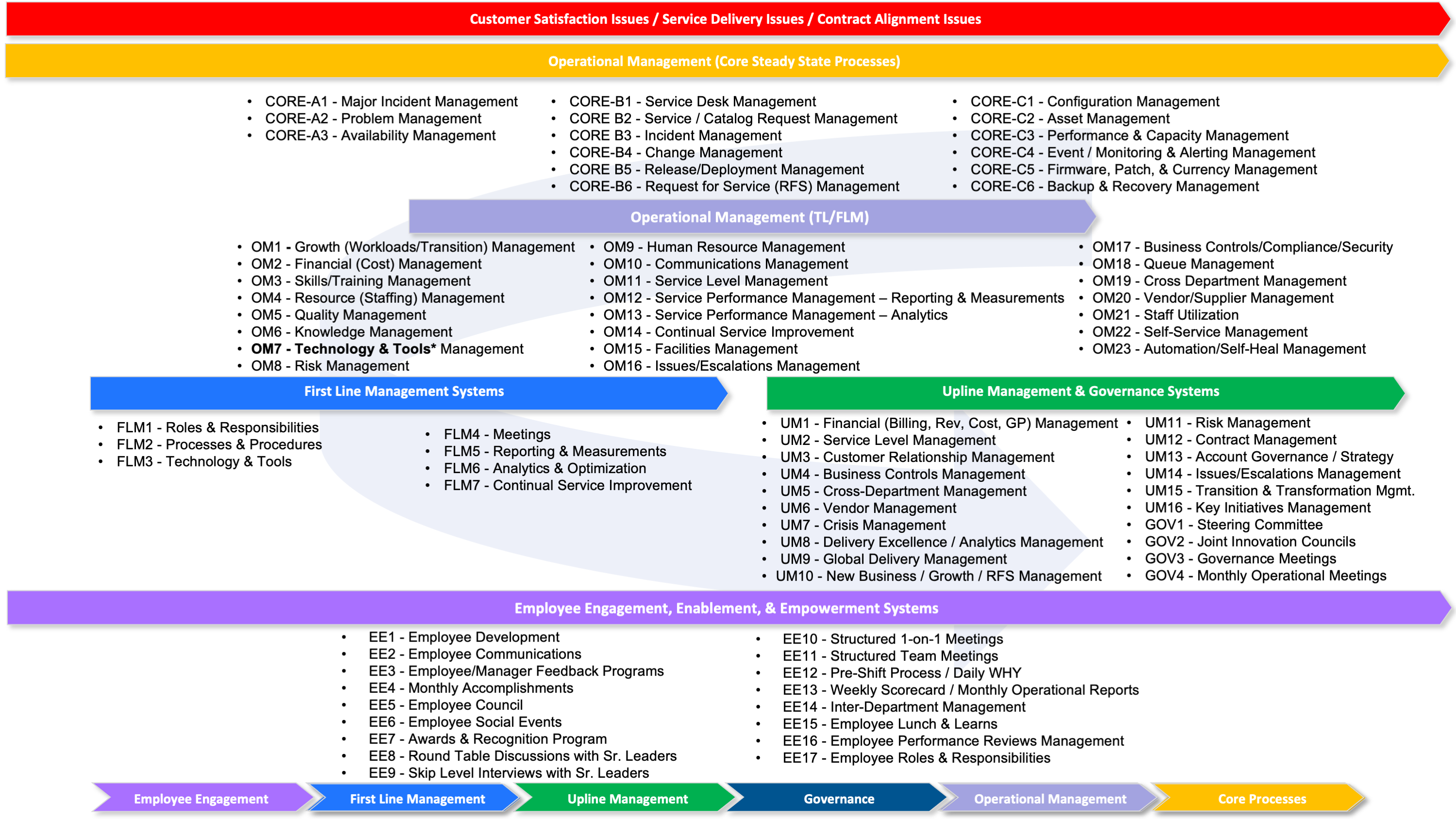
Exercise: What elements of the Operational Management Framework do you think have an impact on Total Quality Management?
Subscribe To My Blog To Learn More: https://www.imadlodhi.com/subscribe


