There’s a persistent myth in sales: the idea that a great salesperson can win the deal.
In complex enterprise sales, that is rarely how it works.
The account executive may be the most visible person in the pursuit, but behind a serious technology, managed-services, outsourcing, or transformation deal you may have SDRs, marketing, solution architects, pre-sales, finance, commercial teams, legal, delivery leaders, customer success, executives, and specialists all contributing to the outcome.
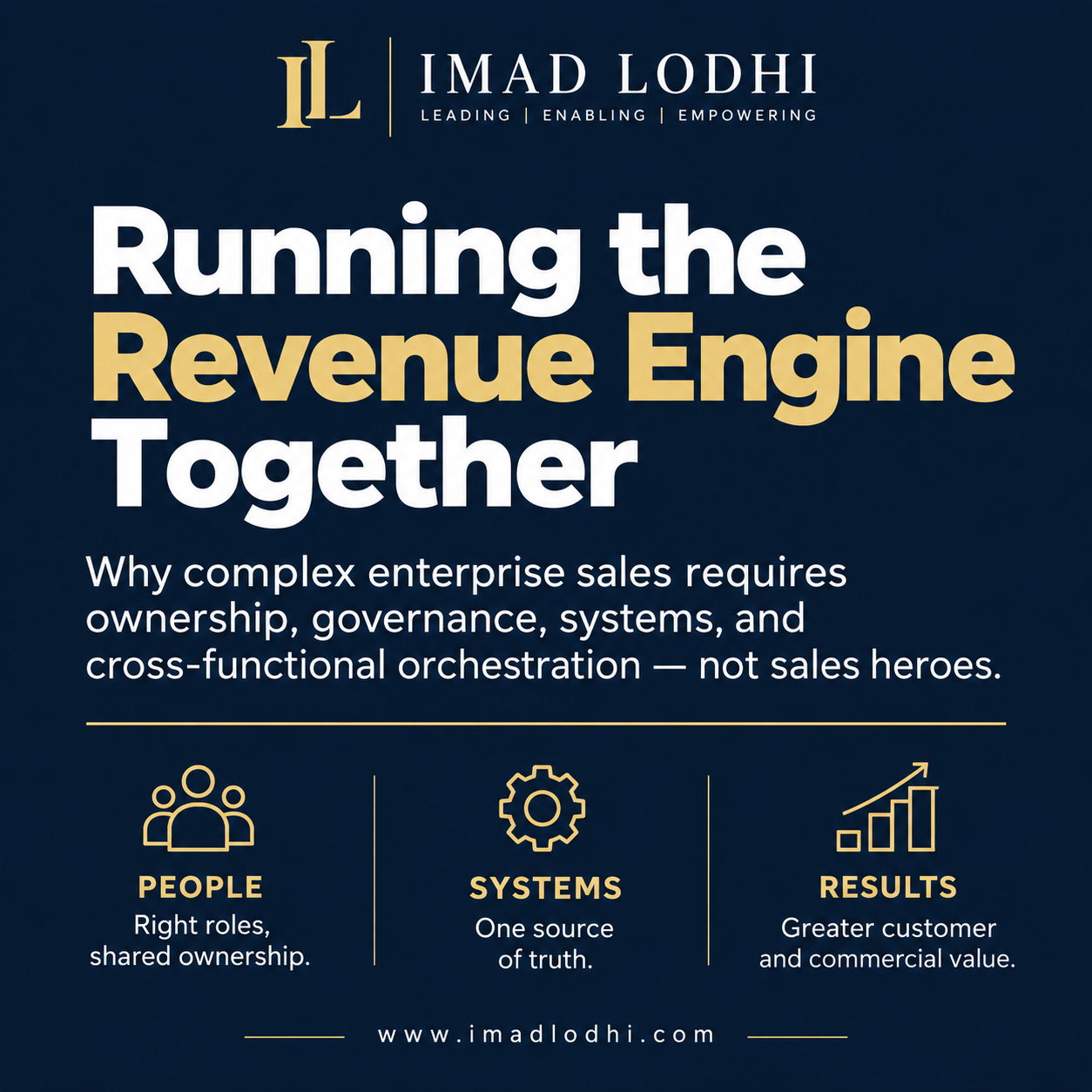
Sales is not a single-hero effort. It is an orchestrated revenue system.
One Opportunity Owner
In my experience, complex opportunities worked best when somebody clearly owned the pursuit. That might be a Client Solutions Executive, Account Executive, or another designated opportunity owner.
The title matters less than the accountability.
Someone has to ensure the different teams are working toward the same objective, risks are surfaced, decisions are made, resources are coordinated, and the economics of the opportunity remain viable. P&L ownership can make that accountability even more tangible.
One Source of Truth
This is where CRM matters. A CRM should contain more than a pipeline stage and expected close date. It should preserve customer intelligence, stakeholders, opportunity status, actions, risks, commitments, next steps, financial information, and important decisions.
When that information lives in email, spreadsheets, PowerPoint decks, notebooks, and people’s memories, coordination becomes fragile.
But there is an important distinction: a CRM can tell you where a deal is. A sales management system should tell you how you’re going to move it.
One Pursuit Strategy
For larger opportunities, we used structured win plans and deal-management disciplines so everybody understood what we were trying to win, why the client should choose us, what could cause us to lose, and what each participant needed to do.
Without that structure, teams can be individually busy while collectively going nowhere.
Marketing generates activity nobody follows up on. Pre-sales gets pulled into poorly qualified opportunities. Solution teams design something the customer never asked for. Commercial teams arrive late and discover margin problems. Delivery inherits commitments it never agreed to.
Everybody worked hard. The deal still went sideways.
A Defined Operating Model
Running a revenue engine requires many of the same management systems required to run an operation: clear roles and responsibilities, defined processes and procedures, usable technology and tools, governance meetings, reporting and measurements, analytics, and continual optimization.
The objective is not bureaucracy. The objective is coordinated execution.
If an opportunity stalls, the system should help management determine why. Is there a qualification problem? A missing stakeholder? Weak value articulation? Pricing resistance? A solution gap? Competitive risk? Internal approval latency? Or simply no compelling customer reason to act?
Management Cadence Matters
This is also where sales managers earn their keep.
Their job is not simply to ask, “Are we closing this quarter?”
Good sales management brings governance, cadence, challenge, coaching, resource coordination, escalation, and decision support. Managers test assumptions. They identify gaps. They remove barriers. And they make sure an opportunity is actually progressing rather than merely aging inside the CRM.
Key Takeaways
Enterprise revenue performance is not created by assembling talented individuals and giving them CRM licences.
It comes from orchestrating people, process, technology, information, governance, accountability, and management cadence around a common customer objective.
The superstar salesperson may still matter.
But in complex enterprise sales, the stronger competitive advantage is often the system operating behind them.


