


Contact Center
Contact Center Rescue Series: How to Identify Factors That Impact Client Experience
Disruptions to the availability of products and services can have a significant impact on client satisfaction. In this blog post, we will discuss the Client Experience Analysis process, which aims to identify factors that have both a positive and negative impact on client satisfaction. We will also discuss how you can use this data to improve your business performance!
Client experiences are being negatively impacted by issues such as poor communication, lack of transparency, unresponsive customer service, and inadequate products or services.
These issues can lead to frustration and dissatisfaction among clients, resulting in a decline in business and a negative reputation. In addition, external factors such as industry trends and competition can further exacerbate these problems.
To improve client experiences and address these issues, it is necessary to adopt a comprehensive approach that considers all relevant factors and involves the participation and collaboration of all stakeholders. This can include implementing better communication channels, increasing transparency and accountability, improving customer service responsiveness, and enhancing the quality and value of products or services. It may also involve adapting to industry trends and staying ahead of competition. By addressing the root causes of these issues and implementing effective strategies, it is possible to significantly improve client experiences and drive business success.
Client experience is a crucial factor in the success of any business, as it directly impacts customer satisfaction and loyalty. However, there are several issues that can negatively impact client experiences, such as poor communication, lack of transparency, unresponsive customer service, and inadequate products or services. These issues can lead to frustration and dissatisfaction among clients, leading to a decline in business and a negative reputation.
Factors that can impact client experiences include the quality of products or services, the level of personalization and customization, the efficiency and effectiveness of processes, and the overall culture and values of the organization. In addition, external factors such as industry trends and competition can also affect client experiences.
To address these issues and improve client experiences, it is necessary to identify and understand the root causes and implement effective strategies to address them. This requires a comprehensive approach that considers all relevant factors and involves the participation and collaboration of all stakeholders.
The Client Experience Analysis process begins with data collection. This data can come from a variety of sources, including surveys, interviews, focus groups, and observations. Once the data has been collected, it is analyzed to identify patterns and trends. This analysis can be used to identify factors that have a positive or negative impact on client satisfaction.
Clients, whether Internal or External, expect their products and services to be available when they need them. Any disruptions in the form of unplanned interruptions or degraded performance can have a significant impact in the ability of the Users to conduct their business and have a negative impact on the business performance in the form of impacted revenues, profits, and customer/employee satisfaction. The Client Experience Analysis process aims to establish a mechanism where data can be harvested to identify factors that have both a positive and negative impact on the Client Experience.
This data can then be used to help improve the client experience by implementing changes that aim to reduce the negative impacts and/or amplify the positive impacts.
The first step in conducting a Client Experience Analysis is to establish what factors will be measured. These factors can be divided into two main categories: those that are within the control of the company and those that are outside of the company's control. Once the factors have been identified, data needs to be collected in order to establish baselines and identify any trends.
This data can come from a variety of sources, such as the top six areas that provide the greatest insights: 1 – Customer Satisfaction, 2 – Customer Escalations, 3 – First Call Resolution rates at the Service Desk, 4 - Ticket Backlogs, 5 - MTTR, and 6 - Employee Experience.
The Client Experience Analysis process is a valuable tool for understanding the factors that have both a positive and negative impact on client satisfaction. If you would like to learn more about how your business can improve its client experience, contact us today. Our team of experts has years of experience helping businesses deliver exceptional customer experiences. We look forward to working with you!

The Objective of The Process:
The Objective of the Client Experience Analysis process is to understand, manage, and improve the overall client experience by maintaining focus on the top six areas that provide the greatest insights: 1 – Customer Satisfaction, 2 – Customer Escalations, 3 – First Call Resolution rates at the Service Desk, 4 - Ticket Backlogs, 5 - MTTR, and 6 - Employee Experience.
- Understand all elements are the Customer Satisfaction surveys are comprised of 1 – Incoming Volumes, Surveys Sent, Surveys Received, Comments of Satisfied Users, Comments of Unsatisfied Users, Personas of the Users, Personas Of the Technical Teams, Types of issues contributing to Sat/Dissat surveys, etc.
- Understand all the escalations from a quantitative and qualitative standpoint.
- Understand the Service Desk efficiency rates
- Understand the impact of Response/Resolve Times (MTTR) on Customer Satisfaction
- Understand the impact of Ticket Backlogs on Customer Satisfaction
- Understand the impact of Employee Experience on Customer Satisfaction
Sample List of Benefits:
- Improved survey response rates
- Improved satisfaction scores and reduced dissatisfied scores
- Reduced escalations
- Improved response/resolve times to escalations
- Improve First Time Fix rates at the service desk
- Improved Employee Experience
Sample List of Observations:
- Impact of Backlog on CSAT scores
- Lower survey return rates
- Lack of responsiveness from the Technical Teams to dissatisfied comments
- Lack of actions being taken from the Technical Teams to address chronic reasons for dissatisfied surveys
- Delayed response to escalations
- Lack of action on escalations
- Lack of understanding and addressing of chronic issues contributing to the escalations
- Lack of process compliance at the Service Desk leading to missed First Time Fix opportunities
- Issues with Skills at the Service Desk
- Issues with Knowledge Management at the Service Desk
- Issues with Quality Management at the Service Desk
- Issues with Service Desk Line Management systems
Sample List of Areas to Probe (Customer Satisfaction):

- What is the monthly incident volume? PBA
- What is the monthly survey count (sent)? PBA
- What is the monthly survey count (received)? PBA
- What is the industry baseline for surveys received?
- What percentage do surveys represent of the total volume?
- What is the monthly breakdown of Sat and Dissat surveys? PBA
- How many dissats have comments?
- What is the quality of the dissat comments?
- Conduct sensitivity analysis of the dissat comments to detect any signals.
- Plot the dissats across a PBA time series and see if any patterns exist?
- Are the dissats confined to a time of hour
- Are the dissats confined to a time of day
- Are the dissats confined to a day of the week
- Are the dissats confined to a week of the month
- Are the dissats confined to a time of quarter
- Are the dissats confined to a month of the year
- Check if the dissats are for the survey sent or is the user referring to something else. Waiver.
- Check if the dissats are for child tickets. Waiver.
- What RCA categories do the dissats fall into? PARETO
- Which towers are generating the dissats and what are the dissat categories?
- Which assignment groups are generating the dissats and what are the dissat categories?
- Which agents are generating the dissats and what are the dissat categories?
- What types of tickets (Category/Subcategory/Requested Item) are generating the dissats?
- Which users/business units/organization/location/country are generating the dissats?
- Which type of users (Standard/VIP) are generating dissats?
Sample List of Areas to Probe (Escalations):

- What is the monthly incident volume? PBA
- What is the monthly escalation count? PBA
- What percentage do escalations represent of the total volume?
- What is the monthly breakdown of Uplift and Overdue escalations?
- How many escalations have comments?
- What is the quality of the escalation comments?
- Conduct sensitivity analysis of the escalation comments to detect any signals.
- Plot the escalations across a PBA time series and see if any patterns exist?
- Are the escalations confined to a time of hour
- Are the escalations confined to a time of day
- Are the escalations confined to a day of the week
- Are the escalations confined to a week of the month
- Are the escalations confined to a time of quarter
- Are the escalations confined to a month of the year
- What RCA categories do the escalations fall into? PARETO
- Which towers are generating the escalations and what are the escalations categories?
- Which assignment groups are generating the escalations and what are the escalations categories?
- Which agents are generating the escalations and what are the escalations categories?
- What types of tickets (Category/Subcategory/Requested Item) are generating the escalations?
- Which users/business units/organization/location/country are generating the escalations?
- Which type of users (Standard/VIP) are generating escalations?
Sample List of Areas to Probe (MTTR):

- Collect and review the MTTR YTD performance with Opened and Resolved/Closed flow rates
- Identify any patterns, signals, anomalies
- Identify if there are issues with MIO skills, capability, and capacity
- Identify if there are issues with response times
- Identify if there are issues with restoration times
- Identify if there are issues with coordination on MIO bridge calls
- Identify if there are skills and capabilities issues
- Identify if there are capacity issue
- Identify if there are issues with vendor engagement
- Identify if there are issues with L2/L3 engagement
- Identify if there are issues with recovery procedures
- Identify which teams have contributed to higher MTTR
- Identify which agents are contributing to higher MTTR
- Identify which Applications/Infra components are contributing to MTTR
- Identify via a time series analysis of MTTR varies by time of day, day of week, week of the month, month of the year
- Identify if MTTR is impacted if issues span multiple teams
- Identify if MTTR varies on repeat/chronic issues
- Identify if there are issues with monitoring and alerting
- Identify if there are issues with event management
Sample List of Areas to Probe (Ticket Backlogs):

- Compare overall Backlog count to the Healthy Backlog target that has been set and determine if the current backlog is healthy or unhealthy? To determine the healthy target, factor in, incoming volumes, resolution SLAs, typical SLA hold usage, 3 strike policy, etc.
- Compare current backlog to previous week backlog count and determine % increase/decrease.
- Explain the root cause of any variance.
- Have overall counts changed?
- Have counts in various buckets changed due to work being done or lack of work and tickets are shifting to the right? (30 days to 60 days to 120 days, etc.)
- Review distribution of aging tickets across a by-week timeline to identify severely aged tickets. Explain the aged tickets.
- Review aged tickets by Incident State and Days Aging and compare current week against previous week to identify shifts in age groups.
- Review aged tickets by Incident State and Days Aging to identify the distribution of aged tickets by state and days aging. Identify oldest groups and explain why.
- Review aged tickets by Incident State and Last Update date (by week) to identify which tickets have not been updated in a timely manner.
- Review aged tickets by Incident State, Days Aging and Escalation Type to identify if Users are escalation aged tickets.
- Review aged tickets by Incident State Reason and Days Aging to identify reasons for why backlog tickets are on SLA Hold.
- Review aged tickets by category and days aging to identify and anomalies. Drill down by looking at short description.
- Review aged tickets by subcategory and days aging to identify and anomalies. Drill down by looking at short description.
- Review aged tickets by contact type and days aging to identify and anomalies. Drill down by looking at short description.
- Review aged tickets by Assigned To and days aging to identify and anomalies. Drill down by looking at short description.
- Review aged tickets by Assignment group and days aging to identify and anomalies. Drill down by looking at short description.
Sample List of Areas to Probe (FCR):

- Review skills and training management program which includes skill gap analysis at regular intervals
- Review the knowledgebase and ensure there is a knowledge management program in place to provide current and accurate information
- Review the total quality management program to ensure that calls, tickets, surveys and other sources of work are being looked at to improve the overall quality.
- Review the service performance management program. Specifically, the reporting and measurements system to track and trend the team's performance.
- Review the service performance management program. Specifically, the analytics and optimization system to ensure insights are being harvested from their performance and recommendations are being made to drive improvement.
- Review the continual service improvement program. Ensure all observations and findings are being tracked in the CSI register and improvement is being made.
- Review employee engagement, enablement, and empowerment systems. Specifically, implement an awards and recognition program. Having engaged and connected employees will contribute to the FCR results.
Sample List of Areas to Probe (Employee Experience):

- Review Employee Engagement, Enablement, and Empowerment systems to reconnect with employees:
- EE1 - Employee Development
- EE2 - Communications
- EE3 - Employee/Manager Feedback Programs
- EE4 - Monthly Accomplishments
- EE5 - Employee Council
- EE6 - Employee Social Events
- EE7 - Awards and Recognition Program
- EE8 - Round Table Discussions with Sr. Leaders
- EE9 - Skip Level Interviews with Sr. Leaders
- EE10 - Structured 1-on-1 Meetings
- EE11 - Structure Team Meetings
- EE12 - Pre-Shift Process / Daily WHY
- EE13 - Weekly Scorecard / Monthly Operational Reports
- EE14 -Inter-Department Management
- EE15 - Employee Lunch and Learns
- EE16 - Employee Roles and Responsibilities
- EE 17 - Employee Performance Reviews Management
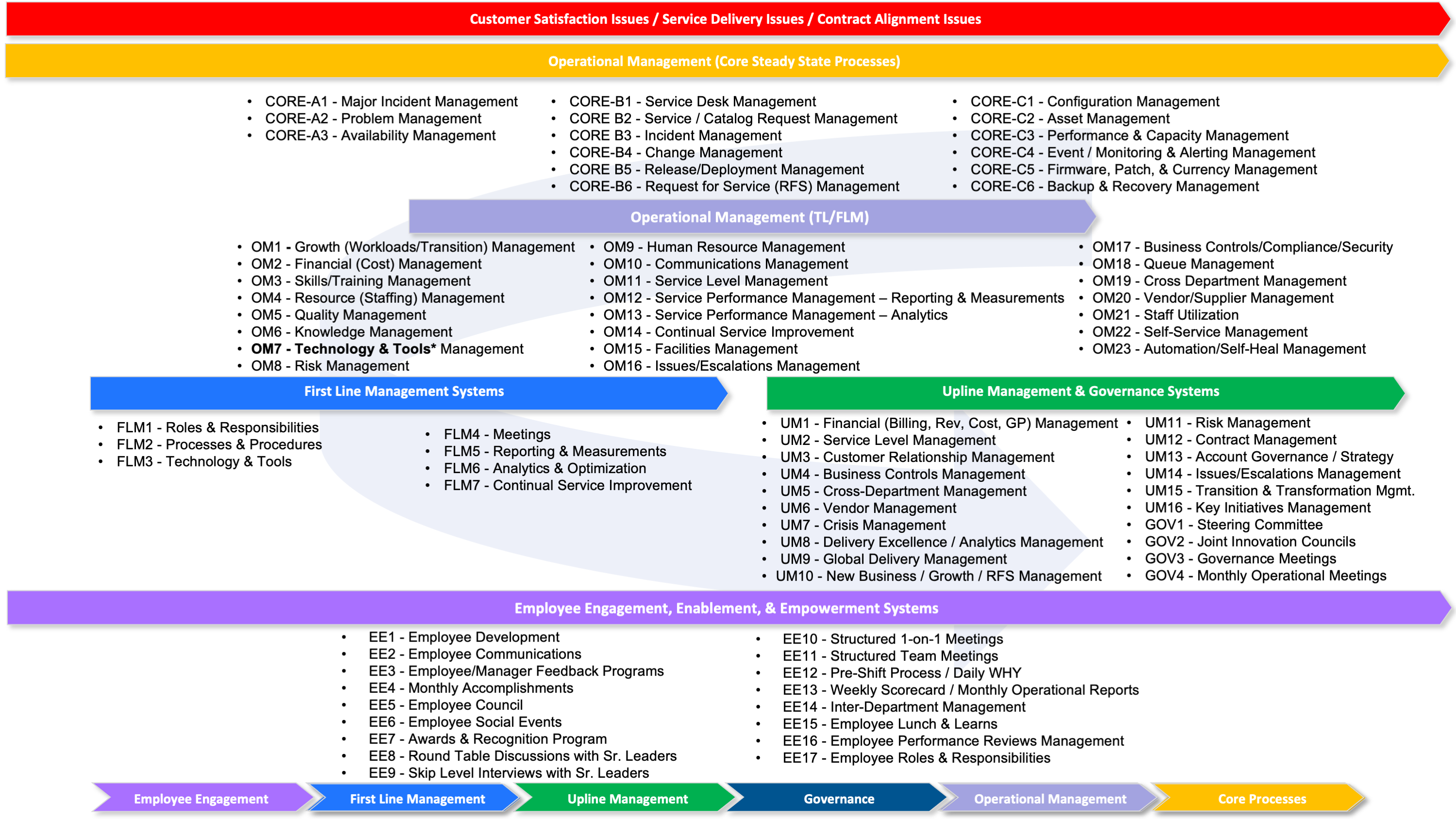
Exercise: What elements of the Operational Management Framework do you think have an impact on Client Experience?
Subscribe To My Blog To Learn More: https://www.imadlodhi.com/subscribe

Contact Center
Unlocking The Power Of Mean Time To Repair (MTTR) In Contact Centers: Understanding How To Measure And Improve MTTR For Enhanced Customer Experience And Business Efficiency
Mean Time to Repair (MTTR) is a crucial metric used to measure the effectiveness of service provided in contact centers. It measures the average length of time it takes for a contact center representative or technical team to diagnose and repair problems, and restore normal operations. In this guide, we will explore the importance of MTTR and how it can be used to improve customer experience and business efficiency.
Are you struggling to understand how to measure and improve your contact center's performance? Are you looking for a way to ensure that your customers are receiving the best possible service in a timely manner?
Are you tired of dealing with customer complaints and poor satisfaction rates? Do you want to know the root cause of your contact center's inefficiencies?
Discover the power of Mean Time to Repair (MTTR) in measuring and improving your contact center's performance. Learn how to diagnose and repair problems quickly and effectively, leading to enhanced customer experience and business efficiency.
Summary:
Mean Time to Repair (MTTR) is a crucial metric used to measure the effectiveness of service provided in contact centers. It measures the average length of time it takes for a contact center representative or technical team to diagnose and repair problems, and restore normal operations. In this guide, we will explore the importance of MTTR and how it can be used to improve customer experience and business efficiency.
Introduction
Mean Time to Repair (MTTR) is an important metric used to measure the effectiveness of service provided in contact centers. It measures the average length of time it takes for a contact center representative or technical team to diagnose and repair problems, and restore normal operations. In essence, it works as an indicator of how quickly the contact center is able to respond to customer inquiries, service requests, and product failures. The lower the MTTR that a contact center can achieve, the better its overall efficiency and performance will be. Additionally, this metric sheds light on areas where improvements need to occur in order to ultimately improve customer experience while providing support. Keeping MTTR low will positively affect both customers and businesses, allowing them to benefit from improved response times and satisfaction rates.
What Are We Looking For When We Try To Understand MTTR?:
The Objective of the MTTR Analysis process is to ensure that the response and resolve times to identified failures are within expectations and improvement opportunities are continually being looked at to minimize failures.
- Obtain an understanding of MTBF (Mean Time Between Failures), MTTR(Mean Time To Repair/Recover/Restore/Resolve/Respond), MTTA (Mean Time To Acknowledge), and MTTF (Mean Time To Failure)
- Establish data collection and calculation methods
- Identify the Impact (Outage Duration x Number of Users x Labour Rate)
- Identify where the problem lies in the process
- Address issues with Monitoring and Alerting
- Address delays in restoring service by teams
- Address issues with response times
- Address delays between failure and alert
- Address issues with alerts taking longer than they should to get to right person
- Address issues with the process of diagnostics
- Address issues with delays in the repair process
What Are Some Sample Benefits When We Bring MTTR Under Control?:
- Accuracy of measurements
- Identification of process gaps
- Improving the effectiveness of Monitoring and Alerting and Event Management
- Improved Response Times
- Improved identification and responsiveness to alerts so failures could be avoided
- Improved Resolution/repair times
- Improved diagnostics
Problem Overview:
Skills, capability, and capacity issues on technical teams, issues with monitoring and alerting, performance and capacity issues, coordination issues with Major Incident Owners (MIO), repeat and chronic issues, and a lack of proper Problem Management process are all common problems that can lead to a high Mean Time to Repair (MTTR) in a contact center. These problems can cause delays in problem diagnosis and resolution, leading to longer wait times for customers and poor satisfaction rates.
- Skills, Capability, and Capacity Issues on Technical Teams: One major problem that can lead to a high MTTR is the lack of proper skills, capability, and capacity on technical teams. This can occur when teams are not properly trained or when they lack the necessary experience or knowledge to diagnose and resolve problems effectively. This can lead to longer wait times for customers as technical teams struggle to find solutions, and can also lead to poor customer satisfaction.
- Issues with Monitoring and Alerting: Another problem that can lead to a high MTTR is issues with monitoring and alerting. This can occur when contact centers do not have proper monitoring systems in place or when alerts are not configured correctly. This can lead to delays in detecting and responding to problems, leading to longer wait times for customers and poor satisfaction rates.
- Issues with Performance and Capacity: Performance and capacity issues can also lead to a high MTTR. This can occur when contact centers do not have the necessary resources, such as staff and technology, to handle a high volume of inquiries, service requests, and product failures. This can lead to longer wait times for customers and poor satisfaction rates.
- Issues with MIO Coordination: Coordination issues with Major Incident Owners (MIO) can also lead to a high MTTR. This can occur when MIOs are not properly trained or when they lack the necessary experience or knowledge to diagnose and resolve problems effectively. This can lead to delays in problem diagnosis and resolution, leading to longer wait times for customers and poor satisfaction rates.
- Issues with Repeat and Chronic issues: Another problem that can lead to a high MTTR is repeat and chronic issues. This can occur when contact centers do not have proper problem management processes in place, leading to the same issues being reported multiple times without proper resolution. This can lead to frustration for customers and poor satisfaction rates.
- Issues with a Lack of Proper Problem Management Process: A lack of proper problem management process can also lead to a high MTTR. This can occur when contact centers do not have a clear and systematic approach to diagnose and resolve problems. This can lead to delays in problem diagnosis and resolution, leading to longer wait times for customers and poor satisfaction rates.
Solution Overview:
To improve Mean Time to Repair (MTTR) in a contact center, there are several strategies that can be implemented. These include strengthening the Major Incident Owner (MIO) team's leadership and technical skills, involving architects during Client Impacting Events, implementing Business Recovery Managers, conducting skill gap analysis of technical teams, ensuring the on-call process is up to date and compliant, ensuring tower leadership on all CIE calls, ensuring Problem Management has visibility and is effective, and collecting and reviewing the MTTR year-to-date performance. Additionally, it is important to identify patterns, signals, and anomalies, and to identify if there are issues with MIO skills, capability, and capacity, response times, restoration times, coordination on MIO bridge calls, skills and capabilities issues, capacity issues, vendor engagement, L2/L3 engagement, recovery procedures, teams contributing to higher MTTR, agents contributing to higher MTTR, Applications/Infra components contributing to MTTR, time series analysis of MTTR varying by time of day, day of week, week of the month, month of the year, issues spanning multiple teams, repeat/chronic issues, monitoring and alerting, and event management.
- Strengthen the MIO Team's Leadership and Technical Skills: To improve MTTR, it is important to strengthen the MIO team's leadership and technical skills. This can be achieved by providing ongoing training and development for MIOs to improve their problem diagnosis and resolution skills. Additionally, it is important to ensure that MIOs have the necessary experience and knowledge to diagnose and resolve problems effectively.
- Involve Architects during Client Impacting Events: To improve MTTR, it is important to involve architects during Client Impacting Events (CIE) when Major Incident and MIO Invoked are true. This can ensure that the correct personnel are involved in problem diagnosis and resolution, leading to faster problem resolution times.
- Implement Business Recovery Managers: To improve MTTR, it is important to implement Business Recovery Managers. This can ensure that recovery procedures are in place and effective in case of a major incident.
- Conduct Skill Gaps Analysis of Technical Teams: To improve MTTR, it is important to conduct a skill gap analysis of technical teams. This can help to identify areas where training and development are needed to improve problem diagnosis and resolution skills.
- Ensure On-call Process is up to date and Compliant: To improve MTTR, it is important to ensure that the on-call process is up to date and compliant. This can help to ensure that the correct personnel are involved in problem diagnosis and resolution in a timely manner.
- Ensure Tower Leadership on all CIE calls: To improve MTTR, it is important to ensure tower leadership on all CIE calls. This can help to ensure that the correct personnel are involved in problem diagnosis and resolution, and that the incident is managed effectively from start to finish. This includes having clear roles and responsibilities, effective communication, and a well-defined incident management process.
- Ensure Problem Management has Visibility and is Effective: To improve MTTR, it is important to ensure that Problem Management has visibility into all incidents and is effective in managing them. This includes having a clear problem management process in place, with defined steps for problem identification, analysis, and resolution. This also includes having the necessary tools and technologies in place to effectively manage incidents and track progress.
- Collect and Review the MTTR YTD Performance with Opened and Resolved/Closed Flow Rates: To improve MTTR, it is important to collect and review the MTTR year-to-date performance with opened and resolved/closed flow rates. This can help to identify patterns and trends in incident resolution times, and to identify areas where improvements can be made.
- Identify Patterns, Signals, and Anomalies: To improve MTTR, it is important to identify patterns, signals, and anomalies in incident resolution times. This can help to identify areas where improvements can be made and to identify problem areas that may be contributing to higher MTTR.
- Identify Issues with MIO Skills, Capability, and Capacity: To improve MTTR, it is important to identify if there are issues with MIO skills, capability, and capacity. This can help to identify areas where training and development are needed to improve problem diagnosis and resolution skills.
- Identify Issues with Response Times: To improve MTTR, it is important to identify if there are issues with response times. This can help to identify areas where improvements can be made to ensure that incidents are being handled in a timely manner.
- Identify Issues with Restoration Times: To improve MTTR, it is important to identify if there are issues with restoration times. This can help to identify areas where improvements can be made to ensure that incidents are being resolved in a timely manner.
- Identify Issues with Coordination on MIO Bridge Calls: To improve MTTR, it is important to identify if there are issues with coordination on MIO bridge calls. This can help to identify areas where improvements can be made to ensure that the correct personnel are involved in problem diagnosis and resolution.
- Identify Skills and Capabilities Issues: To improve MTTR, it is important to identify if there are skills and capabilities issues. This can help to identify areas where training and development are needed to improve problem diagnosis and resolution skills.
- Identify Capacity Issues: To improve MTTR, it is important to identify if there are capacity issues. This can help to identify areas where improvements can be made to ensure that the contact center has the necessary resources to handle a high volume of inquiries, service requests, and product failures.
- Identify Issues with Vendor Engagement: To improve MTTR, it is important to identify if there are issues with vendor engagement. This can help to identify areas where improvements can be made to ensure that vendors are providing the necessary support and resources to help resolve incidents.
- Identify Issues with L2/L3 Engagement: To improve MTTR, it is important to identify if there are issues with L2/L3 engagement. This can help to identify areas where improvements can be made to ensure that the correct personnel are involved in problem diagnosis and resolution at the appropriate levels. Engaging the correct level of support can lead to more efficient problem resolution and faster restoration times.
- Identify Issues with Recovery Procedures: To improve MTTR, it is important to identify if there are issues with recovery procedures. This can help to identify areas where improvements can be made to ensure that recovery procedures are in place and effective in case of a major incident.
- Identify Which Teams Have Contributing to Higher MTTR: To improve MTTR, it is important to identify which teams have contributed to higher MTTR. This can help to identify areas where improvements can be made to ensure that all teams are working effectively to resolve incidents.
- Identify Which Agents are Contributing to Higher MTTR: To improve MTTR, it is important to identify which agents are contributing to higher MTTR. This can help to identify areas where improvements can be made to ensure that all agents are providing effective support to customers.
- Identify Which Applications/Infra Components are Contributing to MTTR: To improve MTTR, it is important to identify which Applications/Infra components are contributing to MTTR. This can help to identify areas where improvements can be made to ensure that all systems and technologies are working effectively to resolve incidents.
- Identify via a Time Series Analysis of MTTR varies by Time of Day, Day of Week, Week of the Month, Month of the Year: To improve MTTR, it is important to identify via a time series analysis how MTTR varies by time of day, day of week, week of the month, and month of the year. This can help to identify patterns and trends in incident resolution times and to identify areas where improvements can be made.
- Identify if MTTR is Impacted if Issues Span Multiple Teams: To improve MTTR, it is important to identify if MTTR is impacted when issues span multiple teams. This can help to identify areas where improvements can be made to ensure that all teams are working effectively together to resolve incidents.
- Identify if MTTR Varies on Repeat/Chronic Issues: To improve MTTR, it is important to identify if MTTR varies on repeat/chronic issues. This can help to identify areas where improvements can be made to ensure that repeat/chronic issues are being resolved effectively.
- Identify if there are Issues with Monitoring and Alerting: To improve MTTR, it is important to identify if there are issues with monitoring and alerting. This can help to identify areas where improvements can be made to ensure that monitoring systems are working effectively and that alerts are configured correctly.
- Identify if there are Issues with Event Management: To improve MTTR, it is important to identify if there are issues with event management. This can help to identify areas where improvements can be made to ensure that events are being handled effectively and that the correct personnel are involved in problem diagnosis and resolution.
Conclusion
Mean Time to Repair (MTTR) is a crucial metric for measuring the effectiveness of service provided in contact centers. By understanding and measuring MTTR, contact centers can identify areas for improvement and work to reduce MTTR, ultimately leading to enhanced customer experience and business efficiency.
Don't wait any longer. Visit https://www.imadlodhi.com/landing-page today and start your journey, one step at a time. My guide offers a wealth of insights and tools to help you improve your management and leadership skills. If you're ready to take your management skills to the next level, visit https://www.imadlodhi.com/subscribe and subscribe. This is the perfect resource for you. Join now and start seeing real results in your team and business.
Exercise: What elements of the Operational Management Framework do you think have an impact on MTTR?

Contact Center
Contact Center Rescue Series: Reducing Wait Times
The objective of the reducing service desk wait times process is to improve the service desk call handling skills through the implementation of the operational management reference framework. The framework will allow the service desk leadership to implement and/or strengthen the key processes that have a direct impact on the wait times and client experience.
The call wait times in our contact center are currently too long, causing frustration for our customers and potentially leading to a loss of business.
This problem is causing our customers to feel frustrated and dissatisfied customers are less likely to continue doing business with us. In addition, long call wait times can also negatively impact our reputation and lead to a loss of potential new customers.
In order to address this issue and improve the customer experience, we need to identify the root causes of the long wait times and implement solutions to address them. Possible solutions may include increasing the number of agents available to handle calls, improving the efficiency of our call routing system, implementing self-service options for customers, and investing in additional technology or resources to improve the overall capacity of the contact center. By implementing these solutions, we can significantly reduce call wait times and improve the customer experience, leading to increased customer satisfaction and potentially even increased business.
Are you looking for ways to reduce contact center wait times? If so, you're in the right place. In this blog post, we'll share tips and tricks to help keep your customers happy and your wait times low. So let's get started!
Imagine you have a deadline to get a proposal out and suddenly your email is not working. You call the service desk and you discover that either you are just waiting in the queue or you are told you will have a 4 hr wait. What would you do?
You decide to hang up and try the chat option. There you discover that you are number xxxx in the queue and you are given an estimated wait time of 8 hrs. What would you do?
You then decide to head over to the self-service site to see if you can submit a web ticket or get some information on what is going on. To your dismay, there is no status message mentioning any email problems. You try to submit a web ticket, but you are unable to navigate all the selections because they are very confusing. What would you do?
Now imagine, you finally get to an agent after hours of waiting and the call gets disconnected. How upset would you be?
This situation is not uncommon. While the wait times may be extreme in this case, far too often, clients are finding that they are either dealing with telephony problems in trying to get to the service desk. Dealing with confusing IVR menu options trying to get to the service desk. Or, waiting too long to get support from the service desk.
One of the biggest cause of poor client experience with the service desk is Wait Times. So what factors have an impact on Wait Times and what can you do to reduce it?
Utilize an AI-powered chatbot to deflect routine inquiries and free up your agents
AI-powered chatbots are an ideal way to improve customer service performance, save costs, and optimize operations. Chatbots can help deflect routine inquiries, freeing up agents for more complex issues that require human interaction. Utilizing a chatbot is simple - you customize it to respond verbatim or offer pre-programmed options - so that customers can easily navigate the response they need without waiting in line for an agent. Furthermore, chatbots provide an improved customer experience as users benefit from getting immediate feedback and quick resolution of their inquiries. Leverage this technology to upgrade your customer service offering, elevate your staff's productivity and drive overall efficiency.
Automate certain processes like password reset or order status updates
Automation has the potential to drastically increase the efficiency of certain tedious processes in business. By automating tasks like password reset or order status updates, organizations can save time for their staff and customers and improve customer satisfaction. Automation also covers up potential human errors that may occur when completing these types of tasks manually. Furthermore, with the right automation solution, organizations can rest assured knowing they have consistent safeguards in place to ensure high levels of accuracy across all automated processes and operations. All of these benefits make automation an indispensable part of any modern organization’s strategy.
Train your agents on active listening and empathy so they can better understand caller needs
Active listening and empathy are essential skills for any customer service agent. It's through these techniques that agents can fully appreciate the needs of a caller, rather than just providing answers to their questions. Training your agents in active listening and empathy will ensure that every interaction with a customer gives them a sense of being valued and understood, leading to better outcomes for both parties. From fewer misunderstandings to decreased call times and increased satisfaction levels, there are plenty of benefits to training your agents in this area. Investing in your agents' development will pay off in the long run, as they proactively respond with more meaningful exchanges that result in heightened customer relationships.
Encourage customers to self-serve through your website or mobile app when possible
Self-service is an important part of the modern customer experience, and it's something we firmly believe in at our business. By taking advantage of our website or mobile app, customers can access features and services with ease. We encourage them to try self-serving whenever possible, as it not only makes their life easier, but it also reduces wait times for everyone. Our system is designed with convenience and efficiency in mind, working to make sure that users can get the help they need without having to talk to a representative. If any issues do arise, however, trained professionals are always standing by to answer questions or provide additional guidance.
Offer multiple channels for customer support including phone, email, chat, and social media
Offering multiple channels for customer support provides convenience, accessibility and a level of choice that can enhance your customers’ experience. Phone, email, chat and social media are reliable methods for resolving queries quickly and effectively. Our commitment to excellent customer service is unwavering as we strive to ensure each interaction with our team members is pleasant and satisfactory. Not only do these channels allow us to provide better service to our existing customers but they create a platform for us to reach more potential customers. By having multiple communication approaches available, we are confident that everyone will find their ideal way of engaging with our business.
By automating routine inquiries and providing customer support through multiple channels, you can free up your agents to provide more personalized service. With the right training, your agents will be able to better understand caller needs and offer solutions that exceed customer expectations. Want to learn more? Subscribe to our blog for updates on the latest trends in AI-powered chatbots and customer support.
Let's take a more detailed view:
The Objective of The Process:
The objective of the reducing service desk wait times process is to improve the service desk call handling skills through the implementation of the operational management reference framework. The framework will allow the service desk leadership to implement and/or strengthen the key processes that have a direct impact on the wait times and client experience.
Sample List of Benefits:
- Reduce Wait Times in the Queue
- Reduce Abandonment Rates
- Improve Average Call Handling Times (AHT)
- Improve Client Experience (CSAT/NPS)
- Minimize the number of service disruptions and calls to the service desk
- Improve Uptime and Availability of products and services
- Improved User productivity
- Address issues with repeat and chronic issues so repeat calls can be avoided
- Improve Response Times and Reduce MTTR
Sample List of Observations:
Let's take a look at the Operational Management Reference Framework to see some of the elements that impact this issue:
- OM1 - Growth Management. If you don't have your operational team or workforce team monitoring the workloads the service desk is dealing with, you could end up in situations where you do not have adequate staffing or staffing is not aligned with call arrival patterns. This can lead to Prolonged Wait Times, High Abandonment Rates, Missed SLAs, CSAT issues, Escalations, etc. Growth Management also needs to factor unexpected call spikes and ensure forecasts are made based on historical patterns.
- OM3 - Skills/Training Management. One way to reduce Wait Times is to reduce Average Call Handle Times (AHT). This can be done via ensuring the service desk agents are adequately trained and skilled.
- OM4 - Resource (Staffing) Management. If your workforce management team is not calculating the staffing needs accordingly to meet the contractual SLAs/SLOs, then you can end up in situations where you do not have adequate coverage to handle the workloads. Staffing plans also need to take into account staffing for unexpected call spikes. This could be Level 0 support or cross-training with other teams to ensure calls are answered within expected levels.
- OM5 - Quality Management. In order to reduce Wait Times, you need to ensure that you have a Total Quality Management (TQM) team, what is reviewing calls and tickets to assess for quality and improve the AHT and overall client experience.
- OM6 - Knowledge Management. One way to reduce Wait Times is to reduce Average Call Handle Times (AHT). This can be done via ensuring the service desk agents have an accurate knowledge base that is regularly maintained. Having readily available knowledge will allow the agents to resolve the issues much quicker, reduce the AHT, and get the calls in the queue.
- OM12 - Service Performance Management –Reporting & Measurements. The Reporting & Measurement Process plays a vital role in collecting data to track and trend performance so informed decisions can be made to improve call handling skills and reduce wait times.
- OM13 - Service Performance Management – Analytics & Optimization. The Analytics & Optimization process is designed to harvest various datasets to gain insights into the historical call handling performance. The insights are used to develop foresight about how to improve the handle times and reduce wait times.
- OM14 - Continual Service Improvement. The Continual Improvement process is to leverage the Reporting & Measurements, Quality Management,Knowledge Management, and Training Management processes to drive the Shift Left Strategy in the organization. The ultimate goal is to increase End User uptime and availability by driving issues towards End User Self Enablement, Automation, and Self-Healing.
- OM18 - Queue Management. The Queue Management process is to ensure that work coming to the operations team is managed and acted upon in a timely manner so as to avoid client delays and dissatisfaction.
- OM21 - Staff Utilization Management. The Staff Utilization Management process ensures that staff productivity is being measured and analyzed to ensure consistent performance across the organization.
- OM22 - Self-Service Management. The Self-Service Management process ensures that a self-service portal is provided to the end users to help themselves instead of calling IT Support.
- OM23 - Automation/Self Heal Management. TheAutomation Management process ensures that an Intelligent Automation program isin place to help drive automation of issues, so users don’t have to spend time calling IT Support.
- FLM1-FLM7 - First Line Management Systems. First-line managers are critical to the well-being of an organization, as they directly manage and have significant influence over employees who perform the day-to-day operational work. If the First-line managers don't demonstrate a robust management system that focuses on both short-term and long-term operational goals, they will not be able to enable an organization to focus on Its people, stabilize its operations, and drive continual improvement.
- UM1-GOV4 - Upline Management & Governance Systems. The up line management and governance systems established and executed by the senior leadership team are essential in ensuring that the day-to-day operations are aligned with the organization's strategic objectives. If they are not implemented, then the senior management team will not have the right level of focus to ensure compliance with departmental and organizational goals and risks will not be identified and mitigated.
- EE1-EE17 - Employee Engagement, Enablement, and Empowerment Systems. If Employee Experience (EX) isn't factored into any of the activities, you will not only struggle to sustain the improvements, but you may not even achieve the improvements.
Sample List of Recommendations:
- Implement Automation
- Implement Shift-Left Strategy
- Understand Where the tickets are coming from: Alerts, Self-Help, Chat, Email, Web or Phone
- Understand The volume of the tickets by time series: By Hour, By Day, By Week, By Month,By Quarter, By Year
- Understand The types of tickets: By Client, By Location, By Department
- Understand The types of tickets: By CSAT, By FCE/FCR, By Reassignment count, By Reopen Count
- Understand The types of tickets: By Category, By Subcategory, By Configuration Item, By Priority, By Incident State, By Incident State Hold Reason
- Understand The types of tickets: By Assigned To
- Understand The types of tickets: By Assignment Group
- Understand The types of tickets: By Ageing
- Understand The types of tickets: By Title, By Description, By Work Notes, By Close Notes
- Implement Total Ticket Quality Management Process
- Conduct Skill-gap analysis
Sample List of Areas to Probe:
- Check If Reporting & Measurements system exists
- Check If Analytics & Optimization system exists
- Check If CSI system exists
- Check If TQM system exists
- Check The currency of the knowledgebase
- Check Response, Resolve, Reassignment, Reopen, FCE/FCR, and backlog counts
- Check Availability of Technology and Tools
- Conduct separate analysis for Alerts and User Reported Incidents
- Compare the current week to the previous week and calculate % increase or decrease.
- Anything above +/- 5% explain the variance.
- Compare the Top 10 Affected Users for the current week to the previous week and see if there are any significant changes. Look at Short Description field to get details on types of issues.
- Compare the Top 10 Business Functional Units for current week to previous week and see if there are any significant changes. Look at Short Description field to get details on types of issues.
- Compare the Top 10 Organization for current week to previous week and see if there are any significant changes. Look at Short Description field to get details on types of issues.
- Compare the Top 10 Location/City/Country for current week to previous week and see if there are any significant changes. Look at Short Description field to get details on types of issues.
- Compare the Top 10 Assignment Groups for current week to previous week and see if there are any significant changes. Look at Short Description field to get details on types of issues.
- Compare the Top 10 Category/Subcategory for current week to previous week and see if there are any significant changes. Look at Short Description field to get details on types of issues.
- Compare the Top 10 Configuration Item for current week to previous week and see if there are any significant changes. Look at Short Description field to get details on types of issues.
- For each of the Top areas, Slice n Dice further to gain additional insights. For example, if you have identified a chronic server, build Time Series PBAs to see if you can detect any patterns. Build Pareto, Matrix, and Compare views to see if you can make any correlations to other variables. i.e. Server X By Priority, Server X by Category/Subcategory, Server X by Short Description, etc.
- Conduct volumetric analysis to identify if there are any emerging patterns. Look at time series PBA views across Year/Quarter/Month/Week/Day/Hour
- Are data points increasing, decreasing, staying flat?
- Are there any seasonal patterns or cyclical behaviour?
- Are there any random/non-random behaviours?
- Are there any exceptions above or below the control limits?
- Are there 8 reporting periods above or below the average?
- Are there 6 consecutive reporting periods increasing or decreasing?
- Is there any gradual trend emerging?
- Is the increase or decrease related to alerts or user-reported volumes
- Are there any repeat/chronic issues? (Servers, Storage, Network, Application, Databases, Middleware)
- Are failed/unauthorized/expedited/emergency changes causing issues?
- Is the release/deployment process causing issues?
- Is the performance and capacity management process causing issues? Disk Space, CPU, Memory, etc.
- Is a lack of monitoring and alerting / event management contributing to issues? Increase in alert volume due to poorly set thresholds, servers not being turned off during maintenance windows, etc.?
- Is a lack of firmware/patch/currency management contributing to incidents? EOL systems, Unsupported systems and applications?
- Are Resolve times being impacted due to backup and recovery issues? Are backups not available?
- Are the issues related to Infrastructure or Applications? (Application, Middleware, Database, Server, Storage, Network).
Exercise: What elements of the Operational Management Framework do you think have an impact on Wait Times?
Subscribe To My Blog To Learn More: https://www.imadlodhi.com/subscribe


Contact Center
Contact Center Rescue Series: Why The Dispatch Rate From The Service Desk Matters And What You Can Do About It
The dispatch rate from the service desk to other teams is crucial since it indicates the efficiency of the desk. When the approximate cost to process a ticket at the service desk is between 8-10 dollars, @25 dollars at Level 1.5, @50 dollars at Deskside, and greater when transferred to other higher level groups, it can become fairly pricey if the dispatch rate is high.
The contact center is experiencing a high dispatch rate, causing an excessive workload for employees, leading to burnout and high turnover rates. In addition, the high dispatch rate is causing longer wait times for customers, leading to frustration and potentially leading to a loss of business. The high dispatch rate is also negatively impacting the overall efficiency and effectiveness of the contact center.
It is important to highlight the negative consequences of the high dispatch rate, such as the impact on employee well-being and customer satisfaction. Emphasize the cost of not addressing the issue, including potential financial losses due to a decline in customer loyalty and the cost of hiring and training new employees to replace those who leave due to burnout.
To address the high dispatch rate, it may be necessary to implement a number of solutions. These could include increasing staff levels to better handle the volume of calls and requests, implementing more efficient processes and technologies to streamline operations, and offering training and support to employees to help them handle the workload. Additionally, it may be necessary to review the current volume of calls and requests to identify ways to reduce the overall workload and improve efficiency.
The dispatch rate from the service desk to other teams is crucial since it indicates the efficiency of the desk. When the approximate cost to process a ticket at the service desk is between 8-10 dollars, @25 dollars at Level 1.5, @50 dollars at Deskside, and greater when transferred to other higher level groups, it can become fairly pricey if the dispatch rate is high. Additionally, if a problem has to be transferred from one team to another, the user may experience extended downtime. In this blog article, we'll look at why the dispatch rate is important and what you can do to improve it.
The service desk is the first point of contact for many IT issues, and its efficiency can have a big impact on the overall cost of resolving problems. That's why it's important to keep an eye on the dispatch rate - the percentage of tickets that are forwarded to other teams for further assistance. A high dispatch rate can be indicative of inefficiencies at the service desk, and it can also lead to extended downtime for users if their problems need to be transferred from one team to another. In this blog article, we'll look at why the dispatch rate is important and what you can do to improve it.
In this blog, we will discuss the following:
1. What is the dispatch rate and why is it important
2. How to calculate the dispatch rate
3. Ways to improve the dispatch rate
4. The benefits of improving the dispatch rate
What is the dispatch rate and why is a high dispatch rate bad for the service desk
The dispatch rate of a service desk is the percentage of incoming requests that are forwarded to another IT support team. A high dispatch rate can indicate inefficiency and affect the speed with which helpdesk queries are answered. This poor level of service can result in extended downtime for customers, meaning that their IT systems and equipment are not available for use when they need them most. As a whole, this has an overall negative impact on customer satisfaction and the reputation of the service desk itself. Consequently, it is important that service desk teams have established processes that enable them to address incoming queries quickly and effectively in order to maintain low dispatch rates.
How to calculate the dispatch rate at the service desk
Calculating the dispatch rate at the service desk is an important step in optimizing customer service. To calculate this rate, total all the tickets received and total the number of tickets forwarded to other groups. The total tickets forwarded should then be divided by the total tickets received resulting in your dispatch rate. An ideal dispatch rate should be around <5%, as this shows that most of the total tickets have been handled efficiently rather than just getting transferred to other teams. Tracking your dispatch rate on a regular basis will help you quickly identify any efficiency gaps or create more opportunities for improvement.
Ways to improve the dispatch rate at the service desk
Improving the dispatch rate at the service desk requires an in-depth analysis of several aspects to ensure sustained improvement. Regular check-ups on staffing, utilization, knowledge base usage, training, quality and schedules should be conducted in order to assess if a dispatch rate improvement is needed or could be achieved. Analyzing all information collected from these check-ups will provide valuable insights as to what areas need specific attention and/or adjustments for a long term increase in dispatch rates.
The benefits of improving the dispatch rate at the service desk
Improved dispatch rates at the service desk provide numerous benefits. Automating processes, such as utilizing ticketing software, can reduce the time it takes to allocate tasks and provide faster service times. Managing customer data more efficiently can improve customer relationships and reduce overall call resolution time. In addition, streamlining processes between departments within a service desk organization helps to boost efficiency and collaborative efforts as well as ensure that customer-facing personnel have access to critical information when needed. All in all, improved dispatch rates at the service desk result in faster task completion times, better customer experiences, and greater satisfaction from both customers and employees alike.
In order to understand and improve the dispatch rate, it is important to first understand what it is. The dispatch rate is simply a measure of how quickly orders are sent to the supplier after they are placed. By improving the dispatch rate, businesses can reduce the amount of time that goods sit in inventory, leading to increased efficiency and profits. There are many ways to improve the dispatch rate, but some methods are more effective than others. We will explore these methods in detail and also look at the benefits of improving this metric.
So, what can you do to decrease the number of dispatches you make? First and foremost, ensure that you have a suitable number of employees working at the service desk. This will guarantee that there are enough staff available to deal with the influx of tickets that come in. Second, train your service desk staff so that they are prepared to deal with a wide range of situations. In addition, quality tools and systems should be purchased to assist the service desk employees in resolving difficulties more quickly and efficiently.
Let's take a look at the Operational Management Reference Framework to see what impact the dispatch rate and what actions can be taken.
Process Objective:
The objective of the Dispatch Rate reduction process is to define how to report, measure, track, trend, and harvest insights about the dispatch rate so that the Service Desk efficiency can increase, costs can be lowered and client satisfaction can be increased.
Sample List of Benefits:
- Reduced costs
- More efficient Service Desk Agents
- Implementation of Shift Left Strategy
- More productive clients
- Improved CSAT
Sample List of Observations:
- OM3 – Growth Management
- OM5 – Skills/Training Management
- OM6 – Resource Management
- OM7 – Quality Management
- OM8 – Knowledge Management
- OM9 – Technology & Tools Management
- OM13 – Service Level Management
- OM14 – Service Performance Management (Reporting & Analytics)
- OM15 – Continual Service Improvement Management
- OM17 – Issues/Escalations Management
- OM19 – Queue Management
Sample List of Recommendations:
- Understand the impact of growth/increased workloads is having on the dispatch rate. Are the agents feeling pressure to send the ticket to deskside to answer the calls waiting in the queue? (OM3)
- Understand the impact of skills/training on the dispatch rate. Is the dispatch rate high because agents do not have the skills or have not be adequately trained? Are skill gaps across the board or confined to a group of agents, day of the week, hour of the day, a specific application, etc.? (OM5)
- Understand the impact staffing levels are having on the dispatch rate. If there are staffing gaps, are agents being forced to cut the call short and send the tickets to deskside so they can take the next available call and avoid ASA and ABDN impact? (OM6)
- Implement a quality management program (quality ticket monitoring and quality telemonitoring) to assess for ticket handling gaps. (OM7)
- Understand the impact of the knowledgebase on the dispatch rate. Are tickets being dispatched to deskside and other teams because the knowledge does not exist, is not clear or is not being used? (OM8)
- Understand the impact of technology and tools on the dispatch rate. Are tickets being dispatched because the agents do not have access to a working or reliable remote takeover tool? Do they not have access to remotely install SW? Do they lack admin rights to perform certain functions? (OM9)
- Understand the impact of Service Levels on the dispatch rate. Are the call SLAs so aggressive that, agents are being forced to cut the calls short and dispatch tickets to deskside to avoid SLA miss? (OM13)
- Understand the impact of Service Performance Management on the dispatch rate. Are adequate reports and measurements lacking to understand the behaviour of the dispatch rate? Is there an adequate analytics process in place to understand where the gaps are and how to close the gaps. Are agent utilization reports and targets in place to ensure consistency in handling tickets? (OM14)
- Understand the impact of a lack of continual service improvement program on the dispatch rate. Are the observations and recommendations being made by the skills, quality, knowledge, reporting and measurements and analytics teams being acted on? (OM15)
- Are issues raised to address challenges with being unable to resolve higher number of tickets at the service desk being addressed by management? (OM17)
- Is there queue management in place to track and trend dispatch rates in real time?
By following these recommendations, you may decrease your dispatch rate while also saving money for your business in the long term. Any other suggestions for decreasing the dispatch rate that you would want to share? Please share your thoughts in the comments section below!
Exercise: What elements of the Operational Management Framework do you think have an impact on Dispatch Rate?
Subscribe To My Blog To Learn More: https://www.imadlodhi.com/subscribe

Mindset & Behaviours
Breaking Free from the Chains of Victim Mentality: Empowering Yourself to Take Control of Your Life
Victim mentality is a state of mind in which someone believes that they are a victim of circumstance or other people. This can be a very limiting way of thinking, as it keeps people from taking responsibility for their own lives. Additionally, victim mentality can be quite toxic, as it can attract negative attention and lead to feelings of self-pity.
Some individuals may have a victim mentality, which is a state of mind that causes them to see themselves as helpless victims of circumstances rather than taking responsibility for their own actions and decisions. This mindset can prevent them from taking positive steps to address problems and challenges in their lives.
The victim mentality can have negative impacts on an individual's mental and emotional well-being, relationships, and overall quality of life. It can lead to feelings of powerlessness, self-pity, and resentment, and it can hinder personal growth and development. It can also contribute to conflicts and communication breakdowns in relationships.
There are several strategies that can help individuals overcome a victim mentality and take a more proactive, empowered approach to life. These strategies may include: 1-Identifying and challenging negative thought patterns: Recognizing and questioning negative thoughts and beliefs that contribute to the victim mentality can help individuals shift their perspective and take a more proactive stance. 2-Setting goals and taking action: Setting specific, achievable goals and taking action to achieve them can help individuals feel more in control of their lives and break out of the victim mentality. 3-Seeking support: Seeking support from friends, family, or a therapist can provide a sounding board and help individuals gain perspective and find new ways to cope with challenges. 4-Practicing gratitude: Focusing on the things that an individual is grateful for can help shift their focus away from a victim mentality and towards a more positive, empowered mindset. 5-Building self-esteem: Engaging in activities that build self-esteem, such as volunteering, learning new skills, or taking on new challenges, can help individuals feel more confident and capable of overcoming obstacles.
Victim mentality is a state of mind that causes individuals to see themselves as helpless victims of circumstances rather than taking responsibility for their own actions and decisions. It can be an easy trap to fall into, especially when faced with challenges or setbacks in life. However, the victim mentality can have a significant negative impact on an individual's mental and emotional well-being, relationships, and overall quality of life. In this blog, we will explore the concept of victim mentality in more depth and provide strategies for overcoming this mindset and taking a more proactive, empowered approach to life.
Problem statement:
Victim mentality is characterized by a belief that one has no control over their circumstances and is at the mercy of external factors. This mindset can lead to feelings of powerlessness and self-pity, and it can hinder personal growth and development. It can also contribute to conflicts and communication breakdowns in relationships.
Additionally, the victim mentality can have a negative impact on mental and emotional well-being. It can lead to feelings of depression and anxiety, as individuals may feel overwhelmed by their perceived lack of control and hopelessness about their ability to change their circumstances.
Blog outline:
The consequences of victim mentality
Identifying and challenging negative thought patterns
Setting goals and taking action
Seeking support
Practicing gratitude
Building self-esteem
The consequences of victim mentality:
Victim mentality can have a range of negative consequences, both for the individual who is experiencing it and for those around them. Some of the potential consequences of victim mentality include:
- Feelings of powerlessness and self-pity: The victim mentality can lead individuals to feel like they have no control over their circumstances and are at the mercy of external factors. This can result in feelings of powerlessness and self-pity, as individuals may feel like they are helpless to change their situation.
- Hindered personal growth and development: The victim mentality can also hinder personal growth and development, as individuals may feel less motivated to take on new challenges or try new things if they believe that they are powerless to change their circumstances.
- Negative impact on relationships: The victim mentality can also contribute to conflicts and communication breakdowns in relationships, as individuals may be less willing to take responsibility for their own actions and may blame others for their problems.
Identifying and challenging negative thought patterns:
One of the key steps to overcoming victim mentality is to identify and challenge negative thought patterns that contribute to this mindset. Some common negative thought patterns associated with victim mentality include:
- "I am a victim of circumstances."
- "It's not my fault."
- "I have no control over what happens to me."
To challenge these negative thought patterns, try asking yourself the following questions:
- Is it really true that I am a victim of circumstances and have no control over what happens to me?
- Could there be other explanations for what has happened?
- What can I do to take control of my circumstances and improve my situation?
Setting goals and taking action:
Another important step in overcoming victim mentality is to set specific, achievable goals and take action to achieve them. This can help individuals feel more in control of their lives and break out of the victim mentality. Some tips for setting and achieving goals include:
- Make your goals specific and achievable: Rather than setting vague or overly ambitious goals, aim for specific, achievable goals that you can realistically work towards.
- Break your goals down into smaller, manageable steps: To make your goals more manageable, break them down into smaller steps that you can tackle one by one. This can help you feel more confident and motivated as you make progress towards your goals.
- Create a plan and stick to it: Once you have identified your goals and the steps you need to take to achieve them, create a plan for how you will work towards them. This might include setting deadlines, creating a schedule, or enlisting the support of others.
Seeking support:
Seeking support from friends, family, or a therapist can be an important part of overcoming victim mentality. Having a supportive network of people to talk to and lean on can provide a sounding board and help individuals gain perspective and find new ways to cope with challenges. If you are struggling with victim mentality, consider reaching out to a trusted friend or family member for support or seeking the help of a professional therapist.
Practicing gratitude:
Focusing on the things that you are grateful for can help shift your focus away from a victim mentality and towards a more positive, empowered mindset. Try keeping a gratitude journal or making a list of things that you are grateful for each day. This can help you cultivate a sense of appreciation and gratitude for what you have, rather than dwelling on negative circumstances.
Building self-esteem:
Engaging in activities that build self-esteem, such as volunteering, learning new skills, or taking on new challenges, can also help individuals overcome victim mentality and feel more confident and capable of overcoming obstacles. These activities can help individuals feel more in control of their lives and better equipped to handle challenges that come their way.
Conclusion:
Victim mentality is a state of mind that can have significant negative impacts on an individual's mental and emotional well-being, relationships, and overall quality of life. However, there are strategies that individuals can use to overcome this mindset and take a more proactive, empowered approach to life. By identifying and challenging negative thought patterns, setting goals and taking action, seeking support, practicing gratitude, and building self-esteem, individuals can break free from the chains of victim mentality and take control of their lives.
Welcome to my blog! If you want to learn more be sure to subscribe to my blog. By subscribing, you'll receive updates whenever I post new content, as well as access to exclusive resources and tips. Whether you're struggling with negative thoughts, dealing with difficult circumstances, or just looking for ways to grow and improve as an individual, my blog has something for everyone. So don't wait – subscribe today and start learning more about how to overcome the challenges in your life. https://www.imadlodhi.com/subscribe

Contact Center
Contact Center Rescue Series: Team Meetings
It is important to have structured team meetings with contact center staff because it provides an opportunity for managers to communicate important information, updates, and goals to the entire team.
Team meetings in the contact center are often inefficient and unproductive, causing frustration for team members and hindering the overall effectiveness of the organization.
These issues with team meetings are not only causing frustration and resentment among team members, but they are also negatively impacting the team's ability to achieve its goals and objectives. This is resulting in missed deadlines, missed opportunities, and decreased morale.
In order to address these issues and improve the efficiency and productivity of team meetings in the contact center, we recommend implementing the following solutions:
- Clearly define the agenda and goals for each meeting in advance, and distribute it to all team members.
- Encourage attendance and participation from all team members by making it clear that their input is valued and necessary for the success of the team.
- Use tools and techniques to keep meetings organized and on track, such as setting time limits for discussion and assigning a designated facilitator.
- Follow up on action items from previous meetings to ensure that tasks are being completed and progress is being made.
- Foster an open and transparent culture of communication within the team, encouraging team members to share their thoughts and ideas openly and honestly.
It is important to have structured team meetings with contact center staff because it provides an opportunity for managers to communicate important information, updates, and goals to the entire team. These meetings can help to improve team cohesion and collaboration, and ensure that all team members are aligned and working towards common goals. Additionally, structured team meetings can provide a forum for managers to gather feedback and ideas from the team, and to address any issues or challenges that the team may be facing. Furthermore, these meetings can also provide a platform for recognizing and celebrating the team's achievements, which can help improve morale and motivation. Overall, structured team meetings are essential for supporting contact center teams' development and success.
If you want your contact center team to be successful, you need to hold regular, structured team meetings. These meetings allow managers to communicate important information and updates to the entire team, and can help improve team cohesion and collaboration. Additionally, structured team meetings can provide a forum for gathering feedback from staff and addressing any issues or challenges the team may face. Ultimately, regular team meetings are essential for supporting the development and success of contact center teams.
In this blog, we will discuss the following:
1. The importance of structured team meetings for contact center staff
2. How can these meetings improve team cohesion and collaboration
3. The benefits of gathering feedback and ideas from the team
4. Addressing any issues or challenges that the team may be facing
5. Recognizing and celebrating the achievements of the team
The importance of structured team meetings for contact center staff
Structured team meetings are essential for the success of any contact center and its staff. Effective communication and collaboration between staff members is paramount to driving customer satisfaction, improving problem resolution, and developing better processes and procedures. Without regular, data-driven team meetings that analyze successes and struggles promptly, staff can easily fall behind and become ineffective. Therefore, thoughtful meeting planning with an intentional agenda is necessary for high-performance standards throughout your contact center. Carefully design these meetings to ensure that all participants find value in participating—this allows them to feel included in the conversation, united as a team, and more dedicated to overall success.
How these meetings can improve team cohesion and collaboration
Holding these meetings regularly can work wonders for team cohesion and collaboration. By gathering together regularly, teams can build stronger relationships with each other, learn how to better communicate and rely on each other's talents and strengths. These meetings can also help break down silos that may have formed over time between departments, creating an open atmosphere of collaboration where ideas can be shared and discussed freely in a safe environment. Ultimately, the improved team cohesion and collaboration that comes from these meetings ultimately leads to better long-term results.
The benefits of gathering feedback and ideas from the team
If a team is to succeed and make significant progress, it is essential to tap into ideas and feedback from each of the members. Receiving good feedback accelerates moving forward with any given project by giving an opportunity to find out what has been working well and where improvements can be made. I’ve found that gathering input from the team not only helps achieve objectives at hand but also encourages trust between the leaders and their staff as well as building relationships based on understanding and respect. The secret here lies in creating an environment where everyone’s voices are heard and everyone feels like their opinion matters. This effort will pay dividends for sure!
Addressing any issues or challenges that the team may be facing
At times, teams may face significant issues or challenges that put the project at risk. It is important to remain level-headed and focus on the ultimate goal: successful completion of the project. I believe in the abilities of our team and am confident that with open dialogue and an honest assessment of our current situation, we will be able to reach a consensus and come up with a plan to address all the roadblocks standing in our way. Let us remember - every challenge is an opportunity for growth and advancement.
Team meetings in the contact center are often inefficient and unproductive, causing frustration for team members and hindering the overall effectiveness of the organization. Some common issues include:
- Lack of clear agendas and goals for meetings, leading to tangents and wasted time.
- Poor attendance and participation from team members, resulting in a lack of buy-in and follow-through on action items.
- Difficulty in keeping meetings organized and on track, leading to confusion and a lack of progress.
- Insufficient follow-up and follow-through on action items, causing important tasks to fall through the cracks.
- Lack of transparency and open communication during meetings, leading to misunderstandings and conflict.
Overall, these issues with team meetings in the contact center are hindering the team's ability to collaborate effectively and make progress on important tasks and projects. It is important to address these issues in order to improve the efficiency and productivity of the team.
Recognizing and celebrating the achievements of the team
Celebrating the achievements of a team is an important way to recognize collective successes. Not only does it show that every member’s contributions are valuable, but it also serves as a motivational tool for future endeavours. When celebrating a team’s achievement, it is essential to consider how each individual was instrumental in making the success possible. Allowing each person to discuss their own input and how it helped the team can be incredibly powerful, as it gives everyone a sense of ownership and accomplishment. Additionally, providing concrete evidence of team success – such as certificates, awards, thank-you notes and even public recognition – can help emphasize the importance of their hard work and dedication. Achieving success together as a team is always worth celebrating, so don’t forget to take time to recognize your team’s achievement!
Team meetings are an important part of any contact center operation. They provide a forum for staff to come together and collaborate, share ideas, address challenges, and celebrate successes. By subscribing to our blog, you’ll stay up-to-date on the latest trends in the contact center industry and learn how to create a more structured and cohesive team. Thanks for reading!
Team Meetings are an important aspect of our work life. If organized correctly, they can be an effective tool to engage your team and share information regarding the team and obtain valuable feedback from the team. Unfortunately, if not conducted properly, they can lead to misuse of time and lack of coordination. How often does the team meet to discuss Corporate, Departmental, and Team related information?
- Schedule Weekly Team Meetings
- Set a Weekly Agenda that allows for structured and unstructured discussions
- Identify a Meeting Coordinator
- Identify meeting minutes focal
- Identify ground rules in terms of laptops, cell phones, speaking over others, etc.
- Identify plan to collect agenda items a day before the meeting
- Identify the meeting template to be used.
- Identify section for collecting and tracking action plans
Process Objective:
- The purpose of this process is to establish a governance structure around Team Meetings to ensure that people’s time is being used in the most effective manner. People spend numerous hours a day/week in meetings and find that none of the meetings were effective of helpful. Most people believe that the majority of the meetings are a waste of time. In order to improve the effectiveness of the Team Meetings, some governance structure needs to be established and executed.
Sample List of Benefits:
- Weekly Team Meetings will allow the team to engage each other
- Team meetings will allow management and employees to share and discuss information relating to the health of the department, status of key measurements, focus areas, risk areas, areas of improvement, accomplishments, etc.
- Allowing different team members to coordinate the team meetings allows development of administrative skills.
- Sharing Meeting minutes allows people to recall what was discussed and what the action items are if any.
Sample List of Observations:
- Meetings are unorganized
- Meetings lack structure
- Meetings lack leadership
- Meeting minutes are not shared to capture discussion points and actions
Sample List of Recommendations:
- Use a standardized meeting minutes template
- Ensure agenda is provided with objectives
- Ensure the right people are invited to review and progress the agenda
- Share meeting minutes with the attendees
Assessment Questions:
- Is the meeting structured and scheduled?
- Is there an Agenda?
- Who facilitates the meeting?
- Is the meeting productive?
- Are actions taken based on the meeting?
- Are the actions tracked?
- Are meeting notes taken and sent?
Exercise: What elements of the Operational Management Framework do you think have an impact on Team Meetings?
Subscribe To My Blog To Learn More: https://www.imadlodhi.com/subscribe

Learning & Development
The Game Is Rigged, But That's Okay - You Can Still Win
So what does all this mean for you? Yes, the game is rigged. But that doesn’t mean you can’t win – it just means you need to be smart about it. Learning the rules of the game and networking like hell will help you get ahead. And when you make moves, make sure they’re strategic ones that will set you up for success.
Life is not always fair. The game is rigged in many ways. But that's okay, because we can still win.
We can still be successful. We can still make a difference. The most important thing is to never give up and never give in. We must keep fighting for what's right, even when the odds are against us. We must never give up on our dreams, even when it seems like they're out of reach. We must never doubt ourselves, even when everyone else does. Because if we believe in ourselves, then anything is possible.
So don't let the fact that the game is rigged stop you from playing and from winning. Because in the end, it's not about how the game is played - it's about how we play the game. And we can always choose to play it with grace, with dignity, and with class.
Learn the rules of the game
You won't get ahead by wallowing in victimhood and self-pity. You will get ahead by being confident and optimistic and willing to take risks and work hard for a better future.
We need to remember what it feels like to win. We need to get back up after setbacks and keep moving forward. We need to come together around a common purpose and build something lasting and valuable. We need to learn the rules of the game so we can play it well and compete with the best in the world.
So let's roll up our sleeves and get to work. Let's show what we are made of.
Network like hell
If you're looking to network like a pro, you need to put in the effort.
It's not enough to attend a few events and exchange business cards. You need to get out there and meet as many people as possible. You need to find common ground and build relationships.
In other words, you need to work hard. But it's not all about meeting new people. You also need to stay in touch with the ones you already know. Send them an email, give them a call, or drop by their office for a chat.
Let them know you're thinking of them and that you value their friendship. If you do all of this, you'll be well on your way to networking like a pro.
Make moves that will help you win
In any given situation, there are a variety of ways you could choose to respond.
But if you want to come out on top, it's important to make strategic moves that will help you achieve your goal. For example, let's say you're in a meeting and someone cuts you off while you're speaking. You could get angry and argue with them, or you could calmly explain why what you have to say is important. The latter approach is more likely to result in a positive outcome for you.
In difficult situations, it's essential to stay focused and think about what steps will help you get closer to your goal. By making moves that are likely to lead to success, you'll improve your chances of coming out on top.
Don't give up - keep playing until you reach the top
In any competitive activity, whether it's sports, business or even a game, there will always be someone who is better than you.
It's easy to get discouraged and give up when you're constantly comparing yourself to others and coming up short. However, it's important to remember that even the best players in the world had to start somewhere. They all had to put in the hard work and dedication required to reach the top.
So don't be discouraged if you're not the best player right away. Keep playing and improving, and one day you'll be the one at the top of the leaderboard.
Conclusion
So what does all this mean for you? Yes, the game is rigged. But that doesn’t mean you can’t win – it just means you need to be smart about it. Learning the rules of the game and networking like hell will help you get ahead. And when you make moves, make sure they’re strategic ones that will set you up for success. Finally, don’t ever give up. Keep playing until you reach the top. So what are you waiting for? Start learning and start winning today!
Sign-up for my newsletter: https://www.imadlodhi.com/subscribe