
Leadership
Why Tearing People Down And Rebuilding Could Be Beneficial For The Person And Also The Organization
There is something to be said for tearing people down in a constructive manner, as a joint effort, in order to rebuild them stronger than ever. For the individual, it can be a very beneficial experience. It can force them to confront their weaknesses and fix them, becoming a stronger person as a result. It can also help them to develop new skills and strengths that they never knew they had.
People may feel demotivated or discouraged when they are constantly criticized or belittled at work. This can lead to low morale and poor performance, which can be harmful to both the individual and the organization.
This negative dynamic can be particularly damaging in a team or organizational setting, where it can create an unhealthy work environment and lead to conflicts and tensions among coworkers. It can also lead to a high turnover rate, as people may choose to leave the organization in search of a more positive work culture.
Instead of tearing people down, it can be beneficial to focus on building people up and helping them to develop and grow. This can be done through supportive coaching and feedback, ongoing learning and development opportunities, and a positive work culture that values and respects its employees. By fostering an environment of growth and development, organizations can not only improve the well-being and performance of their employees, but also enhance the overall success of the organization.
We all know the saying "What doesn't kill you makes you stronger." While it's mostly used in relation to overcoming hardships, it can also apply to more everyday experiences - like constructive criticism at work. When done right, tearing someone down can actually help build them back up again - stronger than before. For the individual, it can be a very beneficial experience. It forces them to confront their weaknesses and fix them, becoming a stronger person as a result. It can also help them develop new skills and strengths that they never knew they had. So next time you're tempted to hold back on giving feedback, remember that there is something to be said for tearing people down in a constructive manner - as long as it's done with the goal of helping them rebuild themselves even stronger than before.
In this blog we will discuss the following:
1. We all have weaknesses that can be fixed
2. Tearing people down can help them develop new skills and strengths
3. It is important to do this in a constructive manner, as a joint effort
4. The individual can benefit greatly from this experience
We all have weaknesses that can be fixed
Every single one of us is capable of greatness, just as we all have weaknesses. None of us can be perfect in every aspect because our strengths and weaknesses all contribute to who we eventually become. But that doesn't mean those weaknesses cannot be improved or fixed. We should embrace our weaknesses as an opportunity for growth, rather than shying away from them. Working hard and striving towards progress over perfection can help make weak areas into something a little more powerful if not perfect. You never know what changes these “fixes” may lead to, but regardless, you will have accomplished something worth celebrating and proud of.
Tearing people down can help them develop new skills and strengths
It is sometimes easy to overlook that tearing people down, a behavior often frowned upon, can be used to help individuals grow and develop new skills and strengths. Despite the difficult circumstances that come with being torn down, it offers a valuable opportunity as it inspires resilience and encourages hard work. It teaches us that while we may not have control over every situation in life, we always have the power to look within and use our abilities to create a positive outcome from any unfortunate situation. Through this difficult experience, we can discover hidden talents or take a risk on something we might not have tried before; Ultimately leading to growth beyond what we could ever imagine beforehand.
It is important to tear people down and rebuild them in a constructive manner, as a joint effort
It's not enough to simply tear a person down. Instead, we must build them back up in a way that is constructive, allowing each individual to reach their full potential. This should be done together as a group with the help of others. We can support one another to ensure beneficial results because together we are stronger and capable of more than we could ever achieve separately. Working together allows us to collectively unlock our capacity for personal growth and development for the good of society as a whole.
The individual can benefit greatly from this experience
Each unique experience in life presents us with a set of valuable lessons to be learned - and this one is no different. With a focus on exploring yourself and testing your mettle, you can undoubtedly come out of the experience feeling fulfilled and self-assured. Whether it's finding strength within yourself to climb that daunting mountain, taking calculated risks that could lead you to undiscovered paths, or having the courage to confront issues you were once hesitant about - all these possibilities are accessible through this initiative. What matters most is being open minded and willing to take chances so that this journey can benefit not only yourself but potentially elevate those around you as well.
We all have weaknesses that can be fixed. In order to become better, it is important for us to identify these weaknesses and work on fixing them. This process can be difficult, but it is worth it in the end. It is also important for us to receive feedback from others so that we can develop our skills and strengths. When this feedback is given in a constructive manner, it can help the individual improve greatly. I hope you will subscribe to my blog so that you can learn more about how people can improve themselves through self-reflection and receiving feedback from others.
Subscribe To My Blog To Learn More: https://www.imadlodhi.com/subscribe

Organization & Management
Maximizing Efficiency and Productivity through First Line Management Systems
Managers are the backbone of any organization. They are the key to an organization’s success. They directly manage and have great influence over employees who perform day-to-day operational work, so their ability as a manager relies heavily on how well they can effectively engage with these workers or “team members." So it's important that they're chosen wisely!
First line managers play a critical role in the success of an organization. However, they often struggle to effectively manage their teams and ensure that work is being completed efficiently and productively. This can lead to reduced morale, increased turnover, and decreased profits for the organization.
The consequences of ineffective first line management can be severe. Not only can it lead to decreased productivity and profitability, but it can also create a toxic work environment that ultimately undermines the success of the organization. This can cause employees to become disengaged, leading to even further declines in productivity and efficiency.
Implementing a first line management system can help to address these issues by providing managers with the tools and support they need to effectively manage their teams. This can include things like training programs, performance management systems, and communication tools. By providing first line managers with the resources and support they need to be successful, organizations can improve efficiency and productivity, leading to increased profits and a more positive work environment.
The Role Of A Manager
A manager is responsible for planning and directing the work of a group of people in an organization. A manager is often also responsible for hiring, training, and supervising employees. In larger organizations, a manager may have a team of people working under him or her. In smaller organizations, a manager may be responsible for all aspects of the organization's operations. A manager must be able to work well with other people and must be able to make decisions that are in the best interests of the organization. A manager must also be able to communicate effectively with both his or her employees and his or her superiors.
What Makes A Good Manager
A good manager is someone who can bring out the best in their team. They motivate and inspire their employees to do their best work, and they create an environment where everyone can thrive. A good manager also knows how to handle conflict and navigate difficult conversations. They are able to provide constructive feedback that leads to positive changes, and they are open to hearing feedback from their team. A good manager builds trust and mutual respect, and they create a space where everyone feels valued. Ultimately, a good manager is someone who makes their team better. They help their employees grow and develop, and they foster a culture of excellence.
The Benefits Of Having A Good Manager
A good manager can make all the difference in a team's success. Strong managers provide clear goals and expectations, give their employees the resources they need to succeed, and provide feedback that helps employees grow. Good managers also create a positive work environment, one that is built on trust and respect. As a result, employees who feel supported by their manager are more engaged and productive. Additionally, good managers help to foster a sense of teamwork and cooperation. They know how to bring out the best in their employees and work to resolve conflicts quickly and effectively. Ultimately, a good manager is an essential asset to any organization.
How To Be A Good Manager
Being a good manager requires more than just delegating tasks and passing out assignments. In order to be an effective leader, you need to be able to communicate clearly, set clear expectations, and build relationships of trust with your team. You also need to be able to give feedback constructively, handle conflict effectively, and make decisions in a timely manner. Of course, no one is perfect, and you will inevitably make some mistakes along the way. The key is to learn from those mistakes and continue to strive for improvement. By following these tips, you can become a manager that your team can respect and rely on.
Tips For New Managers
One of the most important things for a new manager to do is to establish clear expectations with their team. Without a shared understanding of what needs to be done, it will be difficult to achieve success. It's also important to spend time getting to know your team members and their strengths and weaknesses. This will help you when it comes time to delegate tasks and make sure that everyone is working towards the same goal. Finally, don't be afraid to ask for help when you need it. No one expects you to know everything, and admitting that you need assistance can actually end up gaining respect from your team. by following these simple tips, you'll be on your way to becoming a successful manager in no time.
A good manager is someone who can help a team achieve its goals. A good manager is someone who is organized, communicates well, and is able to motivate others. The benefits of having a good manager are many – from increased productivity to improved morale. If you’re new to management, here are some tips to help you get started: 1. Be clear about expectations 2. Don’t micromanage 3. Encourage employees to take initiative 4. Offer feedback regularly 5. Reward hard work Continue reading for more tips on how to be a great manager!

FLM1 – Roles & Responsibilities Management - The objective of the Roles and Responsibilities Management process is to ensure that all staff are fully aware of their roles, function, and responsibilities in the workplace. This system provides a reference framework of core roles and a template to document specific roles that every organization should implement to establish an optimized unified delivery model.
FLM2 – Processes & Procedures Management - The objective of the Processes & Procedures Management process is to ensure that information fundamental to the team's success is captured and communicated, performed in a consistent way that meets the needs of the organization, and is reviewed at established intervals for currency.
FLM3 – Meetings Management - The objective of the Meetings Management process ensures that meetings which are an important part of how work gets done are documented and executed.
FLM4 – Technology & Tools Management - The objective of the Technology & Tools Management process is to provide a a simplified, stable, and predictable technology platform that can benefit the organization and its support teams in providing improved service to its customers and having systems that have greater uptime and availability and more resiliency. It ensures that all Technology is planned, sized, approved, tested and deployed across the support Infrastructure.
FLM5 – Reporting & Measurements Management - The objective of the Reporting & Measurements process focuses on establishing reports that focus on internal and external operational and service level results. It is designed to provide information to both IT teams and Business to ensure informed decisions are being made. It allows both teams to track and trend performance and make any corrective changes.
FLM6 – Analytics & Optimization Management - The objective of the Analytics & Optimization process is to harvest various datasets to gain insights into the historical performance of the area being reviewed. The insights are used to develop foresight about how to reshape the go-forward strategy to drive operational improvements.
FLM7 – Continual Service Improvement Management - The objective of the Continual Service Improvement process is to leverage the Reporting & Measurements, Quality Management, Knowledge Management, and Training Management processes to drive the Shift Left strategy in the organization. The ultimate goal is to increase End User uptime and availability by driving issues towards End User Self Enablement, Automation, and Self-Healing.
Conclusion
The Operational Management, First-Line Management, Upline Management, Governance, and People Management systems are essential in ensuring operational stability and helping the business achieve its goals and objectives, and, overcome its challenges.
If you want to learn more about how to be an effective manager, pick up the e-book at: The Guiding Principles of Management: The 7 Essential First Line Management Systems - https://www.imadlodhi.com/product/the-guiding-principles-of-management-the-7-essential-first-line-management-systems
Subscribe To My Blog To Learn More: https://www.imadlodhi.com/subscribe

Mindset & Behaviours
Success Is Not A Given To The Most Talented Or The Most Intelligent
If you want to be successful, know that it's not going to come easy. The most talented and intelligent people often times don't end up being successful because they're not hungry enough. Success seeks out the hungry. It's attracted to those who are willing to put in the work and hustle.
Many people believe that success is only attainable by those who are the most talented or intelligent.
This belief can be damaging because it can create a fixed mindset, causing individuals to give up on their goals and ambitions if they do not believe they are naturally talented or intelligent enough. It can also perpetuate harmful stereotypes and biases, leading to the marginalization of certain groups of people.
Success is not a given to the most talented or intelligent; it is the result of hard work, dedication, and perseverance. By adopting a growth mindset and focusing on continuous learning and improvement, anyone can achieve success. It is important to recognize that intelligence and talent are not fixed traits, but rather can be developed and nurtured through effort and practice. Additionally, it is crucial to challenge and dismantle the harmful beliefs and systems that perpetuate the idea that success is only attainable by a select few.
Success is not a given to the most talented or the most intelligent
It's not enough just to be talented or intelligent. You also have to be resilient, and you have to be hungry for success. I've seen plenty of people with all the talent in the world who never amount to much, because they don't have the drive to succeed. On the other hand, I've seen people who may not be the most gifted but who have worked hard and achieved great things. So, if you want to be successful in life, it's not enough just to have the right talent or intelligence. You also need to have the determination and dedication to make your dreams a reality.
Success seeks out the hungry - those who are willing to put in the work and hustle
The true test of any individuals' character is not what they do when things are easy, but rather what they do when the going gets tough. It's easy to be successful when everything is going your way, but it's a whole different story when you're faced with adversity. That's when you find out who you really are. The people who are able to overcome challenges and come out on top are the ones who are truly successful. They're the ones who are hungry for success and willing to put in the work and hustle to get there. So if you're looking for success, don't be afraid to put in the hard work. It'll be worth it in the end.
Are you hungry today for success? If not, why not?
I'm often asked what drives me. And the answer is simple: I was hungry for success. I had big dreams. And so I set out to achieve them. I put in the hard work, and I never gave up. Along the way, there were plenty of people who told me that I couldn't do it, that I wasn't good enough, or that I didn't have what it takes. But I didn't let their doubt stop me. Instead, it only made me more determined to succeed. And today, I am proud to say that I have achieved most of my dreams. I am living proof that if you are hungry for success, you can achieve anything you set your mind to. So if you're not feeling motivated today, ask yourself why not. And then go out there and make your dreams a reality.
Let's get hungry together and achieve success for ourselves and our families
We all know that success doesn't come easy. It takes hard work, dedication, and a little bit of luck. But if we want to achieve success for ourselves and our families, we need to be hungrier than ever before. We need to push ourselves to new levels and take risks that we may not have taken before.
So let's get hungry together and go after our dreams. Let's work hard and never give up. And let's remember that success is attainable if we are willing to put in the effort. By working together, we can achieve great things for ourselves and our families. So let's get started!
Hunger is a powerful motivator - let it drive you to succeed
There's no denying that hunger can be a powerful motivator. When you're hungry, all you can think about is finding food, and that drive can help you overcome just about any obstacle in your path. But hunger can also be a great motivator in other areas of your life - like your career. When you're hungry for success, you'll work harder and push yourself further than you ever thought possible. So if you're feeling stuck or like you're not reaching your full potential, let hunger be your guide. Allow yourself to be driven by a desire to achieve something greater, and you'll find that anything is possible. Let hunger motivate you to succeed, and you'll never go hungry again.
Conclusion
If you want to be successful, know that it's not going to come easy. The most talented and intelligent people often times don't end up being successful because they're not hungry enough. Success seeks out the hungry. It's attracted to those who are willing to put in the work and hustle. So I ask you, are you hungry today for success? If not, why not? Let's get hungry together and achieve success for ourselves and our families. Hunger is a powerful motivator - let it drive you to succeed.
Welcome to my blog! If you want to learn more be sure to subscribe to my blog. By subscribing, you'll receive updates whenever I post new content, as well as access to exclusive resources and tips. Whether you're struggling with negative thoughts, dealing with difficult circumstances, or just looking for ways to grow and improve as an individual, my blog has something for everyone. So don't wait – subscribe today and start learning more about how to overcome the challenges in your life. https://www.imadlodhi.com/subscribe

Learning & Development
Why Are Some Role Models Unrealistic And Why Is That A Bad Thing For Us?
Role models are important. They inspire us, motivate us, and give us something to aspire to. However, some role models are unrealistic and this can be a bad thing for us. When we see someone who is unattainably perfect, it can make us feel hopeless and discouraged.
Not sure how this will be received, but it's something I have discussed with many friends in the past and more recently with my daughters.
When my girls see Ginni Rometty Indra Nooyi and other female executives, they know that having been born in Canada, with a Indian Father and Canadian Mother, they do have a shot at achieving similar heights. My nationality and their mother's nationality has nothing to do with this - rather it is the CDN/American Dream notion.
But my cousins in India and friends in Africa, Turkey, Middle East, etc., when they see these female executives, they know they will never reach those heights. Perhaps never is too strong because anything is possible. But their shot at the Canadian or American dream of if you eat your vitamins, say your prayers, and train/work hard, you can achieve whatever you what to achieve, is not going to happen.
My staff/friends in India who are app dev guys, infra admins, etc - they know they will never become the CEO of a Fortune company. The path is not there.
So having these south asian CEOs, female CEOs, etc doesn't really help them much because they know there is no path to that for them.
Perhaps we need more realistic role models? Someone closer to reach. Someone a path can lead to?
Why are some role models unrealistic and why is that a bad thing for us?
Role models are important. They inspire us, motivate us, and give us something to aspire to. However, some role models are unrealistic and this can be a bad thing for us. When we see someone who is unattainably perfect, it can make us feel hopeless and discouraged. We may start to believe that we can never measure up, no matter how hard we try. This can lead to feelings of inadequacy and low self-esteem. It's important to remember that nobody is perfect. Everyone has flaws and shortcomings. What matters is not whether or not we are perfect, but whether or not we are trying to improve ourselves. When we strive to become the best that we can be, we will find that we are capable of far more than we ever thought possible. So let's focus on finding realistic role models who inspire us to be our best selves. After all, that's what truly matters in the end.

Contact Center
Contact Center Rescue Series: Reducing Call Handle Times
Call handle time refers to the amount of time a customer service representative spends on the phone with a single customer. This includes not only the time spent addressing the customer's issue or question, but also any hold time.When call handle times are too long, customers can become frustrated and may even take their business elsewhere. Additionally, long call handle times can lead to increased costs for your business, as representatives spend more time on each call and are unable to take on as many calls overall.
Are you struggling to keep call handle times under control in your contact center? Long wait times and frustrated customers can lead to lost business and damage to your company's reputation.
Are you tired of hearing complaints from customers about long wait times on the phone? Are you losing business because of poor customer service? It's time to take action and find solutions to reduce call handle times.
You can improve customer service and retain customers by providing comprehensive training for representatives, streamlining systems and processes, increasing staffing levels, setting clear metrics and goals, and implementing intelligent call routing systems. Visit https://www.imadlodhi.com/subscribe to learn more about reducing call handle times and improving your management skills.
Overview:
In this guide, Imad Lodhi, a veteran with 24+ years of global expertise in the field of leadership, management, and contact centers, provides an in-depth analysis of the subject of call handle time in contact centers. He defines call handle time, explains its importance, and provides solutions for reducing it. By understanding the causes of both high and low call handle times, and implementing solutions such as training, system streamlining, and intelligent call routing, businesses can reduce wait times and improve customer service.
Introduction:
As customer demands become increasingly specific and complex, it is essential for businesses to be able to provide quickly executed solutions or risk losing those customers. Poor customer service is one of the leading causes of customer frustration and can have a detrimental effect on customer loyalty. To ensure that customers are satisfied with the level of service they receive, contact centers should strive to reduce call handle times and offer effective support in a timely manner. This will help build confidence with existing customers and create positive connections with potential ones.
Call handle time refers to the amount of time a customer service representative spends on the phone with a single customer. This includes not only the time spent addressing the customer's issue or question, but also any hold time.
When call handle times are too long, customers can become frustrated and may even take their business elsewhere. Additionally, long call handle times can lead to abandoned calls for those customers who are waiting and increased costs for your business, as representatives spend more time on each call and are unable to take on as many calls overall.
Problem Overview: The Problem of High Call Handle Times
High call handle times can be a major problem for contact centers, leading to frustrated customers and lost business. The causes of high call handle times can include inadequate training for customer service representatives, complicated or outdated systems and processes, insufficient staffing levels, a lack of clear metrics and goals for call handle times, and poorly designed call routing systems.
- Inadequate training for customer service representatives can lead to representatives not having the necessary skills and knowledge to handle customer interactions efficiently.
- Complicated or outdated systems and processes can lead to confusion and delays in addressing customer issues.
- Insufficient staffing levels can lead to a high volume of calls and long wait times for customers.
- A lack of clear metrics and goals for call handle times can make it difficult for managers to measure and improve performance.
- Poorly designed call routing systems can lead to calls being mishandled and customers being transferred multiple times.
The Problem of Low Call Handle Times
- Overly restrictive metrics and goals for call handle times
- A lack of empathy and personalization in customer interactions
- Insufficient time for representatives to fully address customer concerns
- An overreliance on automation and self-service options
- A lack of follow-up and follow-through on customer issues
Solution Overview: Solutions for Reducing High Call Handle Times
By understanding the causes of high call handle times, businesses can implement solutions to reduce them and improve customer service. These solutions can include providing comprehensive training for representatives, streamlining systems and processes, increasing staffing levels, setting clear metrics and goals, and implementing intelligent call routing systems.
- Providing comprehensive training for customer service representatives can improve their skills and knowledge, resulting in more efficient interactions with customers.
- Streamlining systems and processes can make them more efficient and user-friendly, reducing confusion and delays.
- Increasing staffing levels during peak periods or as needed can help ensure that customers receive prompt service.
- Setting clear and realistic metrics and goals for call handle times, and tracking progress regularly can help managers measure and improve performance.
- Implementing an intelligent call routing system that prioritizes high-priority calls and assigns them to the most appropriate representatives can ensure that calls are handled efficiently and effectively.
Sample List of Benefits of Improving The Call Handle Times:
- Reduce Wait Times in the Queue
- Reduce Abandonment Rates
- Improve Client Experience (CSAT/NPS)
- Minimize the number of service disruptions and calls to the service desk
- Improve Uptime and Availability of products and services
- Improved User productivity
- Address issues with repeat and chronic issues so repeat calls can be avoided
- Improve Response Times and Reduce MTTR
Sample List of Observations For Long Call Handle Time:
So what causes high Average Handle Times and how can you reduce it? For that, we will once again refer to our Operational Management Reference Framework.
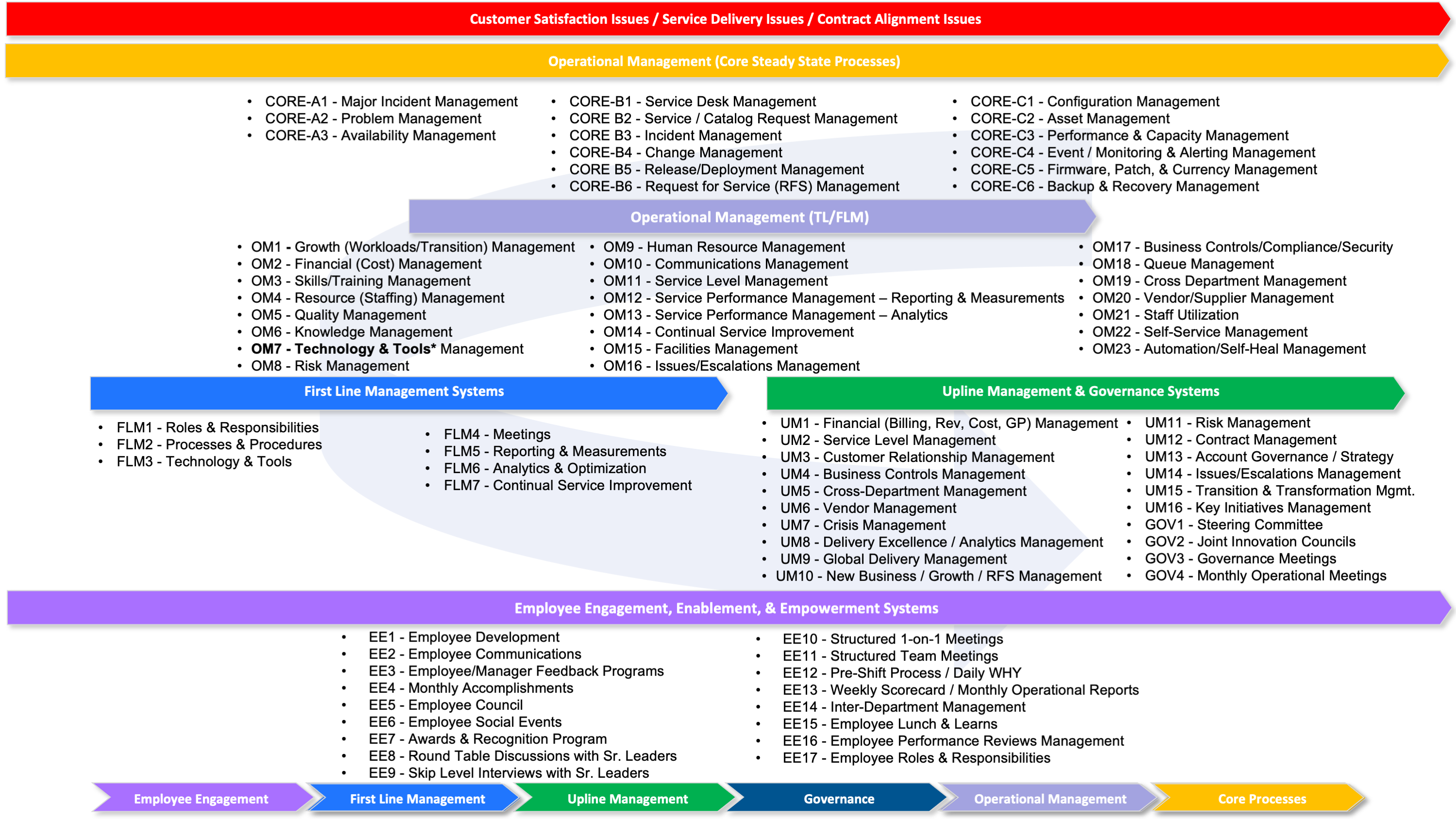
Let's take a look at the Operational Management Reference Framework to see some of the elements that impact this issue:

- OM3 - Skills/Training Management. One way to reduce Call handle Times is to ensure the service desk agents are adequately trained and skilled.
- OM5 - Quality Management. In order to reduce Call Handle Times, you need to ensure that you have a Total Quality Management (TQM) team, what is reviewing calls and tickets to assess for quality and improve the AHT and overall client experience.
- OM6 - Knowledge Management. One way to reduce Call Handle Times is to ensure the service desk agents have an accurate knowledge base that is regularly maintained. Having readily available knowledge will allow the agents to resolve the issues much quicker, reduce the AHT, and get the calls in the queue.
- OM12 - Service Performance Management –Reporting & Measurements. The Reporting & Measurement Process plays a vital role in collecting data to track and trend performance so informed decisions can be made to improve call handling skills.
- OM13 - Service Performance Management – Analytics & Optimization. The Analytics & Optimization process is designed to harvest various datasets to gain insights into the historical call handling performance. The insights are used to develop foresight about how to improve the handle times.
- OM14 - Continual Service Improvement. The Continual Improvement process is to leverage the Reporting & Measurements, Quality Management,Knowledge Management, and Training Management processes to drive the Shift Left Strategy in the organization. The ultimate goal is to increase End User uptime and availability by driving issues towards End User Self Enablement, Automation, and Self-Healing.
- OM18 - Queue Management. The Queue Management process is to ensure that work coming to the operations team is managed and acted upon in a timely manner so as to avoid client delays and dissatisfaction.
- OM21 - Staff Utilization Management. The Staff Utilization Management process ensures that staff productivity is being measured and analyzed to ensure consistent performance across the organization.
- FLM1-FLM7 - First Line Management Systems. First-line managers are critical to the well-being of an organization, as they directly manage and have significant influence over employees who perform the day-to-day operational work. If the First-line managers don't demonstrate a robust management system that focuses on both short-term and long-term operational goals, they will not be able to enable an organization to focus on Its people, stabilize its operations, and drive continual improvement.
- UM1-GOV4 - Upline Management & Governance Systems. The up line management and governance systems established and executed by the senior leadership team are essential in ensuring that the day-to-day operations are aligned with the organization's strategic objectives. If they are not implemented, then the senior management team will not have the right level of focus to ensure compliance with departmental and organizational goals and risks will not be identified and mitigated.
- EE1-EE17 - Employee Engagement, Enablement, and Empowerment Systems. If Employee Experience (EX) isn't factored into any of the activities, you will not only struggle to sustain the improvements, but you may not even achieve the improvements.
A Real World Example:
Imagine you have a proposal to get out to a client and your email does not seem to be working. You reached out to others to see if they can send the email, but they are also having issues. You did basic troubleshooting such as restarting your computer, reseating the network cable, trying the computer on another network port, trying another email client, etc. But no luck.
You check the self-help portal and there are no messages indicating any issues. You decide to call the contact center, versus using the chat option, due to the urgency of the situation.
Imagine after waiting on the phone, for what seems like an eternity, you finally get to an agent. Although very frustrated, you are also anxious to resolve your problem.
You try to tell the agent the urgency of the matter and that there could be significant business impact if the deadline is not met.
What you hear back is the dreaded script.
The agent takes you through the standard questions to triage and understand the issue. Even though you shared many of the troubleshooting steps you had done and conclusions you have made. The agent still continues to ask his questions. Throughout this time period, you find that you are repeating yourself quite often.
Once the triaging questions are concluded. You assume a solution will be provided. However, you realize that, that assumption is incorrect.
Now the agent has to place you on hold as he researches his knowledgebase. After what seems to be a few mins of being on hold, he returns and walks you through very basic and preliminary troubleshooting steps to determine the root cause.
You realize the agent missed it when you indicated in the beginning that you had already tried these steps. After repeating them again with the agent, he places you on hold once again to research.
After several more attempts at troubleshooting and being placed on hold. He informs you that, he will need to pass the ticket to the Level 2 team to further look into the issue.
By this time, you have wasted 30-45 mins.
Although you remind him of the importance of getting the proposal out in a few hours, he tells you that the level 2 team will get back to you in approximately 8 business hours. You indicate to him that his is unacceptable and remind him that nearly everyone on your floor is having the same issue.
He places you on hold once again and finally comes back to tell you that there is a global email outage and nothing can be done. Internal and External teams are working on the issue and while there is an SLA of 1 hr, there is no guarantee.
You don't realize it, but the average handle time is approximately 9 mins on the phone and 2 mins of after call work to finish documentation.
Another thing you don't realize is that, the agent did not capture all the necessary information or captured some of the information incorrectly.
Although the agent still sent the ticket to Level 2, when they finally did get to your ticket, they realized that information is missing. Normally they would have sent the ticket back to the agent to get the necessary information, as they do not call clients directly. This could have taken a few days. However, in this case, you got lucky. Because there were hundreds of other people with the same issue, the other agents did capture the necessary information in their tickets.
I just listed some key areas where the call was not handled correctly. There have been calls where many more errors were made leading to significant call handle times.
On the flip side, you might also come across situations where the agent is under pressure to get you off the phone as quickly as possible because one of the things they are measured on is the Average Call Handle Time (AHT). Having high AHT is a no-no so agents and their management do whatever they can to end the call quickly. Even if it means "accidentally" disconnecting it.
Conclusion
Call handle time is a crucial metric for any contact center, as it directly impacts customer satisfaction and loyalty. By understanding the causes of both high and low call handle times, and implementing solutions such as training, system streamlining, and intelligent call routing, you can reduce wait times and improve customer service. Don't wait any longer to start seeing real results in your team and business. Visit Imad Lodhi's website today and start your journey, one step at a time. His guide offers a wealth of insights and tools to help you improve your management and leadership skills. If you're ready to take your management skills to the next level, visit Imad Lodhi's website and subscribe.

Technology & Tools
What Are The Advantages Between A Digitally Native Organization And A Legacy Enterprise
It is important for both digital native organizations and traditional enterprises to understand the advantages and disadvantages of their respective business models in order to succeed in the ever-changing digital world. By understanding the strengths and weaknesses of each approach, businesses can make informed decisions about how best to move forward in order to maximize their success.
There is a decision to be made about which type of organization to work with or invest in.
There are potential advantages and disadvantages to both digitally native organizations and legacy enterprises, and it can be difficult to determine which type of organization will be the most successful or beneficial to work with.
To make this decision, it may be helpful to consider the specific goals and needs of the business or project at hand, and to weigh the pros and cons of each type of organization. Some potential advantages of digitally native organizations may include their agility and ability to quickly adapt to changing market conditions, their expertise in using digital technologies and platforms, and their potential for innovation. On the other hand, legacy enterprises may offer a strong track record of stability and reliability, a well-established customer base, and a wealth of resources and experience. Ultimately, the best choice will depend on the specific needs and goals of the business or project.
A digitally native organization is an organization that was born in, and has been operating primarily in, the digital age. This means that they have been using technology to their advantage since their inception, whether it be through social media, cloud-based storage, or mobile apps. A legacy enterprise, on the other hand, is an organization that was founded before the digital age and has been primarily reliant on traditional methods of communication and operation.
There are a number of advantages and disadvantages between digitally native organizations and traditional enterprises. Some of the advantages of digital native organizations include:
-They are faster to adopt new technologies
-They are more agile and can respond quickly to changes in the market
-They are more customer-centric
Some of the disadvantages of digital native organizations include:
-They may have difficulty scaling up
-They may be less efficient than traditional enterprises
-They may be less profitable than traditional enterprises
-They may lack the resources needed to compete with larger organizations.
On the other hand, traditional enterprises have advantages such as:
-They have established processes and systems in place which makes it easier to scale up operations
-They are more efficient due to their well-established infrastructure
-They have a higher likelihood of being profitable due to their size and resources
Some of the disadvantages of traditional enterprises include:
-They may be slow to adopt new technologies
-They may lack the agility needed to stay competitive
-Their customer base may be too small to sustain long term success.
Overall, it is important for both digital native organizations and traditional enterprises to understand the advantages and disadvantages of their respective business models in order to succeed in the ever-changing digital world. By understanding the strengths and weaknesses of each approach, businesses can make informed decisions about how best to move forward in order to maximize their success.
Welcome to my blog! If you want to learn more be sure to subscribe to my blog. By subscribing, you'll receive updates whenever I post new content, as well as access to exclusive resources and tips. Whether you're struggling with negative thoughts, dealing with difficult circumstances, or just looking for ways to grow and improve as an individual, my blog has something for everyone. So don't wait – subscribe today and start learning more about how to overcome the challenges in your life. https://www.imadlodhi.com/subscribe
Learning & Development
What Is A Role Model And What Do They Do For Us?
A role model is someone who we look up to and aspire to be like. Role models can be found in all areas of life, from our personal relationships to the celebrities we see on TV. They can teach us how to live our lives, how to be successful, and how to overcome challenges.
What is a role model and what do they do for us?
A role model is someone who we look up to and aspire to be like. Role models can be found in all areas of life, from our personal relationships to the celebrities we see on TV. They can teach us how to live our lives, how to be successful, and how to overcome challenges. While we all have different role models, they can all provide us with invaluable lessons and insight into the world around us. Just as importantly, role models can also give us a sense of hope and inspiration. In a world that can often seem difficult or unfair, they remind us that it is possible to achieve our dreams. In short, role models show us what is possible in life, and for that reason, they are invaluable to us.
Why are some role models unrealistic and why is that a bad thing for us?
Role models are important. They inspire us, motivate us, and give us something to aspire to. However, some role models are unrealistic and this can be a bad thing for us. When we see someone who is unattainably perfect, it can make us feel hopeless and discouraged. We may start to believe that we can never measure up, no matter how hard we try. This can lead to feelings of inadequacy and low self-esteem. It's important to remember that nobody is perfect. Everyone has flaws and shortcomings. What matters is not whether or not we are perfect, but whether or not we are trying to improve ourselves. When we strive to become the best that we can be, we will find that we are capable of far more than we ever thought possible. So let's focus on finding realistic role models who inspire us to be our best selves. After all, that's what truly matters in the end.
The benefits of having a role model in our lives - from improving our self-esteem to teaching us new skills!
We all need role models in our lives. They provide us with an example to follow, someone to aspire to be like. They can help us to develop our self-esteem and teach us new skills. For young people, in particular, role models can be essential in helping them to navigate the challenges of growing up. Having a positive role model in our lives can help us to feel valued and supported. seeing someone who is successful and happy making their way in the world can inspire us to believe that we can do the same. Role models can also provide us with practical guidance, showing us new techniques and methods that we can use in our own lives. In short, role models play an important role in our development and wellbeing. So, if you are feeling lost or struggling to find your way, look around you for a role model – they may just be the inspiration you need!
How to choose the right role model for ourselves, based on our own individual needs and wants.
Choosing the right role model for ourselves can be a daunting task. There are so many people in the world, and it can be hard to know who to look up to. However, it's important to choose someone who meets our individual needs and wants. First, consider what qualities you admire in a person. Do you want someone who is kind and compassionate? Or someone who is successful and driven? Once you have a good idea of the qualities you are looking for, start looking for people who embody those traits. It can be helpful to think about people you know personally, as well as public figures. If you don't know anyone who meets all of your criteria, that's okay! There are plenty of role models out there, and you're sure to find someone who inspires you. Remember, it's important to choose someone who YOU admire and looks up to- not someone who everyone else admires. When you find that special person, hold on tight and never let go!
Conclusion
So remember, when looking for a role model, it is important to choose someone who is realistic and attainable. They should also be someone whose qualities you admire and would like to emulate in your own life. With the right role model by your side, you can improve your self-esteem, learn new skills and become a better version of yourself! So what are you waiting for? Start searching for your ideal role model today!
Sign-up for my newsletter: https://www.imadlodhi.com/subscribe

